
Reviewed · HISTORICAL TOURS
Walkabout Durham History Tour
Durham rewards a slow first look. This 90-minute walking tour links the Market Place, riverside, university Bailey, and Cathedral with a friendly guide who makes local stories easy to follow. I like the clear route and the chance to ask questions along the way. I also like that guide Peter adds local anecdotes, legends, and practical tips for the rest of your visit.
The main drawback is the hilliness. You will walk steadily, and one review sensibly warns that Durham can leave you wanting a cup of tea by the end. The tour also finishes at Durham Cathedral rather than including the cathedral tower, so visitors hoping for a climb should plan that separately. One practical point deserves attention: the supplied location field says Middlesbrough, but every meeting point and stop is in Durham. Confirm the exact booking details before setting out.
In This Review
- Key points to know before booking
- Why this short Durham walk works well
- Starting in Durham Market Place
- Framwellgate Bridge and the first Cathedral view
- The River Wear and Prebends Bridge
- Medieval walls and the Durham University Bailey
- St. Mary the Less and local legends
- Bow Lane and the story of St. Cuthbert
- Palace Green and the final approach to Durham Cathedral
- Peter’s guiding style and the small-group feel
- Price, pace, and practical value
- Who should book this Durham walk?
- Should you book the Walkabout Durham History Tour?
- FAQ
- Where does the Walkabout Durham History Tour start?
- Where does the tour end?
- How long does the walking tour last?
- How much does the tour cost?
- Is the Cathedral tower included?
- Are dogs allowed?
- What is the cancellation policy?
Key points to know before booking
- The route ends at Durham Cathedral: You finish at the main cathedral doors, after walking through the city’s historic centre and along the River Wear.
- Peter is a warm, story-led guide: He is praised for clear explanations, local anecdotes, and making questions welcome.
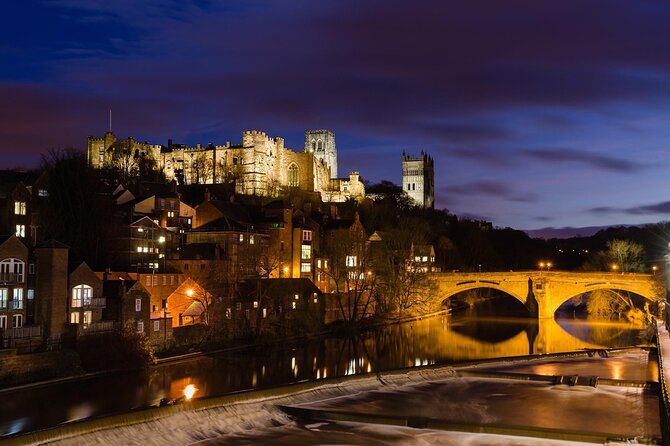
- The riverside section is a highlight: Framwellgate Bridge and Prebends Bridge provide some of the best views of Durham Cathedral and Castle.
- You cover a lot in 90 minutes: Seven stops introduce the Market Place, medieval walls, university buildings, college history, St. Cuthbert, and Palace Green.
- Dogs and all ages are welcome: Service animals are allowed, and dogs are specifically welcomed.
- The group is capped at 20 people: That keeps the walk reasonably personal without making it a private tour.
Why this short Durham walk works well
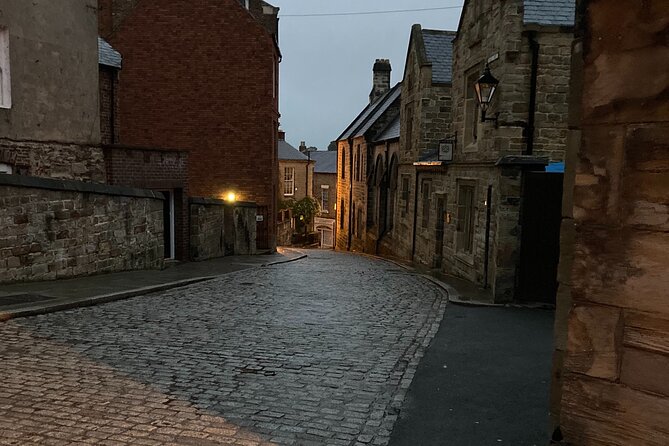
Durham is compact, but it is not simple. The Cathedral and Castle dominate the skyline, yet the story around them includes medieval power struggles, university traditions, bridges, mills, saints, legends, and conflict with Scotland.
I like this tour because it gives you a framework before you start exploring on your own. Instead of seeing the Cathedral as one impressive building, you begin to understand how it fits into the city, the river, the Prince Bishops, and the university.
The route is also practical. It starts in Durham Market Place and ends at the Cathedral, so you move through the city rather than circling back to your starting point. That makes the walk useful on a first afternoon, especially if you have only one night in town.
The guide is a major part of the experience. Peter is repeatedly praised for his friendly manner, clear delivery, and willingness to answer questions. He is also described as a former geography teacher, which helps explain the mix of place, landscape, and history in his approach. You get facts, but you also get stories that help the buildings feel connected to real people.
The current rating is 5 out of 5 from 89 ratings, with 100 percent of participants recommending the tour. That is unusually consistent. Still, you should set your expectations correctly: this is an outdoor walking introduction, not a full interior tour of Durham Cathedral or Castle.
More History Tours in England:
- London Small Group Tour of Historical Pubs
★ 5.0 · 10,422 reviews - Soho Music & Historic Pubs Tour
★ 5.0 · 1,993 reviews - Shadows of York: Ghost Walk and Horrible History.
★ 5.0 · 1,403 reviews
Starting in Durham Market Place
The tour begins in Durham Market Place, in the centre of the city. This is a useful starting point because the square brings together several layers of Durham civic life.
You will look at the 19th-century Town Hall and Guildhall, St. Nicolas Church, and statues linked to the city and county. The guide uses these landmarks to introduce the people who helped shape Durham. That gives you a sense of the city beyond its best-known religious buildings.
The opening 20 minutes are also about orientation. You can learn where the main historic areas sit before the route leads away from the square. I find this especially useful in a city where the river, steep streets, bridges, and Cathedral precinct can make the layout feel less obvious than it first appears.
There is no admission charge for this stop. The focus is on seeing the exterior setting and listening to the guide rather than entering a paid attraction.
Framwellgate Bridge and the first Cathedral view
From the Market Place, you take a short walk to Framwellgate Bridge, described as the oldest of Durham’s bridges. This is one of the strongest visual moments of the tour.
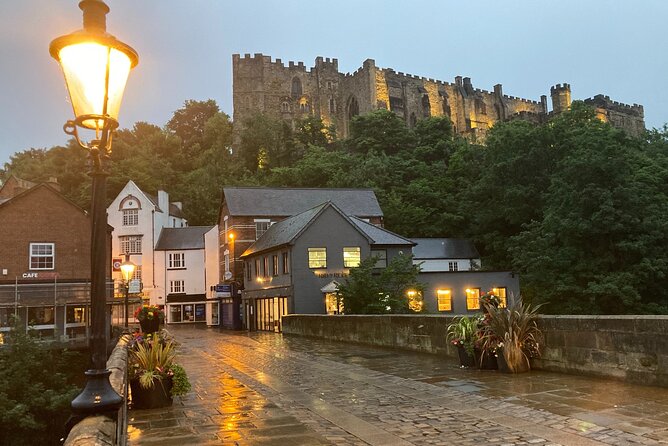
From the bridge, you get a magnificent view of Durham Castle and Cathedral. The guide then turns that view into a history lesson, explaining the role of the Prince Bishops and the relationship between religious and political power in Durham.
The stop lasts about 15 minutes. That is enough time to take in the view without letting the tour become a long photo break. If you like architecture, this is where the route starts to make visual sense. The Cathedral and Castle are not isolated monuments. Their position above the river helps explain their defensive and symbolic importance.
This is also a good place to listen for the guide’s storytelling style. Peter is praised for bringing the city through different periods with local perspective, rather than delivering a list of dates. That makes the history easier to remember after the walk ends.
The River Wear and Prebends Bridge

The route continues along the riverside toward Prebends Bridge, with the walk between stops taking about five minutes. Along the way, the guide discusses mills and the riverbanks before reaching another fine Cathedral viewpoint.
The bridge itself is a short stop, listed at around five minutes, but the setting gives it more weight than the timing suggests. You can pause for the view of the Cathedral from a different angle and see how strongly the River Wear shapes Durham.
I like this portion because it breaks up the built-up streets. You are still close to the centre, but the pace feels calmer. It also adds useful context: the river was not just scenery. Mills and riverbanks were part of the working city.
Do not treat this as a completely flat stroll. Durham is hilly, and the route eventually climbs toward the Bailey and Cathedral area. Wear sensible shoes, especially if the weather is wet. The tour has gone ahead in rain and cold, and the guide has still kept the walk lively, but good weather will make the riverside section more enjoyable.
A few more to weigh up in England
- Guided Walking Tour of Durham & its Infamous Characters
★ 5.0 · 248 reviews - Durham Food Tour
★ 5.0 · 137 reviews - Essential Whitby: Discover the town’s legends on a self-guided audio tour
★ 5.0 · 47 reviews
Medieval walls and the Durham University Bailey
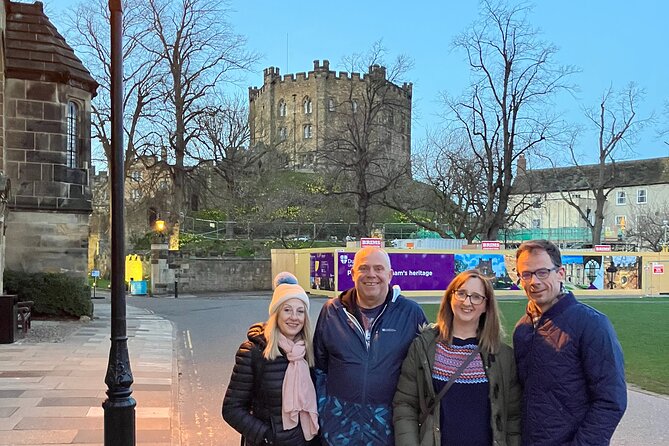
After Prebends Bridge, the walk heads toward St. Cuthbert’s Society and Durham University. You will encounter part of the medieval city wall and hear about Durham’s historic rivalry with the Scots.
This section adds a different side to the city. The early stops focus on civic buildings, bridges, river views, and the Cathedral. Here, the emphasis shifts toward defence, borders, and the way Durham’s position affected its past.
You then enter the South Bailey, home to Durham University. The university buildings are not treated as a separate modern campus story. Instead, they form part of the old city, occupying historic spaces and carrying on traditions linked to Durham’s religious and civic past.
The stop lasts around 15 minutes. That is enough for an introduction, though not enough for a detailed tour of every college. If you want an in-depth look at Durham University, you will need extra time after the walk.
Still, this is a valuable part of the route because it helps explain why Durham feels like both a small historic city and a university town. The Bailey is not simply a road between attractions. It is part of the city’s identity.
St. Mary the Less and local legends
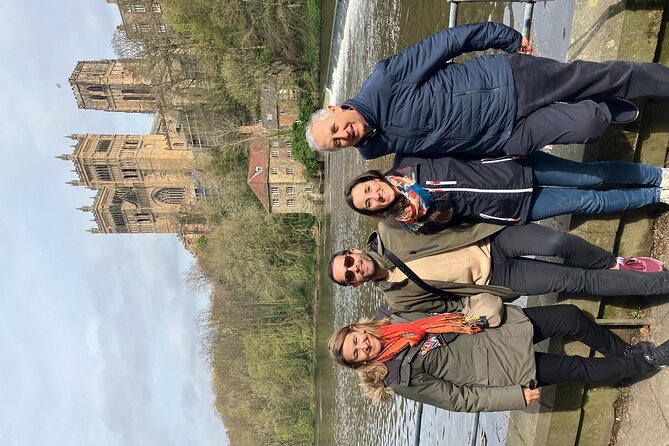
The next stop is St. Mary the Less, now affiliated with St. John’s College. The guide uses the church to explore Durham legends and stories connected with the building.
This is where Peter’s approach seems especially effective. His strongest praise comes from his ability to mix solid historical information with myths, local tales, and anecdotes. That combination suits Durham, a city where saints, miracles, battles, tragedies, and legends sit close together.
You will also have time to look at the architecture of the Bailey. The stop lasts about 10 minutes, so expect a focused explanation rather than a full architectural study.
For me, this kind of stop is one reason to choose a guided walk instead of relying only on a map. A map can show you the church and college buildings. It cannot easily explain why a place matters or connect it to the stories told elsewhere on the route.
Bow Lane and the story of St. Cuthbert
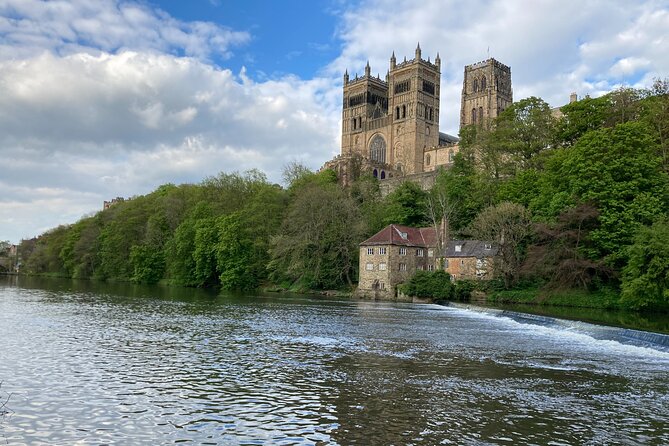
At Bow Lane, on the eastern side of the Cathedral, the tour returns to early medieval Durham. The guide discusses St. Cuthbert and introduces more of Durham University’s colleges as you continue along the Bailey toward the top of Saddler Street.
This is a useful transition. The tour has moved from the city’s public square, over its bridges, along the river, through the old wall, and into the Bailey. Now it brings you back toward the spiritual centre of Durham.
The St. Cuthbert stories help explain why Durham Cathedral became such an important destination. The guide does not simply point toward the Cathedral and say that it is old. He connects the building and its setting with the saint’s story and the early medieval past.
The stop is scheduled for about 10 minutes. Because the tour covers a lot of ground, you should expect the guide to select key stories rather than provide every detail. That is a strength if you want a lively introduction, but a limitation if you already have advanced knowledge of Durham and want specialist detail.
Palace Green and the final approach to Durham Cathedral
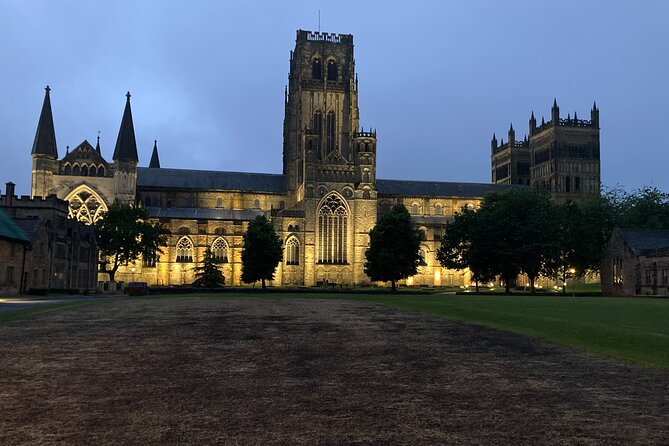
The final 15 minutes take you to Palace Green, the centre of Durham’s UNESCO World Heritage site. Here, the surrounding buildings become part of the main story, with discussion of battles, tragedies, and miracles before the walk finishes at Durham Cathedral.
This is the natural climax of the route. You have seen the Cathedral from Framwellgate Bridge and Prebends Bridge. Now you arrive at its doors and see it within the historic precinct itself.
The ending is well chosen for first-time visitors. You finish in a place where you can continue exploring on your own. You might choose to enter the Cathedral, spend more time around Palace Green, or use Peter’s suggestions for other things to do in the city.
Keep in mind that the tour does not include the Cathedral tower. One participant specifically noted that the experience would have been even better with tower access. That is fair, but tower entry would also change the timing and physical demands of the walk. Think of this experience as an introduction that brings you to the Cathedral, not as a complete Cathedral visit.
Peter’s guiding style and the small-group feel
A good city walk depends heavily on its guide, and Peter appears to be the heart of this one. He is praised for being friendly, entertaining, open to questions, and able to pitch the information at the right level.
That last point matters. A history walk can become either too academic or too shallow. The comments about Peter suggest a useful middle ground. You get enough detail to understand Durham, but the stories keep the pace moving.
The maximum group size is 20 people. That is not a private tour, but it is small enough to make questions practical. If you are curious, you should feel comfortable asking about a building, a local story, or what to see next.
The guide also offers tips for the rest of your stay. That adds value beyond the 90-minute route. A short orientation can save you time later, especially if you have limited time in Durham.
Price, pace, and practical value
At $22.20 per person, this is a reasonably priced way to get a structured introduction to Durham. You are paying for about an hour and a half of guiding, not admission to an attraction. All seven stops are listed with free admission, and the main value is the guide’s interpretation of what you see.
I think the price makes the most sense if you are new to Durham, have only a short stay, or want local context before visiting the Cathedral and other sites. It is less useful if you already know the city well or prefer to explore without a set pace.
The tour is offered in English and uses a mobile ticket. It is near public transportation, and most people can participate. Service animals are allowed, and dogs are welcome, which is a pleasant touch for a city walk.
The booking pattern suggests that it is often reserved about 15 days ahead. You may not need to plan quite that early, but booking ahead is sensible if your schedule is fixed. The group limit is 20, and popular time slots can fill.
You can cancel for a full refund up to 24 hours before the start time. Changes or cancellations inside that 24-hour window are not accepted for a refund. The cut-off uses local time.
Who should book this Durham walk?
I would recommend it most strongly to:
- First-time visitors who want to understand Durham quickly
- People staying only one night
- History fans who enjoy stories, legends, and local personalities
- Visitors who want a guide before exploring the Cathedral and Castle
- Families and mixed-age groups looking for an accessible introduction
- Dog owners seeking a dog-friendly outdoor activity
It also suits people who like asking questions. Peter’s friendly, open style is a big part of the experience, so you get more from the tour if you join in rather than simply follow at the back.
You should think twice if you dislike hills, have difficulty walking for 90 minutes, or want substantial indoor sightseeing. The route is outdoors and includes the riverbanks, bridges, Bailey, and Cathedral approach. It also does not include a Cathedral tower visit.
Rain need not ruin the experience. The walk has been enjoyed in poor weather, but Durham’s exposed bridges and riverside paths will be more pleasant on a dry day. Bring suitable footwear and allow time for a drink afterward if you prefer a slower pace.
Should you book the Walkabout Durham History Tour?
Yes, if you want a friendly, well-paced introduction to Durham rather than a formal lecture. The best reasons to book are Peter’s storytelling, the river views, and the way the route connects the Market Place with the Cathedral.
I would book it early in a short Durham visit. The tour gets you oriented, shows you the main historic spine of the city, and leaves you at the Cathedral doors with useful ideas for what to do next.
Just confirm the Durham meeting details because the supplied location field mentions Middlesbrough, and remember that the route is hilly and ends outside the Cathedral rather than at its tower. If those limits suit you, $22.20 buys a lot of useful context in 90 minutes.
FAQ
Where does the Walkabout Durham History Tour start?
It starts at Durham Market Place, Durham DH1 3NJ, in the historic centre of the city.
Where does the tour end?
The tour ends at the main doors of Durham Cathedral, Durham DH1 3EH.
How long does the walking tour last?
The tour lasts approximately 1 hour and 30 minutes.
How much does the tour cost?
The listed price is $22.20 per person.
Is the Cathedral tower included?
No. The route finishes at Durham Cathedral, but the supplied tour details do not include Cathedral tower access.
Are dogs allowed?
Yes. Dogs are very welcome, and service animals are allowed.
What is the cancellation policy?
You can cancel up to 24 hours before the start time for a full refund. Cancellations or changes made less than 24 hours before the start time are not accepted for a refund.
Just added in England
- Private Tour: Royal High Tea At Kensington Palace Gardens★ 5.0 · 39 reviews
- Private Tour: Personal Travel Photographer Tour in London★ 4.5 · 27 reviews
- London East End Private Walking Food Tour – Secret Food Tours★ 5.0 · 26 reviews
- Private Tour: Night Photography Tour in London★ 5.0 · 48 reviews
- London Like a Local, Private & Personalized (2-3 hrs)★ 4.5 · 11 reviews
- British Museum & National Gallery of London – Exclusive Guided Combo Tour★ 5.0 · 48 reviews
- Private Tour: Tower of London and St Paul’s Cathedral★ 5.0 · 1 review
- London Soho District – Exclusive Guided Walking Tour★ 5.0 · 2 reviews
Historical Tours, compared.

Shadows of York: Ghost Walk and Horrible History.
Read our review →

A Walk Through Time: History of Liverpool Walking Tour
Read our review →
Royal Historic Pubs Walking Guided Tour in London
Read our review →
Private Group: Historical Pub Walking Tour of London
Read our review →
Best Of Liverpool Heritage, History & Culture Guided Walking Tour
Read our review →Browse the lists this tour appears in