
Reviewed · JACK THE RIPPER TOURS
Jack the Ripper Walking Tour with Expert Ripperologist
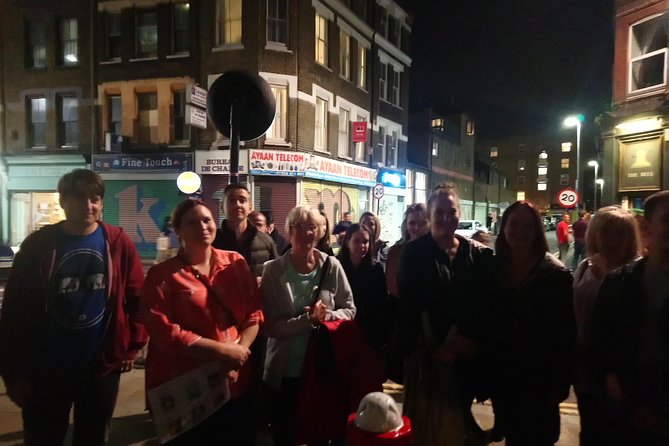
Jack’s story begins in the streets. This 2.5-hour Whitechapel walk follows the sites linked to the 1888 murders, with a costumed guide, period images, and clear explanations of how the City of London differed from the Metropolitan Police area. I like the route’s strong sense of place, and I like that the focus stays largely on the victims and the harsh conditions around them. The main drawback is that the group can reach 20 to 30 people, so this is not an intimate private walk.
The tour also gives you a useful corrective to the Hollywood version of Jack the Ripper. Guides such as Lindsey, Jenny, and Paul bring research, visuals, and a little theatrical flair, while the route itself does much of the work. Expect narrow streets, busy modern surroundings, limited toilet access, and a subject that includes murder, mutilation, poverty, and exploitation.
In This Review
- Key points to know before you book
- Starting at St Botolph’s Aldgate
- Aldgate Square and the hard facts of Whitechapel
- Mitre Street and the double event
- Petticoat Lane and the police boundary
- Goulston Street and the only clue
- Gunthorpe Street and Martha Tabram
- Thrawl Street and Mary Ann Nichols
- Hanbury Street and Annie Chapman
- Wilkes Street and the Dear Boss letter
- The Ten Bells and Itchy Park
- Old Spitalfields Market and the Lusk letter
- Mary Kelly and the walk’s final scene
- How the guides shape the experience
- Group size, walking, and practical comfort
- Is $23.61 a fair price?
- Who should book this Whitechapel walk?
- Should you book it?
- FAQ
- How long is the Jack the Ripper walking tour?
- Where does the tour begin?
- Where does the tour end?
- What locations are included?
- Are photographs included?
- Is the tour suitable for children?
- How much walking is involved?
Key points to know before you book

- The route covers major 1888 crime sites: Mitre Square, Hanbury Street, Goulston Street, George Yard, the Ten Bells, and the area linked with Mary Kelly.
- A 14-inch backlit tablet brings the past closer: The guide shows photographs of victims, locations, and the old neighborhood in a format intended to be easy to see.
- The tour treats Whitechapel as more than a murder backdrop: Poverty, overcrowding, policing, prostitution, and daily survival receive plenty of attention.
- Expect a moderate walking commitment: You need to walk and stand for more than two hours, with very few toilet options along the way.
- The price is reasonable for a guided London walk: At $23.61 per person, you pay mainly for interpretation, research, and navigation rather than admission fees.
- The audience is restricted by age: Children under 15 cannot join, and 16 and 17-year-olds must be accompanied by an adult.
Starting at St Botolph’s Aldgate
Meet outside St Botolph’s Church at Aldgate Station. This is a practical starting point because the station is close to public transport, and the church gives the guide a recognizable landmark for gathering the group.
The opening story concerns the church’s old nickname, the Prostitutes Church. The explanation refers to women soliciting on the island where the church stood, which immediately places the subject within the social world of Victorian Whitechapel rather than presenting Jack as a detached monster from a storybook.
You spend only about five minutes here, so this is an introduction rather than a long church visit. There is no admission charge for the stop. Arrive with enough time to find the meeting point, since the tour starts outdoors and the group may then move on promptly.
More Walking Tours in London
- Tour for Muggles The Ultimate Harry Potter Walking Tour in London
★ 5.0 · 4,684 reviews - London Jack The Ripper Guided Walking Tour
★ 5.0 · 3,131 reviews - Changing of the Guard Guided Walking Tour in London
★ 5.0 · 1,793 reviews
Aldgate Square and the hard facts of Whitechapel
The next stop, Aldgate Square, gives the tour its social foundation. You hear about overcrowding, poverty, crime, and the daily strain faced by people living on the breadline in 1888.
This context matters. Without it, the murders can become a grim collection of addresses. With it, you get a clearer sense of why lodging houses, pubs, dark lanes, casual labor, and poor sanitation shaped the victims’ lives and the police response.
The stop lasts around ten minutes. There is no included attraction to enter, so the value comes from the guide’s account and your ability to connect modern streets with the older neighborhood. I would pay close attention here, because later stops make more sense once you understand the area’s class divisions and crowded living conditions.
Mitre Street and the double event
Mitre Street, just inside the City of London boundary, is one of the most important points on the route. Here the guide discusses Elizabeth Stride, known as Long Liz, described as the first victim killed by Jack on the night of the double event.
A few yards away, the story turns to Catherine Eddowes, killed only about 45 minutes later. The close timing gives this section a strong sense of urgency, especially when paired with the explanation of how the killer moved between different police jurisdictions.
This is also where the City of London and Metropolitan Police distinction becomes important. Separate forces operated on opposite sides of the boundary, creating confusion and limits that affected the investigation. You do not need to know police geography beforehand. The guide explains why a short walk across a boundary could matter so much.
Petticoat Lane and the police boundary
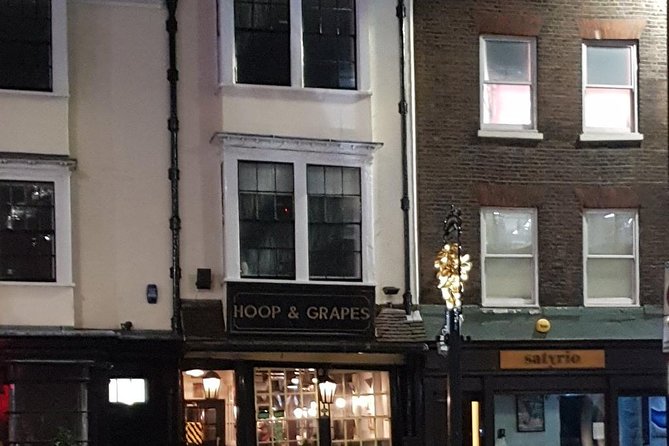
The route continues to Petticoat Lane Market, now called Middlesex Street. This stop lasts about five minutes and focuses less on a murder than on the boundary between the City of London and the Metropolitan area.
That detail may sound dry, but it is one of the tour’s more useful historical points. The investigation involved separate police forces, different areas of authority, and the practical problem of sharing information across boundaries. A map alone can show the border, but standing near it helps you understand why the location mattered.
The market itself is not presented as a paid attraction within the tour. You are passing through a modern part of London while the guide explains the older divisions beneath it.
More Jack the Ripper walks:
- London Jack the Ripper Guided Tour with Ripper-Vision
★ 4.5 · 4,840 reviews - Ultimate Jack the Ripper : Guided Tour of London
★ 5.0 · 1,495 reviews - The Original Jack the Ripper : Guided Tour
★ 5.0 · 1,264 reviews - London Jack The Ripper Small-Group Walking Tour
★ 5.0 · 1,013 reviews
Goulston Street and the only clue
At Goulston Street, you stop at the doorway associated with the only clue found along the police route that night. The guide explains how officers were following the trail and why this small piece of evidence drew attention.
This is a good example of the tour’s method. Instead of only telling you what happened at a murder site, the guide places you along the route taken by the police. That shift gives the investigation a physical shape, though it does not resolve the case.
The stop lasts about ten minutes. Since the tour takes place on public streets, you should expect to listen while standing rather than enter a museum or preserved crime scene.
Gunthorpe Street and Martha Tabram
From Wentworth Street, you view Gunthorpe Street and the spot connected with Martha Tabram, who was found murdered on August 7, 1888, in George Yard Buildings. The tour presents her as the person now thought most likely to have been Jack the Ripper’s first victim.
This stop is valuable because it introduces the uncertainty surrounding the victim list. The commonly discussed five victims are not the only women associated with the case, and Martha Tabram’s story shows how the boundaries of the investigation remain disputed.
The presentation appears to avoid treating every claim as settled fact. That is important for a subject filled with theories. You hear what is known, what is suspected, and how later research has changed the way people view the murders.
Thrawl Street and Mary Ann Nichols
The route continues toward Brick Lane and pauses opposite the Frying Pan pub at the corner of Thrawl Street. Here you hear about Mary Ann Nichols, who had her last drink before walking down Whitechapel Road toward Bucks Row, behind Whitechapel Station, where she was murdered.
The pub reference gives the story an ordinary human detail. Nichols was not simply a name in a case file. The stop connects her final known movements with familiar places where people ate, drank, worked, and tried to get through the night.
This section also shows why walking matters. You are not viewing the murder sites as isolated points on a map. You are following movement through the district, from a pub to a road and then toward the place where the crime occurred.
Hanbury Street and Annie Chapman
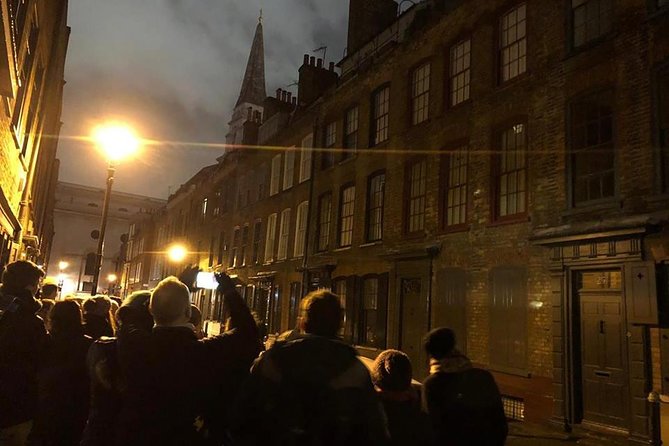
Hanbury Street brings you to the location associated with Annie Chapman’s murder in the back yard of 29 Hanbury Street. The guide uses the site to explain both the crime and the physical character of the neighborhood.
The stop lasts around twelve minutes, making it one of the longer pauses on the route. That extra time allows the guide to set out the circumstances more fully and to show images on the backlit tablet.
The visual material is one of the tour’s strongest tools. Period photographs and images of the victims help you picture the people and places being discussed. The material is also difficult, so you should book only if you are comfortable with a serious account of murder rather than a light ghost walk.
Wilkes Street and the Dear Boss letter
Wilkes Street is described as a stretch that has changed little since the 1800s. From there, the walk continues to Puma Court, where the guide discusses the Dear Boss letter.
This part of the route offers a welcome change from murder sites. The letter is tied to the way Jack the Ripper’s public identity developed, including the role of written communication and newspaper attention in creating the name known around the world.
The stop is brief, about five minutes, but its setting helps. Older-looking streets can make it easier to picture the district without relying entirely on photographs. Still, do not expect a preserved Victorian street free of modern London. This is a working city route, not a film set.
The Ten Bells and Itchy Park
Opposite the Ten Bells, the guide discusses Mary Kelly’s favorite pub. You also look toward Christchurch Graveyard, known as Itchy Park, where homeless people would sleep during the day.
This is one of the more atmospheric sections of the walk. The Ten Bells connects the case with a real social gathering place, while Itchy Park points to the wider problems of homelessness and poverty. The focus again reaches beyond the killer and toward the women and communities affected by the conditions of the time.
The stop lasts only about five minutes. You may want to keep listening closely because the surroundings can be busy, and a group of up to 30 people can make it harder to stand right beside the guide.
Old Spitalfields Market and the Lusk letter
Near Old Spitalfields Market, the guide stops in the entrance of the London Fruit and Wool Exchange. The subject here is the letter sent to George Lusk, head of the Whitechapel Vigilance Group.
This stop adds the local response to the story. The murders did not concern only police officers and newspapers. Residents formed vigilance groups because fear had spread through the district, and Lusk became connected with one of the case’s most famous pieces of correspondence.
You also get a sense of how commerce shaped the area. The market and exchange were part of the district’s working life, and the route uses those surroundings to show that Whitechapel was not merely a collection of alleys and crime scenes.
Mary Kelly and the walk’s final scene
The tour ends in the square behind the London Fruit and Wool Exchange, with the story of Mary Kelly, identified here as Jack’s last victim, killed on November 9, 1888.
Ending with Kelly gives the walk a clear final chapter. By this point, you have heard about the victims, the police boundaries, the letters, the area’s poverty, and the public fear. The final stop brings those strands together without pretending to solve a mystery that has resisted a definitive answer.
From the end point at 66 to 68 Bell Lane, it is about a five-minute walk to Liverpool Street Station. Your guide will direct you, and the station offers several Tube lines, making it easy to continue sightseeing or return to your accommodation.
How the guides shape the experience
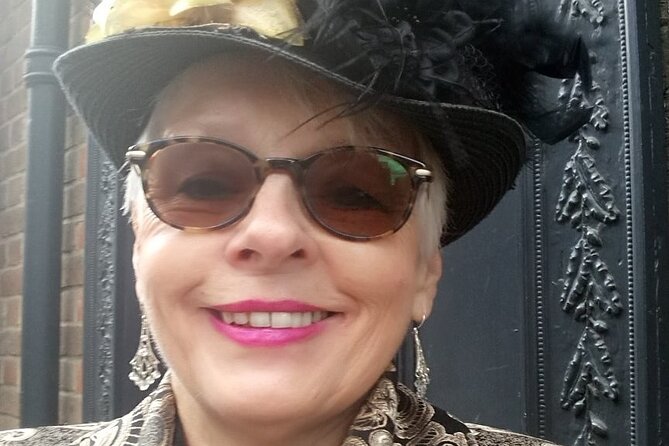
The guide makes a major difference here. Lindsey receives especially strong praise for her research, upbeat manner, visual presentation, and sensitivity toward the women who were killed. Jenny is described as punctual, informative, and good at correcting the Hollywood version of the story, while Paul is also singled out for an excellent presentation.
The costuming adds a small theatrical touch. It helps create the mood, but the strongest part of the experience is the explanation of the period and the use of images on the 14-inch backlit tablet.
I like that the guide can show photographs of victims, sites, and the neighborhood as you stand in the modern locations. The before-and-after effect helps you understand how much London has changed, even when a street plan or building line still feels familiar.
The tone is generally serious, with occasional wit. That balance can keep a grim subject listenable, but this is not a comedy tour. The material includes murder and mutilation, and the guide’s sensitivity toward the victims is an important part of the experience.
Group size, walking, and practical comfort
The maximum group size is 30. Actual groups can reach roughly 20 to 25 people, which some people may find too large for a street tour. A microphone is used so the guide can be heard, but you may still need to position yourself near the front if you want the clearest view of the tablet.
A private option is available for people who want individual attention or a different balance between victims, suspects, and police work. The standard walk gives more attention to the victims and the area than to long discussions of suspects.
Plan for more than two hours of walking and standing. Toilet access is very limited along the route, so use facilities before meeting at Aldgate Station. Comfortable shoes and weather-appropriate clothing matter, since the tour continues in rain and other ordinary London conditions.
The walk is not suitable for anyone unable to walk and stand for two or more hours. Children under 15 are not permitted, and those aged 16 or 17 must come with an adult.
Is $23.61 a fair price?
At $23.61 per person, I consider this a good-value guided walk for a specialized subject. There are no major paid attractions included, so you are paying for the guide’s research, storytelling, route planning, visuals, and ability to connect scattered locations.
The route covers a lot of ground in roughly two and a half hours. If you tried to find every site yourself, you would need to research the addresses, understand the City and Metropolitan Police boundary, and carry your own images for comparison. The fee saves that work and gives you a coherent story.
The value drops if you want a small group or a heavy focus on suspects. In that case, a private tour may suit you better, though the supplied price applies to the standard shared experience.
The tour is usually booked well ahead, with an average booking lead time of about 40 days. If your London dates are fixed, arranging it early is sensible. Free cancellation is available up to 24 hours before the start time, while cancellations or changes inside that period are not refunded or accepted.
There is also one important practical caution: a recorded booking problem describes a group arriving early but finding no guide and receiving no response to calls or emails. That appears to be an exception rather than the general pattern, given the strong overall rating, but I would keep your confirmation details handy and verify the meeting point before setting out.
Who should book this Whitechapel walk?
I would choose this tour if you enjoy dark history, unsolved crimes, Victorian London, or guided walks that connect social conditions with individual stories. It is especially useful if you know Jack the Ripper mainly through popular culture and want a more grounded account.
You should also enjoy visual storytelling. The tablet images are central to the presentation, and the guide uses them to make locations easier to picture.
I would hesitate if you dislike graphic material, struggle with long periods on your feet, or need regular toilet access. I would also choose a private tour if a group of up to 30 feels too large or if you want a detailed discussion of suspects rather than the victims and neighborhood.
Should you book it?
Book this Jack the Ripper walking tour if you want a well-researched, victim-conscious route through Whitechapel for a modest price. The combination of real locations, period visuals, costumed guides, and police-history detail gives you more than a string of spooky anecdotes.
Skip it if you want a short ghost story, indoor comfort, or a conclusive answer about the killer. For the right audience, though, the walk offers a sober and atmospheric look at one of London’s most disturbing mysteries, while keeping the people and the neighborhood in view.
FAQ
How long is the Jack the Ripper walking tour?
The tour lasts approximately two hours and 30 minutes.
Where does the tour begin?
The meeting point is outside St Botolph’s Church at Aldgate Station, Aldgate High Street, London EC3N 1AH.
Where does the tour end?
The walk ends at 66 to 68 Bell Lane, inside the square of the London Fruit and Wool Exchange. Liverpool Street Station is about a five-minute walk away, and the guide will give directions.
What locations are included?
The route includes St Botolph’s Aldgate, Aldgate Square, Mitre Street, Petticoat Lane, Goulston Street, Gunthorpe Street, Thrawl Street, Hanbury Street, Wilkes Street, the Ten Bells, Old Spitalfields Market, and the London Fruit and Wool Exchange.
Are photographs included?
Yes. The guide shows photographs of the murder victims, crime sites, and the surrounding area on a 14-inch backlit tablet.
Is the tour suitable for children?
Children under 15 are not allowed. Those aged 16 or 17 must be accompanied by an adult.
How much walking is involved?
You need a moderate level of physical fitness and must be able to walk and stand for more than two hours. Toilet facilities are very limited along the route.
Just added in London
- Private Tour: Royal High Tea At Kensington Palace Gardens★ 5.0 · 39 reviews
- London East End Private Walking Food Tour – Secret Food Tours★ 5.0 · 26 reviews
- Private Tour: Personal Travel Photographer Tour in London★ 4.5 · 27 reviews
- Private Tour: Night Photography Tour in London★ 5.0 · 48 reviews
- London Like a Local, Private & Personalized (2-3 hrs)★ 4.5 · 11 reviews
- British Museum & National Gallery of London – Exclusive Guided Combo Tour★ 5.0 · 48 reviews
- Private Tour: Tower of London and St Paul’s Cathedral★ 5.0 · 1 review
- London Soho District – Exclusive Guided Walking Tour★ 5.0 · 2 reviews
Jack the Ripper Tours, compared.
London Jack the Ripper Guided Tour with Ripper-Vision
Read our review →
Ultimate Jack the Ripper : Guided Tour of London
Read our review →
London Jack The Ripper Small-Group Walking Tour
Read our review →
The Original Jack the Ripper Coach Tour of Haunted London
Read our review →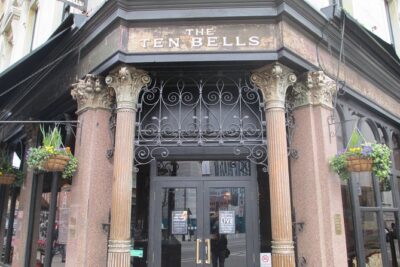
Browse the lists this tour appears in