
Reviewed · HISTORICAL TOURS
History of London Photography Tour
London rewards a second look. This two-hour walking tour links City churches, grand financial buildings, St Paul’s Cathedral, the Millennium Bridge, Tower Bridge, and Tate Modern, giving you a creative way to see familiar sights. I like the mix of practical camera advice and British history, especially when the guide helps you find a better angle instead of simply pointing out a landmark.
I also like that the tour suits different skill levels. Richard, one of the guides, has helped beginners with camera settings while giving more experienced photographers fresh ideas. The main drawback is the pace and route: with ten stops in about two hours, you should expect a brisk urban walk and mostly exterior photography, not a slow visit inside each attraction.
In This Review
- Key points before you book
- Starting beneath the City at St Mary Woolnoth
- Framing the Royal Exchange and Bank of England
- Gothic details at Guildhall
- Listening for the bells at St Mary-le-Bow
- Taking on St Paul’s Cathedral from the City
- Photographing the National Firefighters Memorial
- Crossing the Millennium Bridge toward the South Bank
- River views and Tower Bridge
- Finishing at Tate Modern
- What the photography teaching is really like
- Group size, timing, and physical demands
- Is $71.63 good value?
- Who should book this London photo walk?
- Should you book the History of London Photography Tour?
- FAQ
- Where does the photography tour start?
- Where does the tour finish?
- How long does the tour last?
- What equipment should I bring?
- Is the tour suitable for beginners?
- How many people can join the tour?
- What happens if bad weather cancels the tour?
Key points before you book
- A compact route with ten major stops: You walk from St Mary Woolnoth in the City of London to Tate Modern on the South Bank.
- Practical instruction is central: Your guide can advise on composition, lighting, camera settings, and better angles.
- The route mixes famous and less familiar views: You photograph major landmarks while also looking at churches, monuments, and city details.
- The group can include mixed abilities: Previous sessions included people using different cameras, from SLRs to camera phones.
- The price is $71.63 per person: That is fair if you want guided instruction, but less appealing if you only want a sightseeing walk.
- Weather and numbers matter: Poor weather or too few bookings can cancel the experience, and the maximum group size is 18.
Starting beneath the City at St Mary Woolnoth
The meeting point is IMPRINT Church London, at St Mary Woolnoth, 10 to 13 Lombard Street. This puts you right in the financial district, where old churches sit among office towers and busy commercial streets.
St Mary Woolnoth has an unusually long religious past. Worship has taken place here for at least 2,000 years, and traces of Roman and pagan religious buildings were found beneath the present church. The current building dates from 1727 and was commissioned from Nicholas Hawksmoor, one of the major architects of the English Baroque period.
That contrast makes this a smart opening stop. You can work with an ornate historic facade while modern London presses in around it. I would use the first few minutes to get your camera ready and ask the guide what the session will cover. If you have not used manual settings for a while, this is the right moment to say so.
The tour description places around ten minutes here, with no admission fee. The emphasis is on photographing the exterior and understanding how to frame it, rather than entering for a long architectural visit.
More History Tours in London
- London Small Group Tour of Historical Pubs
★ 5.0 · 10,422 reviews - Soho Music & Historic Pubs Tour
★ 5.0 · 1,993 reviews - Royal Historic Pubs Walking Guided Tour in London
★ 5.0 · 803 reviews
Framing the Royal Exchange and Bank of England
The Royal Exchange is next, also in the heart of the City. Its grand frontage offers the kind of formal architecture that can tempt you into a straightforward postcard shot. A professional photographer guide can help you think past the obvious view and consider symmetry, scale, lines, and the people moving through the space.
You then spend about 15 minutes at the Bank of England. The building carries both financial and architectural weight, making it useful for learning how to photograph large urban structures. You may work on finding a clean angle, balancing the building against the surrounding streets, or using light and shadow to give a flat facade more character.
These first three stops establish the tour’s main idea. You are not simply collecting landmarks. You are learning how to look at them. That difference matters because many visitors leave London with the same wide shot of the same building. Small changes in position and composition can make a familiar subject feel more personal.
The tour does not include paid entry to the Royal Exchange or Bank of England. That keeps the cost focused on the guide and the instruction, but it also means you should not expect a museum-style interior visit.
Gothic details at Guildhall
Guildhall brings a very different visual mood. This Gothic complex is about 800 years old and offers a chance to photograph pointed forms, stone detail, and strong vertical lines. The planned stop lasts around 15 minutes.
This is the point where a guide’s experience can be especially useful. Large buildings can be hard to photograph well because the camera may exaggerate perspective or lose detail in dark areas. Advice on position, exposure, and composition can help you produce something more thoughtful than a quick snap.
Guildhall also gives the historical side of the walk some weight. The route is not limited to royal monuments. It shows how London’s civic and commercial institutions shaped the City over centuries.
Still, do not expect a lengthy architectural lesson at every stop. The schedule gives you roughly ten to 15 minutes per location. The strength of the tour is variety and instruction, not exhaustive commentary.
Listening for the bells at St Mary-le-Bow
St Mary-le-Bow is one of the route’s more charming stops. Tradition says that a true Cockney must be born within earshot of its bells. That detail gives the church a direct connection to London identity and local folklore.
You have about ten minutes here. The guide can help you photograph the church as an urban subject, perhaps focusing on its tower, architectural details, or relationship with the surrounding street. The useful lesson is learning to spot visual interest in places that you might otherwise hurry past.
This is also a good example of the tour’s balance. The route includes famous buildings, but it does not treat London as a string of isolated monuments. Churches such as St Mary-le-Bow make more sense when you see them as part of the City’s working streets.
A completely different sort of day out:
- Stonehenge, Windsor Castle, and Bath from London
★ 4.5 · 18,662 reviews - London Big Bus Hop-On Hop-Off Tour with Optional River Cruise
★ 3.5 · 10,803 reviews - Stonehenge, Windsor Castle and Bath with Pub Lunch in Lacock
★ 4.5 · 7,402 reviews - Tower of London and Crown Jewels Exhibition Ticket
★ 4.5 · 6,677 reviews
Taking on St Paul’s Cathedral from the City
St Paul’s receives the longest stop, about 20 minutes. It is often called the nation’s church and has witnessed major moments in British history. The supplied historical notes connect it with the marriage of Catherine of Aragon to Prince Arthur in 1501, Queen Elizabeth I’s visit after the defeat of the Spanish Armada in 1588, and the punishment of Guy Fawkes and his fellow conspirators.
For photography, St Paul’s gives you a large and familiar subject with plenty of possible approaches. You can look for the full dome, work with architectural detail, or use the surrounding streets to create scale. Your guide is there to help you find a memorable view rather than simply repeat the standard tourist picture.
Because this stop is longer, it may be the best place to ask specific questions about your own camera. One person on a previous tour had become too dependent on automatic settings and found the session useful for trying different techniques again. That is a good measure of the tour’s level: it can refresh someone with an SLR, while still helping someone who is new to camera controls.
You will not enter St Paul’s as part of this photography walk. The value here is the guided exterior work and the historical setting.
Photographing the National Firefighters Memorial
The National Firefighters Memorial adds a human subject to a route otherwise filled with architecture. Sculptor John Mills created the monument to honor the firefighters who helped London survive the Blitz, including professional firefighters and men and women who served during the bombing.
This ten-minute stop can produce a more dramatic photograph than a building facade. The statue’s figures, expressions, and physical setting give you opportunities to think about mood, contrast, and storytelling. The surrounding London landmarks can help provide context.
It is also a useful reminder that good city photography is not only about famous buildings. A monument can carry a strong story, and your framing determines how much of that story comes through.
Crossing the Millennium Bridge toward the South Bank
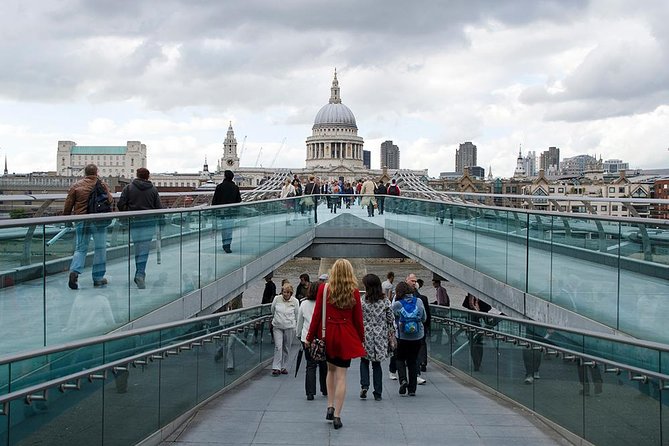
The route then reaches the 325-meter Millennium Bridge. Opened on June 10, 2000, the footbridge links Tate Modern with the City of London and St Paul’s Cathedral.
This is one of the clearest photo opportunities on the walk. The bridge offers strong lines and a direct connection between the north and south banks of the Thames. St Paul’s provides an especially recognizable visual anchor, while the bridge itself can lead the eye into the frame.
You have about ten minutes here, so the guide may encourage you to work quickly with angles and composition. This is not the place for a long tripod session. It is a chance to make a few deliberate choices and put the advice from earlier stops into practice.
The bridge also marks a change in feel. The first part of the walk focuses heavily on the City’s historic and financial core. From here, you move into a more open river setting and finish among South Bank landmarks.
River views and Tower Bridge
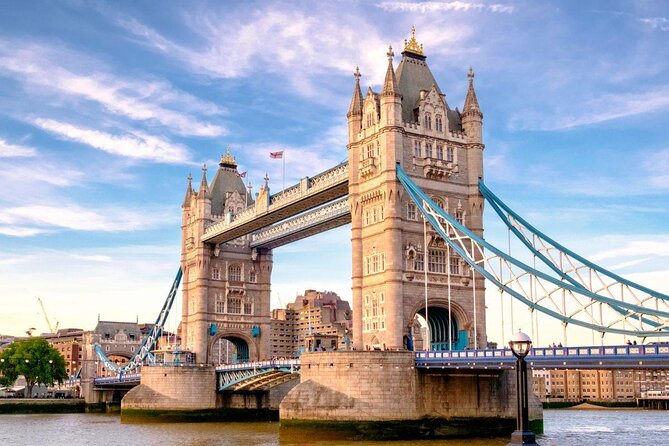
At Tower Bridge, the focus shifts to panoramic views of the River Thames and the bridge itself. The listed stop lasts around ten minutes, which is enough for a guided look at possible compositions but not a full exploration of the bridge or its exhibition.
Tower Bridge is one of London’s most recognizable subjects, so the challenge is avoiding the ordinary tourist image. Your guide may help you consider how much river, sky, bridge structure, and surrounding city to include. I would pay attention to the balance between the moving water and the strong geometry of the bridge.
The route’s timing is worth keeping in mind here. Reaching Tower Bridge and then finishing at Tate Modern means the walk covers a fair stretch of central London. Comfortable shoes are sensible, and you should keep your camera easy to reach. The experience is designed around walking and shooting, not frequent sitting breaks.
Finishing at Tate Modern
The tour ends at Tate Modern, where you have about ten minutes to photograph the building. Housed in the former Bankside Power Station, Tate Modern occupies a huge brick structure originally designed by Sir Giles Gilbert Scott, the architect also associated with Battersea Power Station.
The building dominates this part of the South Bank, and its size makes it another useful subject for composition practice. You can think about scale, texture, vertical lines, and how to frame a large industrial building without losing its shape.
Tate Modern is Britain’s national gallery of international modern art, but admission to the gallery is not part of this experience. The end point is useful, though, because you can continue independently after the tour if you want to visit the collection.
Ending here also makes practical sense. The tour leaves you near a major cultural attraction and the South Bank, rather than returning you to the City. Check your plans before booking so you know whether you want to continue south of the river or return to another part of London.
What the photography teaching is really like
The most praised part of this experience is the guide’s approach. Richard is described as friendly, supportive, and good at helping people who are not fully comfortable with their camera settings. Another session included a mix of ages and abilities, and the leader adjusted well to that range.
You should not expect a formal classroom course. This is a walking workshop, so the teaching happens beside the buildings and streets you are photographing. The advice can cover composition, lighting, camera technique, and settings, with the subject in front of you.
That format works best if you bring questions. Tell the guide if you want help with manual controls, getting sharper images, finding better angles, or moving beyond automatic mode. If you arrive expecting a private lesson tailored entirely to your camera, a group tour may feel less personal.
You can use a dedicated camera or a camera phone, but you need to bring your own equipment. There is no listed camera hire or professional photo package. The result is your own set of images and the skills you practice during the walk.
Group size, timing, and physical demands
The maximum group size is 18 people. That is not a private experience, but it is still small enough for a guide to offer some individual advice, especially if everyone takes turns asking questions.
The two-hour schedule is tight. The ten stops average only a few minutes each once walking time is included, even though the listed stop durations add up to the full session. You should expect an energetic route rather than a slow wander with long periods at each site.
Most people can participate, and the tour is near public transportation. Service animals are allowed. The minimum age is 18, and children must be accompanied by an adult, with both paying for tickets.
Good weather is required. If poor weather cancels the tour, you are offered another date or a full refund. The same applies if the minimum number of participants is not reached. In other cases, the $71.63 booking is non-refundable and cannot be changed, so choose your date carefully.
Is $71.63 good value?
At $71.63 per person, this is more expensive than an ordinary self-guided walk, but that is not the right comparison. You are paying for a professional photographer guide, practical advice, historical information, and a planned route through some of London’s best-known subjects.
I think the price works for three kinds of people. First, it suits visitors who want to improve their photos while sightseeing. Second, it suits London residents who know the landmarks but want new angles and a reason to use their camera again. Third, it suits beginners who would rather learn outdoors than sit through technical instruction.
The value is weaker if you already know exactly how to compose and expose city photographs, or if you mainly want an inexpensive introduction to London landmarks. You can walk past many of these locations without paying an admission fee. The guide is the product, so the experience depends heavily on how much you engage with the instruction.
The overall rating is 4.5 from 10 ratings, with 90 percent recommending it. That points to a strong experience for the right audience, but the small number of ratings means you should still read the itinerary carefully. One negative experience focused on the route feeling too centered on standard tourist sights and the group feeling large. If you want only obscure locations, this may not satisfy you.
Who should book this London photo walk?
I would recommend it to anyone who wants a relaxed, social way to practice photography in central London. The guide’s supportive manner seems particularly useful if your camera has been sitting on automatic mode or if you are unsure how to approach architecture.
It also works for locals. Familiar places can look different when you are asked to study their lines, light, scale, and setting. The historical details give the walk more purpose than a simple camera outing.
You should think twice if you dislike walking, need a slow pace, or want extended visits inside the churches, St Paul’s Cathedral, or Tate Modern. You should also be realistic about the phrase hidden corners. The route includes some less familiar views, but it also includes unmistakable tourist sights such as St Paul’s Cathedral, Tower Bridge, and the Millennium Bridge.
Bring the camera you actually use, not the one you hope to understand someday. A camera phone is acceptable, but the tour may be most useful if you want guidance with settings on an SLR or another dedicated camera.
Should you book the History of London Photography Tour?
Book it if you want hands-on camera advice tied to real London streets and buildings. The combination of history, architecture, and practical coaching gives you more to take home than a gallery of standard snapshots.
Skip it if you want a slow historical tour, a private photography lesson, or a route devoted only to obscure corners. At two hours, the walk moves quickly, and the focus is on making photographs rather than entering attractions.
For most visitors who enjoy taking pictures and want a friendly push beyond automatic settings, $71.63 is a reasonable price. Ask questions early, wear comfortable shoes, and arrive ready to shoot.
FAQ
Where does the photography tour start?
The tour starts at IMPRINT Church London, St Mary Woolnoth, at 10 to 13 Lombard Street, London EC3V 9AN, UK.
Where does the tour finish?
The experience ends at Tate Modern, Bankside, London SE1 9TG, UK.
How long does the tour last?
The walking photography tour lasts approximately two hours.
What equipment should I bring?
You need to bring your own camera or camera phone to get the most from the tour.
Is the tour suitable for beginners?
Yes. The guide provides advice on camera skills, composition, lighting, and settings, and the group can include people with different levels of experience.
How many people can join the tour?
The maximum group size is 18 people.
What happens if bad weather cancels the tour?
If poor weather causes cancellation, you are offered a different date or a full refund. If the minimum number of participants is not reached, you are offered a different date or experience, or a full refund.
More Photo Tours in London
- Professional Photoshoot in London Photographer
★ 5.0 · 102 reviews - Private landmarks photoshoot for families and couples
★ 5.0 · 92 reviews - 30 Major London Attractions Walking Tour With Photos
★ 4.5 · 51 reviews - Private Tour: Night Photography Tour in London
★ 5.0 · 48 reviews
Just added in London
- Private Tour: Royal High Tea At Kensington Palace Gardens★ 5.0 · 39 reviews
- Private Tour: Personal Travel Photographer Tour in London★ 4.5 · 27 reviews
- London East End Private Walking Food Tour – Secret Food Tours★ 5.0 · 26 reviews
- Private Tour: Night Photography Tour in London★ 5.0 · 48 reviews
- London Like a Local, Private & Personalized (2-3 hrs)★ 4.5 · 11 reviews
- British Museum & National Gallery of London – Exclusive Guided Combo Tour★ 5.0 · 48 reviews
- Private Tour: Tower of London and St Paul’s Cathedral★ 5.0 · 1 review
- London Soho District – Exclusive Guided Walking Tour★ 5.0 · 2 reviews
Historical Tours, compared.
Shadows of York: Ghost Walk and Horrible History.
Read our review →
A Walk Through Time: History of Liverpool Walking Tour
Read our review →
Royal Historic Pubs Walking Guided Tour in London
Read our review →
Private Group: Historical Pub Walking Tour of London
Read our review →
Best Of Liverpool Heritage, History & Culture Guided Walking Tour
Read our review →Browse the lists this tour appears in