
Reviewed · HISTORICAL TOURS
City of London History Tour: The Square Mile that Rose to Empire
History hides in plain sight. This 2.5-hour walk connects Roman ruins, medieval churches, powerful guilds, and the financial institutions that shaped London. I like its focus on lesser-seen corners, and I like the small maximum of eight people, which should make it easier to hear the guide and ask questions. The main consideration is pace: fifteen stops in one walk means some places receive only five minutes.
I would choose this for a first look at the City of London, especially if you want more than famous landmarks and postcard views. The tour is led by Argun, and one earlier participant praised the informative, educational approach and the off-the-beaten-path choice of sights. At $30.69 per person, the price is fair for a guided walk lasting about two and a half hours, though you should not expect lengthy interior visits at every stop.
In This Review
- Five things to know before you go
- Why this small City of London walk works
- Roman London begins at St. Alphage and the City Wall
- Guild gardens reveal the power of trade
- Guildhall connects mythology with city government
- Churches and guild traditions lead toward the Royal Exchange
- The Bank of England and the dragons finish the story
- Price, pace, and practical value
- Who should book this City of London tour?
- Should you book it?
- FAQ
- Where does the City of London History Tour start?
- Where does the tour finish?
- How long does the tour last?
- What language is the tour offered in?
- How many people can join the tour?
- Is the tour wheelchair and stroller accessible?
Five things to know before you go
- The walk links several eras: Roman Londinium, Celtic Britain, Norman London, medieval guilds, and the modern financial district all appear in one compact route.
- The group is capped at eight people: That is a useful advantage on narrow streets and beside busy City landmarks.
- You see major institutions from the outside: Guildhall, the Royal Exchange, Mansion House, and the Bank of England all feature in the route.
- The lesser-known stops are the point: St. Alphage, St. Giles Cripplegate, Salter’s Hall Garden, and the church ruins give the walk its local character.
- The route ends among twelve dragon lamp posts: The London Troops War Memorial provides a memorable final setting on Cornhill.
- It is listed as wheelchair and stroller accessible: The tour begins near public transport and most people can take part, though the supplied details do not explain the exact street surfaces or restroom arrangements.
Why this small City of London walk works
The City of London is easy to misunderstand. It is the historic core of the capital, but it is not simply another central neighborhood. The City has its own municipal governing body, ancient wards, livery companies, churches, financial institutions, and traditions. This walk gives you a way to connect those pieces.
I like the route because it does not treat London as a string of isolated sights. A Roman wall leads into the story of defense. A guild garden leads into trade and governance. A church ruin points to the City’s changing population and wartime destruction. The Royal Exchange and Bank of England then show how commercial power took over from older forms of civic authority.
The group limit matters here. With no more than eight participants, you are less likely to lose the guide in a crowded street or miss a short explanation beside a monument. The tour is offered in English, and the booking information says confirmation arrives at the time of booking.
The walk is scheduled for roughly 2 hours and 30 minutes. That is long enough to cover a lot, but short enough to fit before another London plan. Since the route has fifteen stops, the guide has to keep moving. If you want to enter every church, museum, or institution at length, this is not that kind of experience. It is a carefully packed outdoor history lesson.
More History Tours in London
- London Small Group Tour of Historical Pubs
★ 5.0 · 10,422 reviews - Soho Music & Historic Pubs Tour
★ 5.0 · 1,993 reviews - Royal Historic Pubs Walking Guided Tour in London
★ 5.0 · 803 reviews
Roman London begins at St. Alphage and the City Wall
The meeting point is Barbie Green at 2 London Wall Place, near the Barbican, London EC2Y 5AU. The first stop is St. Alphage London Wall, where the walk begins in Salters Garden.
This opening location sets up the main idea of the tour: London was built in layers. The story reaches from Roman times to the Norman period, with the site serving as a place where the histories of different peoples meet. You get the broad frame before the walk turns to specific monuments.
Next comes the Roman city wall. The route identifies the oldest section here as a fort, and the wall becomes an early physical sign of how London protected itself from outside threats. The tour also brings in the Celtic people, described as the indigenous people of these lands, and explains why the Romans fortified Londinium.
That is a useful beginning because it keeps the Roman story from becoming a simple parade of dates. You are looking at a structure built for security, then considering the people and pressures that made it necessary. The stop is free, as are all the listed stops, but the time is brief at about ten minutes.
St. Giles Cripplegate follows. It is described as one of the City’s oldest medieval churches, with Norman-era connections and an earlier Saxon church on the site. The name and building offer a reminder that the City was a settled religious and civic center long before today’s offices and banks arrived.
I would pay close attention here if you enjoy medieval London. The stop is only about ten minutes, so you may get the main story rather than a long architectural inspection.
Guild gardens reveal the power of trade
Salters Hall Garden returns the walk to the Roman wall and then shifts the subject toward trade, government, and sacrifice. Salters Hall is connected to the Salters, ranked ninth among the twelve most important livery companies, formerly known as guilds.
The value of this stop is the explanation of how London’s commercial life was organized. A livery company was not merely a trade association. In the context of this walk, it becomes part of the City’s political and social structure. The garden is therefore a practical place to explain how old organizations helped shape civic London.
Brewers’ Hall adds a lighter touch. It is associated with the livery company that set standards for alcoholic drinks. That short stop gives the broader guild story a concrete subject. Instead of hearing only about abstract power, you connect the system to an everyday product that has long been part of London life.
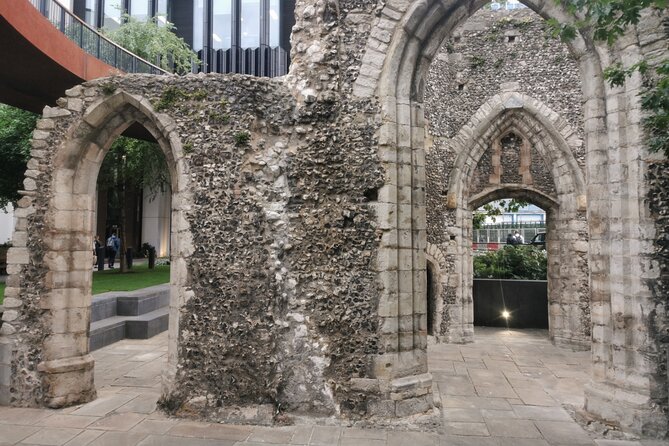
St. Mary Aldermanbury Garden offers a different mood. The ruins of the church take their name from the ancient court, or bery, of the aldermen, now connected with Guildhall. The garden also contains memorials to Shakespeare and to two notable figures associated with different livery companies.
This is one of the places I would value most on the route. A ruined church, civic history, literary memory, and guild tradition occupy the same small setting. It is a good example of the City’s habit of placing several centuries beside one another.
The drawback is that these stops are compact. Salters Hall Garden and Brewers’ Hall each receive about ten minutes, while St. Mary Aldermanbury Garden also receives about ten. You will hear the story and see the setting, but the guide cannot linger over every memorial.
Guildhall connects mythology with city government
The next section moves into the City of London itself, including its municipal governing body and historic center. At just five minutes, this is a transition stop, but it matters because it frames the City as a distinct civic entity.
Guildhall gets more time, about fifteen minutes. The town hall has occupied its current site since at least the thirteenth century. The tour follows its story through Greek, Roman, Saxon, and Norman influences, mixing documented civic development with the mythology attached to the place.
I like the decision to include Guildhall as more than a grand building. The site represents how London’s government developed over time. You are not just looking at an old facade. You are considering the institutions that managed the City as London expanded around it.
St. Lawrence Jewry comes next. This is the official church of the City of London Corporation, and its story recalls a saint whose sacrifice helped Christianity grow. The stop is short, about five minutes, so expect a focused explanation rather than a full religious or architectural tour.
Guildhall Art Gallery is scheduled for twenty-five minutes and marks the location of the Roman amphitheater. This is the longest stop on the route, which makes sense. The amphitheater site provides one of the clearest physical links between modern London and Roman Londinium.
You should note the wording of the stop carefully. The route highlights the location of the Roman amphitheater, but the supplied information does not promise a full art-gallery visit or a separate admission experience. Treat this as a substantial explanatory stop within the walking tour, not as a replacement for a dedicated museum visit.
A completely different sort of day out:
- Stonehenge, Windsor Castle, and Bath from London
★ 4.5 · 18,662 reviews - London Big Bus Hop-On Hop-Off Tour with Optional River Cruise
★ 3.5 · 10,803 reviews - Stonehenge, Windsor Castle and Bath with Pub Lunch in Lacock
★ 4.5 · 7,402 reviews - Tower of London and Crown Jewels Exhibition Ticket
★ 4.5 · 6,677 reviews
Churches and guild traditions lead toward the Royal Exchange
St. Margaret Lothbury represents two of the City’s wards. Here, the guide explains how livery companies came to be called Worshipful companies. This is a small detail with a useful payoff: names that may sound formal or mysterious begin to make sense within the City’s old civic system.
The stop lasts about five minutes, so you will need to stay alert. The same is true at the Royal Exchange, where the visit lasts about five minutes. The building was created as a meeting place for adventurers, and the men connected with it went on to shape the New World.
The Royal Exchange is a strong place to discuss ambition, finance, and overseas expansion. Its story shows that the City’s power did not remain local. London’s merchants and financiers helped support ventures that reached far beyond England.
The golden grasshopper on top gives the stop a memorable visual hook. The route explains what the symbol is doing there, so look upward when you arrive. Five minutes is not enough for a detailed study of the building, but it is enough to attach a striking image to a larger story about commerce.
Mansion House follows. This is the home of the Lord Mayor of the City of London, who also serves as an international ambassador for the United Kingdom’s financial and professional services sector. The short stop makes clear that the City’s ceremonial government remains connected to its modern economic role.
This portion of the walk is especially useful if London’s financial district usually feels like a wall of office buildings to you. The guide supplies the civic and commercial background that the streets do not explain on their own.
The Bank of England and the dragons finish the story

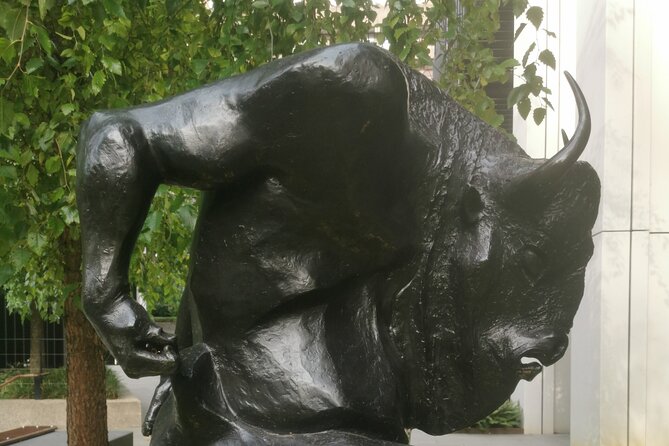
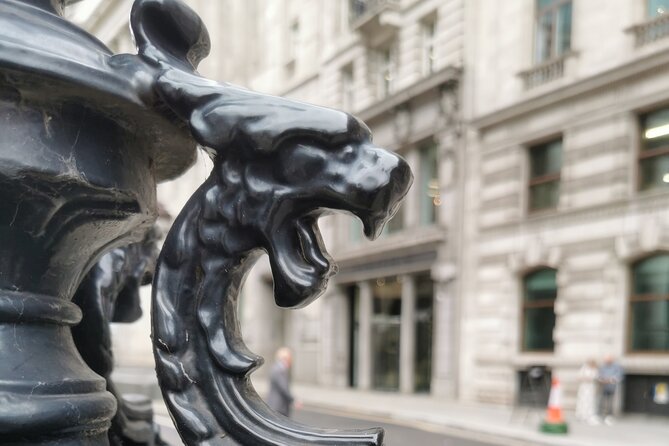
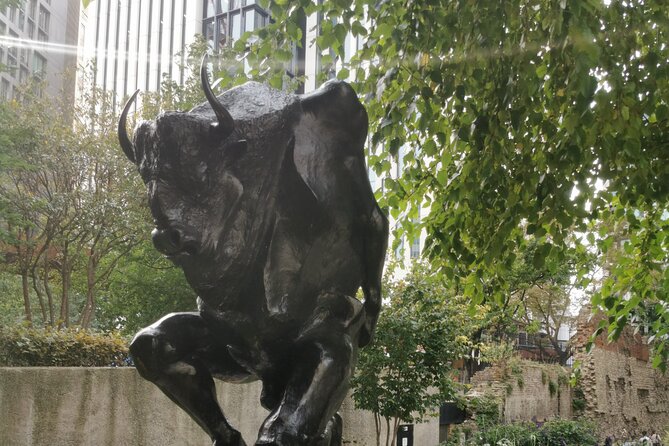
The London Troops War Memorial provides the final major setting. It sits inside a circle of twelve dragon lamp posts representing the twelve great livery companies. The tour uses this area to remember notable figures connected with the surrounding City and to return to the story of the Minotaur.
That ending has a pleasing sense of structure. The walk began with ancient defenses and moves through churches, guilds, trade, civic power, and finance before returning to symbols, sacrifice, and memory. The Minotaur reference gives the final explanation a mythic thread without taking the tour away from the streets around you.
The last stop is the Bank of England. The institution is described as influential, traditional, and still forward looking. A golden statue on top supplies another visual detail and another story for the guide to explain.
The endpoint is 1 Cornhill, London EC3V 3LN, inside the circle of dragons. This is convenient for continuing into the City, but the information provided does not specify onward directions or a particular transport connection from the endpoint. The starting area is near public transportation.
Price, pace, and practical value
At $30.69 per person, I consider this a good-value introduction to the City of London. You are paying for a small-group guide, a tightly connected historical route, and explanations at fifteen locations. All listed admission tickets are free, so there are no extra entrance charges built into the walk.
The value depends on what you want. If you enjoy context, symbols, old institutions, and short stops at unusual sites, the price is sensible. If you want extended time inside Guildhall Art Gallery, the Bank of England, or any church, you may prefer to visit those places separately.
The walk is booked, on average, 39 days in advance. That suggests planning ahead is sensible, especially because the group is limited to eight people. The tour is offered in English and includes a mobile ticket.
The accessibility information is encouraging. The experience is listed as wheelchair and stroller accessible, and most people can participate. Still, the details do not specify the exact pavement conditions, slopes, interior access, or toilet arrangements, so anyone with particular mobility needs should confirm those points before booking.
Free cancellation is available up to 24 hours before the start time for a full refund. Cancellations or changes made less than 24 hours before the start time are not accepted for a refund, and the cut-off follows local time.
Who should book this City of London tour?
I would recommend it most strongly to history buffs, London newcomers, and anyone who has already seen the usual central sights and wants a different side of the capital. The route gives you a useful framework for understanding why the City has its own identity.
It also suits people who like guides to explain small details. The golden grasshopper, the dragon lamp posts, the naming of Worshipful companies, and the meaning behind St. Mary Aldermanbury Garden all give you something specific to remember.
Families with older children may enjoy the mix of Roman walls, churches, guilds, statues, and the Minotaur story. The short stops keep the walk moving, though younger children may find two and a half hours of historical explanation demanding.
I would be less likely to choose it for someone who wants a relaxed photographic stroll, extensive interiors, or a food-centered experience. The schedule is active, and the emphasis is firmly on civic and historical interpretation.
Should you book it?
Book this walk if you want London’s Square Mile explained through its surviving walls, churches, guild halls, symbols, and financial institutions. Argun’s approach, described as informative and educational, fits the route well, and the small group should make the experience more personal than a large city walk.
Skip it if you prefer to explore at your own pace or need long visits inside each building. For $30.69, though, it offers a focused introduction to one of London’s most important and least immediately understood districts. I would book ahead, wear comfortable shoes, and arrive ready to look up, down, and beyond the glass towers.
FAQ
Where does the City of London History Tour start?
The tour starts at Barbie Green, 2 London Wall Place, Barbican, London EC2Y 5AU, United Kingdom.
Where does the tour finish?
The walk ends at the London Troops War Memorial, 1 Cornhill, London EC3V 3LN. The closing explanation takes place inside the circle of dragon lamp posts.
How long does the tour last?
The experience lasts approximately 2 hours and 30 minutes.
What language is the tour offered in?
The tour is offered in English.
How many people can join the tour?
The maximum group size is eight people.
Is the tour wheelchair and stroller accessible?
Yes. The experience is listed as wheelchair and stroller accessible, and most people can participate. The supplied details do not specify the exact street surfaces or interior access arrangements.
Just added in London
- Private Transfer From London to Southampton Cruise Terminal★ 4.0 · 2 reviews
- Layover Tour of London from LHR Executive Luxurious Vehicle Private Tour 6 hour★ 4.5 · 9 reviews
- Pub & History Tour London (History & Beers)★ 5.0 · 3 reviews
- eSIM for UK (34 EU countries) | 3 to 30 days. Up to 40GB of data★ 4.0 · 18 reviews
- Young Victoria’s London: Windsor Castle & Kensington Palace★ 5.0 · 1 review
- Zombie Scavengers Game – Southend-on-Sea, UK★ 4.5 · 2 reviews
- Women of Whitechapel 2 hour Walking Tour★ 5.0 · 15 reviews
- Working Women of the East End Walking Tour★ 5.0 · 85 reviews
Historical Tours, compared.

Shadows of York: Ghost Walk and Horrible History.
Read our review →

A Walk Through Time: History of Liverpool Walking Tour
Read our review →
Royal Historic Pubs Walking Guided Tour in London
Read our review →
Private Group: Historical Pub Walking Tour of London
Read our review →
Best Of Liverpool Heritage, History & Culture Guided Walking Tour
Read our review →Browse the lists this tour appears in