
Reviewed · RIVER THAMES CRUISES
Shakespeare in the City Walk – In Shakespeare’s footsteps North of the Thames
Shakespeare is hiding in plain sight. This two-hour walk from Blackfriars to Barbican shows you a less familiar side of London through overlooked statues, churches, plaques, old streets, and the places tied to William Shakespeare’s life and work. It is not a standard sightseeing stroll. The focus is on stories, clues, and performances that give the city a literary spark.
I especially like the small-group feel, with bookings limited to 15 people and a larger tour limit of 45. I also like the way guide Declan, a former professional actor, uses complete Shakespeare speeches rather than simply pointing at buildings and reciting dates. The main consideration is that this is best for people who already have a real interest in Shakespeare, history, or literature. If you want famous London sights with only brief commentary, the steady stream of details may feel too specialized.
The price is $20.83 per person, which is good value for a two-hour walking tour that includes a professional guide and live entertainment. You should arrive at Blackfriars Underground Station before the 11:00 a.m. start, not at Blackfriars Overground Station south of the Thames. Wear shoes you can walk in, since the route continues through city streets and operates in all weather.
In This Review
- Key things to know before you go
- Starting at Blackfriars, with one important station warning
- Blackfriars Theatre and the price of seeing Shakespeare
- Quiet lanes, a Shakespeare house, and Richard III
- Queen Victoria Street and a speech carved into something strange
- Carter Lane plaques and two very different daughters
- St. Paul’s Cathedral and Shakespeare’s cosmic side
- Cheapside, a pub, and the limits of Shakespeare’s vocabulary
- Love Lane and the men who preserved Shakespeare’s plays
- London Wall and Shakespeare’s unhappy marriage
- St. Giles Cripplegate, two actors, and a goodbye
- Is $20.83 good value for two hours?
- Practical advice for the walk
- Who should book Shakespeare in the City Walk?
- FAQ
- Where does the Shakespeare in the City Walk begin?
- Which transport lines serve Blackfriars Underground Station?
- Is the meeting point at Blackfriars Overground Station?
- How do I find the guide?
- What time does the tour start?
- How long does the experience last?
- Where does the walk finish?
- Which Underground lines serve Barbican?
- Is the tour suitable for children?
- Does the tour operate in bad weather?
- What is included in the price?
- Can I cancel for a full refund?
Key things to know before you go
- The route begins at Blackfriars Underground Station: Use the Circle or District lines, and stay north of the river. The guide waits near the single station exit with a Shakespeare sign on his rucksack.
- Declan adds live acting to the history: He performs complete speeches, including a final passage about saying goodbye from Shakespeare’s last play.
- The walk visits easily missed places: Look for a small Shakespeare statue, a fragment of Blackfriars Monastery, a hidden sculpture, and an unusual totem pole based on a famous speech.
- The route ends at Barbican Underground Station: The station serves the Circle, Metropolitan, and Hammersmith & City lines, making the finish practical for the rest of your day.
- This is an adults-and-older-children outing: Children must have an adult with them, and the recommended age is 10 and above.
- You need moderate physical fitness: The tour lasts about two hours and takes place outdoors in all weather.
Starting at Blackfriars, with one important station warning
The meeting point is outside Blackfriars Underground Station on Blackfriars Road in London. This station is served by the Circle and District lines, and it has one exit, which makes the meeting arrangement fairly simple.
The warning matters: do not go south of the Thames to Blackfriars Overground Station. The two names are similar, but they are different stations on opposite sides of the river. Give yourself enough time to get oriented, especially if you are carrying luggage or arriving from another part of London.
Declan waits just outside the Underground exit with a sign showing Shakespeare’s face on his rucksack. That is a useful touch in a busy part of the city. The tour begins at 11:00 a.m., and the walk finishes at Barbican Underground Station.
This is a point-to-point route, not a loop. That means you will see more of central London than you would on a short walk around one neighborhood, but you should plan your onward journey from Barbican rather than back at Blackfriars.
More Walking Tours in London
- Tour for Muggles The Ultimate Harry Potter Walking Tour in London
★ 5.0 · 4,684 reviews - London Jack The Ripper Guided Walking Tour
★ 5.0 · 3,131 reviews - Changing of the Guard Guided Walking Tour in London
★ 5.0 · 1,793 reviews
Blackfriars Theatre and the price of seeing Shakespeare
The first substantial stops introduce the world behind Shakespeare’s London. Near EC4Y 0JP, you see a Shakespeare statue that many people pass without noticing. The discussion turns to Shakespeare’s popularity and the long-running conspiracy theories about who really wrote his plays.
The emphasis here is not on treating every mystery as equally plausible. Instead, Declan explains why the conspiracy theories should be set aside. That gives the walk a useful tone from the start: curious, but not gullible.
You then visit a church connected with the original Blackfriars Theatre. The stop explains why attending a performance there required money and social position, along with how wealthy Shakespeare himself became. This is an important correction to the picture of Shakespeare as only a struggling playwright. The tour connects his writing to the business of theater, property, patronage, and status.
At Ireland Yard, you see the remaining fragment of the Blackfriars Monastery. This brief stop also introduces Shakespeare’s recurring concerns and themes. It is a good example of how the walk uses small physical remains as prompts for larger questions.
Quiet lanes, a Shakespeare house, and Richard III

Carter Lane provides a peaceful change of pace. The street connects Shakespeare with King James, and its quieter atmosphere makes it easier to imagine the old city as a place of courts, churches, theater, and narrow lanes rather than only offices and traffic.
At Saint Andrew’s Hill, the story becomes more personal. This was the location of one of Shakespeare’s London houses, and you hear what happened to it. The stop also considers which play was likely written there, giving a physical setting to work that is usually encountered only on a printed page or a stage.
A church here contains a hidden sculpture of Shakespeare praying. The tour also brings in an important document and a researcher whose work has a connection that will make Americans proud. These details are not just decoration. They show how Shakespeare’s story has been pieced together through records, scholarship, and objects that are easy to miss.
The same stop explores Richard III and its connection to the area. If you know the play, this adds texture. If you do not, it gives you a clear example of how Shakespeare reshaped history for drama.
Queen Victoria Street and a speech carved into something strange
One of the walk’s most unusual moments comes on Queen Victoria Street. Here you find an extraordinary hidden totem pole made from words taken from a famous William Shakespeare speech.
You would not likely find this monument on your own. It is the sort of odd, specific sight that gives a guided walk its value. Declan performs the entire speech, drawing on his experience as a professional actor. That live performance changes the mood from sightseeing to theater, even though you are still standing on an ordinary city street.
The stop continues at the College of Arms, where you learn about the Shakespeare family’s coat of arms and why the honor arrived two months too late. Ben Jonson’s joke at Shakespeare’s expense adds a lighter note. The discussion also covers Shakespeare’s children, keeping the playwright connected to family life rather than treating him as a figure floating above ordinary concerns.
For me, this section best explains the tour’s appeal. You are not simply looking at a memorial. You are being shown how reputation, family, status, and literary fame grew around one man.
More Thames cruises:
- High-Speed Thames River Speedboat in London
★ 5.0 · 3,971 reviews - London Tootbus Hop on Hop off Bus Tour and Thames River Cruise
★ 4.0 · 3,834 reviews - Westminster to Greenwich Sightseeing Thames Cruise in London
★ 4.5 · 2,969 reviews - London Dinner Cruise on the Thames River
★ 4.0 · 1,772 reviews
Carter Lane plaques and two very different daughters

The route returns to Carter Lane for a plaque connected with Shakespeare’s generosity. It also raises the entertaining possibility that important evidence may still be waiting in dusty attics.
The focus then turns to Shakespeare’s two daughters and their very different fortunes. This gives the family story more shape and avoids making Shakespeare’s children a footnote. You get a sense of how inheritance, marriage, money, and opportunity could lead to sharply different lives.
This stop is short, but it helps balance the larger literary material. The tour is not only about famous lines. It is also about the practical choices and family circumstances behind the name.
St. Paul’s Cathedral and Shakespeare’s cosmic side
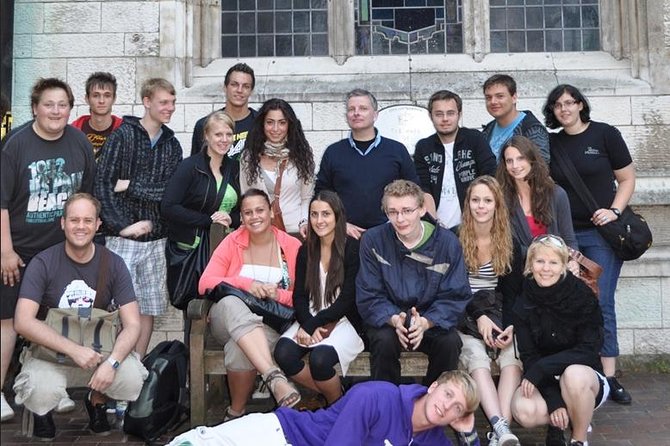
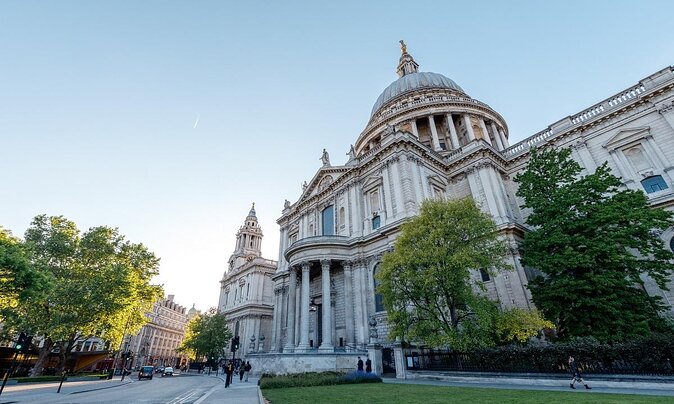
The walk continues to St. Paul’s Cathedral, one of London’s most impressive landmarks. You do not go inside, so you should not book this expecting a cathedral visit. Instead, the building provides the setting for what the tour describes as a breathtaking revelation about Shakespeare and the site.
The discussion includes Shakespeare’s best-selling work, his sonnets, and a careful interpretation of his sexuality. The wording matters here. You are offered a reasonable reading rather than a claim that settles a question scholars and readers have debated for centuries.
Declan also shares his favorite four words by Shakespeare, described as cosmic. That small detail gives the stop a personal edge. It shows how the guide’s own enthusiasm shapes the experience, rather than leaving you with a stack of neutral facts.
St. Paul’s is also a useful point for understanding the city’s scale. You are moving through areas where major landmarks and tiny traces of earlier London sit close together. The tour’s pleasure comes from putting those pieces side by side.
Cheapside, a pub, and the limits of Shakespeare’s vocabulary
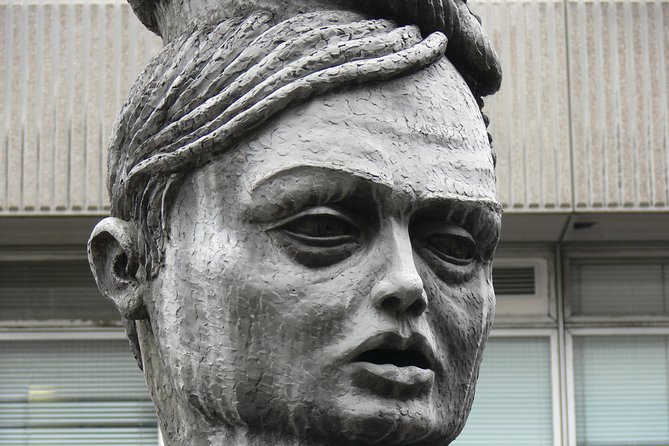
At Cheapside, the subject turns to Shakespeare’s extraordinary vocabulary, followed by the reason even that vocabulary was not enough. This section appears to look at the limits of language, a fitting question on a walk about one of the most famous writers in English.
You also hear about a pub where Shakespeare drank and who else drank there. The detail brings him down from the pedestal. He was not only the author of monumental speeches. He was also a working man of London who spent time in ordinary social places.
The stop considers Shakespeare’s religion and why he became lonely and reclusive. These subjects can easily be treated as simple biography, but they are more useful when presented as questions about his choices, beliefs, and later life. You should expect interpretation here, not a neat answer for every mystery.
Love Lane and the men who preserved Shakespeare’s plays
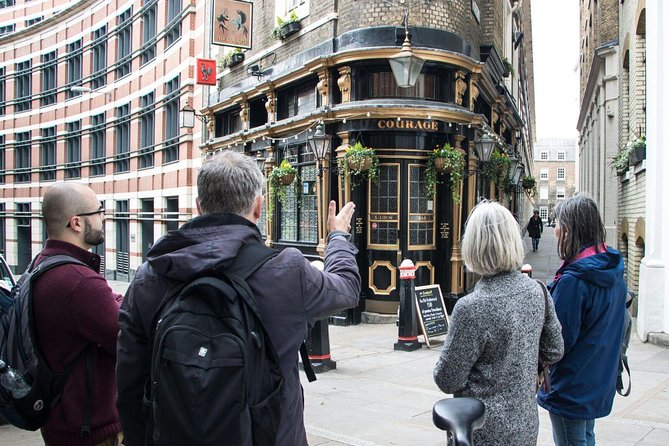
Love Lane brings a bust of Shakespeare and the men who honored him. The discussion explains which plays might have been lost without their efforts, along with more information about Shakespeare’s writing style.
This is one of the route’s most valuable literary sections because it looks beyond the author’s name. Shakespeare’s survival depended on people who collected, printed, performed, and remembered his work. Without them, the modern reading list would be smaller.
The guide also warns you not to become too starry-eyed about the name Love Lane. The title may sound romantic, but the history is less sentimental. That bit of humor keeps the walk from becoming solemn.
London Wall and Shakespeare’s unhappy marriage
At London Wall, you learn about Shakespeare’s second house and why he ended up in this part of London. The stop then gives the full story of how he made a marriage and later regretted it.
This is a more personal and potentially uncomfortable part of the route. It treats Shakespeare as someone who made choices with lasting consequences, not as a perfect literary hero. That human scale is useful, particularly if you are tired of polished biographies that smooth away awkward details.
The location also helps explain why the tour moves beyond the usual Shakespeare sites. You are following the practical geography of his London life, including homes and neighborhoods that do not appear on every sightseeing route.
St. Giles Cripplegate, two actors, and a goodbye
The final major stop is St. Giles Cripplegate, a church Shakespeare knew. Here the story includes the two best-known actors of his age and the sad case of Shakespeare’s brother Edmund.
This ending widens the focus again. Shakespeare’s career depended on actors, family members, colleagues, and the wider theater world. Edmund’s story adds a somber note and reminds you that fame did not protect everyone around him.
Declan finishes with a complete speech from Shakespeare’s last play. The passage concerns saying goodbye, and the performance is intended to be haunting and cosmic. Ending with spoken Shakespeare rather than another plaque is a strong choice. It gives the walk a clear emotional finish.
From St. Giles Cripplegate, Declan walks to Barbican Underground Station. You may accompany him for the final part, or use the station as your onward connection. Barbican serves the Circle, Metropolitan, and Hammersmith & City lines.
Is $20.83 good value for two hours?
At $20.83 per person, this is a fairly priced London walking tour. You are not paying admission to a major attraction, since the stops are viewed from public streets and church areas, but you are paying for a route that would be difficult to assemble on your own.
The value rests in three things:
- The route links many small Shakespeare references into one story.
- Declan provides live performances, not just spoken commentary.
- The group size can be intimate, with a maximum of 15 people per booking.
A larger overall group limit of 45 is also stated, so you should confirm the expected group arrangement when booking if personal interaction matters to you. The smaller booking limit is encouraging, but the experience may still have more people present depending on the day.
You will get the most from the price if you care about the subject. The tour is less useful as a general introduction to London landmarks, since you do not enter St. Paul’s Cathedral and the route gives much more time to Shakespeare than to broad city sightseeing.
Practical advice for the walk
Wear comfortable shoes and dress for rain, wind, or sun. The walk operates in all weather conditions, and no indoor sightseeing option is promised.
Children must be accompanied by an adult, with age 10 and above recommended. I would treat that recommendation seriously because the talk includes biography, literary interpretation, religion, sexuality, marriage, and death. Older children with an interest in theater or history may enjoy the performances, while younger children may lose patience.
Confirmation arrives when you book, and the experience is offered in English with a mobile ticket. Free cancellation is available up to 24 hours before the 11:00 a.m. start. Changes or cancellations inside that window are not accepted for a refund.
The tour is usually booked about 25 days ahead. That suggests you should reserve early if your London schedule is fixed, especially if you want a particular date.
Who should book Shakespeare in the City Walk?
You should book this walk if you enjoy literary history, like finding overlooked corners of a city, or want a more focused experience than a standard London sightseeing tour. It also suits London residents who know the main landmarks but have not followed Shakespeare’s local connections.
The route is especially strong for anyone who values a guide with performance skills. Declan’s complete speeches, including the opening performance at Queen Victoria Street and the farewell passage at the end, give the walk a theatrical shape.
I would skip it if you want to go inside major attractions, avoid outdoor walking, or prefer a broad overview of London. The walk has a clear subject and stays with it. That focus is its strength, but it also makes the tour less suitable for people with little interest in Shakespeare.
FAQ
Where does the Shakespeare in the City Walk begin?
It begins outside Blackfriars Underground Station in London, near Blackfriars Road.
Which transport lines serve Blackfriars Underground Station?
Blackfriars Underground Station is served by the Circle and District lines.
Is the meeting point at Blackfriars Overground Station?
No. You must meet at Blackfriars Underground Station north of the River Thames, not the Overground station south of the river.
How do I find the guide?
The guide waits a few metres from the Underground station exit with a sign showing Shakespeare’s face on his rucksack.
What time does the tour start?
The walk starts at 11:00 a.m.
How long does the experience last?
The walk lasts approximately two hours.
Where does the walk finish?
It finishes at Barbican Underground Station on Aldersgate Street.
Which Underground lines serve Barbican?
Barbican is served by the Circle, Metropolitan, and Hammersmith & City lines.
Is the tour suitable for children?
Children must be accompanied by an adult. The recommended age is 10 and above.
Does the tour operate in bad weather?
Yes. The walk operates in all weather conditions, so you should dress appropriately.
What is included in the price?
The price includes a professional guide, pickup and drop-off at the designated meeting points, and live entertainment.
Can I cancel for a full refund?
Yes, if you cancel at least 24 hours before the experience start time. Cancellations made less than 24 hours before the start are not refunded.
Just added in London
- Private Transfer From London to Southampton Cruise Terminal★ 4.0 · 2 reviews
- Layover Tour of London from LHR Executive Luxurious Vehicle Private Tour 6 hour★ 4.5 · 9 reviews
- Pub & History Tour London (History & Beers)★ 5.0 · 3 reviews
- eSIM for UK (34 EU countries) | 3 to 30 days. Up to 40GB of data★ 4.0 · 18 reviews
- Young Victoria’s London: Windsor Castle & Kensington Palace★ 5.0 · 1 review
- Zombie Scavengers Game – Southend-on-Sea, UK★ 4.5 · 2 reviews
- Women of Whitechapel 2 hour Walking Tour★ 5.0 · 15 reviews
- Working Women of the East End Walking Tour★ 5.0 · 85 reviews
River Thames Cruises, compared.

London Tootbus Hop on Hop off Bus Tour and Thames River Cruise
Read our review →
Westminster to Greenwich Sightseeing Thames Cruise in London
Read our review →

Uber Boat – Single Journey River Thames Cruise
Read our review →
Hop-On Hop-Off Sightseeing River Cruise on the Thames
Read our review →
Lunch River Cruise on the Thames with 2-Course Meal
Read our review →
Browse the lists this tour appears in