
Reviewed · WALKING TOURS
Roman London Private Walking Tour
Roman London is hiding in plain sight. This private walking tour threads through the City of London, linking Roman walls, temples, baths, gates, and an amphitheater with later stories from the medieval period, the Blitz, and modern skyscrapers. I especially like the way it reaches places you could easily miss, including ruins below street level and Roman remains tucked behind ordinary city buildings.
I also like the personal format. Your guide can meet you at a Central London hotel, help you reach the starting point by Tube, and adjust the conversation to your interests. The main drawback is physical: this is a serious walk, not a gentle stroll. Some outings have covered more than seven miles, and you should expect to walk for three or four hours with few long breaks.
In This Review
- Roman walls, underground ruins, and practical highlights
- Why Roman London works best on foot
- Starting at St Paul’s and the old Diana site
- Noble Street, Cripplegate, and the Roman wall
- Guildhall and the amphitheater below your feet
- Bank, the Royal Exchange, and Leadenhall Market
- The Gherkin, the Roman girl, and Aldgate
- Vine Street, Trajan, and the Tower area
- All Hallows, St Dunstan, and the Roman baths
- The old London Bridge and the Great Fire
- The Mithraeum makes the best finish
- What the $254.93 price means
- Walking conditions, timing, and who should book
- Should you book the Roman London walk?
- FAQ
- Where does the Roman London Private Walking Tour start?
- Can the guide pick me up at my hotel?
- Where does the tour end?
- Is the London Mithraeum included?
- How much walking is involved?
- What happens if I need to cancel?
Roman walls, underground ruins, and practical highlights
- Roman London beneath modern streets: See fragments of Londinium under buildings, in alleys, parking areas, churches, and public spaces.
- A private guide from start to finish: Your group has the guide to itself, with time for questions and a pace suited to your interests.
- The London Mithraeum: Finish among Roman artifacts before going below street level to the Temple of Mithras.
- A route packed with variety: Follow the Roman wall, visit the amphitheater, look for Roman baths, and find traces of the old London Bridge.
- Hotel pickup in Central London: Your guide can meet you at your hotel and take you by public transport to the start.
- A strong choice for history fans: The tour adds medieval, Norman, Victorian, wartime, and modern London to the Roman story.
Why Roman London works best on foot
The City of London is compact, but its history is not easy to read. Roman Londinium lies under office blocks, churches, markets, roads, and financial institutions. You can walk past a major Roman site without seeing anything more than a plaque, a bit of stone, or an unremarkable wall.
That is where this tour earns its keep. A guide can connect scattered remains into one city plan. You do not simply see a wall fragment at Noble Street, then another at Cripplegate, then another near the Tower. You begin to understand how the old Roman settlement was enclosed, entered, built, abandoned, and later covered by centuries of new London.
I also like the contrast. One moment you are beside St Paul’s Cathedral. Soon after, you are in a narrow lane or looking below a modern building. The tour puts ancient masonry beside glass towers and Victorian markets, which is one of the most interesting things about the City.
The guides praised most often are Kevin and Stephen Liddell. Both are described as friendly, enthusiastic, and strong storytellers. Their subject is not limited to Rome. You might also hear about Norman and Saxon London, Dickens, the Blitz, medieval churches, architecture, and the way the modern City grew around older streets.
More Walking Tours in London
- Tour for Muggles The Ultimate Harry Potter Walking Tour in London
★ 5.0 · 4,684 reviews - London Jack The Ripper Guided Walking Tour
★ 5.0 · 3,131 reviews - Changing of the Guard Guided Walking Tour in London
★ 5.0 · 1,793 reviews
Starting at St Paul’s and the old Diana site
The advertised meeting point is Panyer Alley, near St Paul’s, at 9:30 in the morning. If you are staying at a Central London hotel, pickup can be arranged there before you travel by Tube to the starting area. Transportation to and from the attractions is not included, so you should have a valid way to pay for public transport.
The opening stop is in the shadow of St Paul’s Cathedral. The cathedral itself is not included, but it provides a grand modern marker for the older settlement beneath your feet. The tour explains why this area mattered before the cathedral existed, including the Roman association with a temple to Diana.
A few steps away, the Church of St Vedast Alias Foster provides the first less obvious Roman connection. The remains are not presented as a large monument. That is the point. This is the sort of place you may pass without knowing what lies beneath or nearby.
The early stops are brief, usually about five minutes each. You will spend more time listening and orienting yourself than examining large ruins. If you want long, quiet visits at every location, the pace may feel quick. If you enjoy following a connected story, it works well.
Noble Street, Cripplegate, and the Roman wall
At Noble Street, you see a stretch of Roman wall discovered after wartime destruction. The remains came to light thanks to bombing during the Second World War, an unlikely link between Roman London and the Luftwaffe.
That detail captures the tone of the whole outing. The history is not arranged in a neat museum display. Modern events have exposed it, buried it, and sometimes preserved it by accident.
Cripplegate brings you to one of the old entrances to Roman London, with well-preserved sections of wall nearby. The stop lasts around ten minutes, enough to get a sense of the gate and its position without turning the tour into an architectural lecture.
The route continues to other sections of London Wall. This repetition is useful because the wall changes character from place to place. In one spot you may see a clear surviving section. In another, the route is easier to understand through its position among newer buildings and streets.
The guide’s role matters here. A single fragment can look plain until someone explains what it once protected and how the Roman city fitted around it. You will also hear how later London used, altered, or built over the old defenses.
Guildhall and the amphitheater below your feet
Guildhall is one of the City’s grand civic buildings, and its square gives the tour another chance to connect ancient and present-day London. The old City of London Corporation remains central to the area, while Roman traces survive close by.
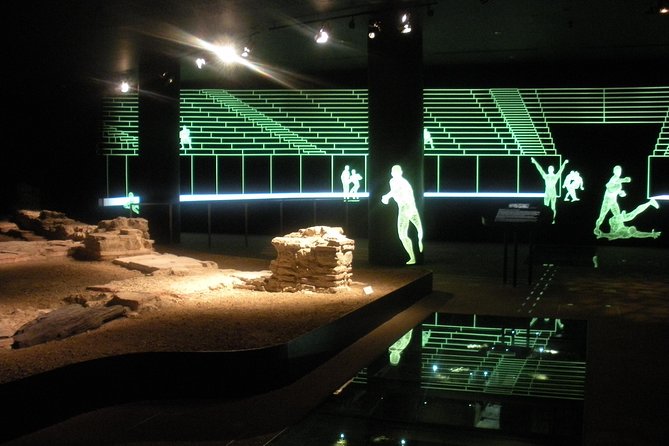
The major stop here is London’s Roman amphitheater. It was discovered only a few decades ago and sits below the modern city. The visit lasts about 25 minutes, making it one of the longer stops on the route.
This is one of the tour’s strongest moments because the scale of Roman London becomes easier to grasp. You are not just looking at a wall fragment. You are standing in the place where public spectacles took place, with the modern city built above it.
Admission to the amphitheater is included. Guildhall itself is not listed as an included ticket, so you should not assume the tour includes a full visit to every building mentioned. The focus is on Roman connections and the surrounding streets.
The itinerary also refers to the former official residence of the Lord Mayor of London. It is a short connecting point rather than a major scheduled stop, but it adds another layer to the City’s civic story.
A completely different sort of day out:
- Stonehenge, Windsor Castle, and Bath from London
★ 4.5 · 18,662 reviews - London Big Bus Hop-On Hop-Off Tour with Optional River Cruise
★ 3.5 · 10,803 reviews - London Small Group Tour of Historical Pubs
★ 5.0 · 10,422 reviews - Stonehenge, Windsor Castle and Bath with Pub Lunch in Lacock
★ 4.5 · 7,402 reviews
Bank, the Royal Exchange, and Leadenhall Market
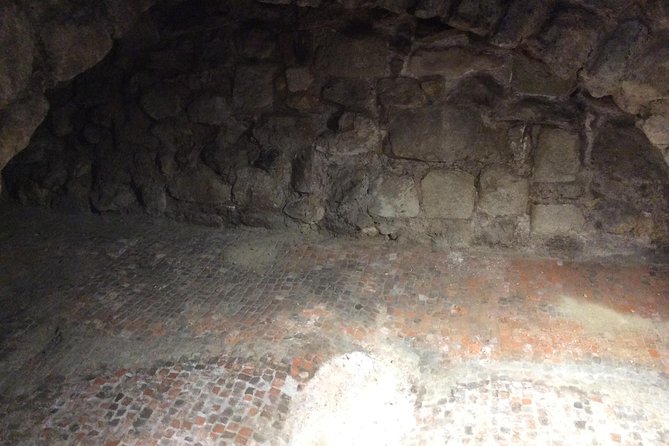
At the Bank of England, the route reaches the heart of old Roman London. The buildings here are imposing, but the guide helps you look past the stone facades and financial power to the earlier settlement beneath them.
The Royal Exchange follows, with about ten minutes outside this impressive building. The setting can feel almost imperial, which makes the comparison with ancient Rome easy to picture, even though the building itself belongs to a far later age.
Leadenhall Market is a more colorful change of scene. The Victorian market was built over an earlier Roman market, and the tour may reveal a surviving piece of that predecessor. The stop lasts around 15 minutes and includes admission to the market.
This part of the walk shows why the tour is more than a list of ruins. You are learning how commerce continued in the same general area across Roman, medieval, Victorian, and modern London. The market also offers a useful pause from the more formal financial district.
The Gherkin, the Roman girl, and Aldgate
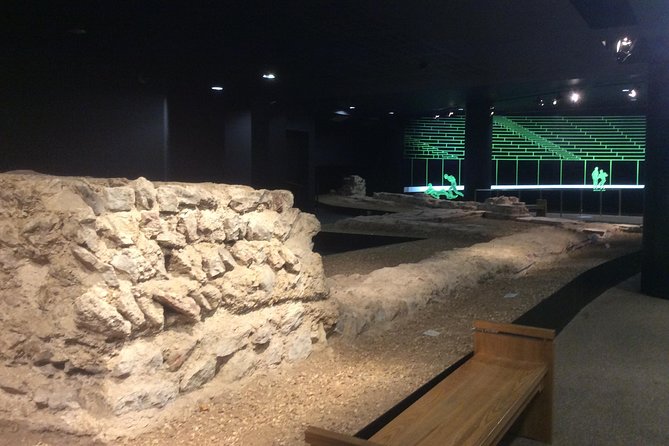
Near 30 St Mary Axe, better known as the Gherkin, the ancient and modern City collide in a particularly sharp way. Beneath the famous skyscraper is an unexpected Roman memorial.
The next stop is the Tomb of the Unknown Roman Girl, a small and moving memorial to one of London’s earliest known residents. It takes only a couple of minutes, but its scale gives the Roman story a human face.
At Aldgate Square, the Roman gate itself is buried below the landscaped park. You can trace the old wall route and understand where the entrance once stood, even though you will not see a large exposed gate.
These stops are a reminder to set your expectations correctly. Roman London is not a single archaeological park. Much of the evidence is partial, reconstructed, or hidden. The reward comes from learning to read the streets rather than expecting ruins at every corner.
Vine Street, Trajan, and the Tower area
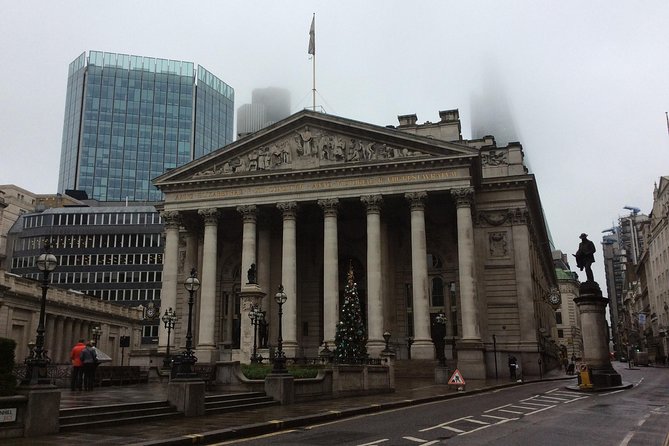
Vine Street brings newer archaeological material into the day. The site includes Roman wall remains and artifacts, and it helps fill in the route around the eastern side of the old city.
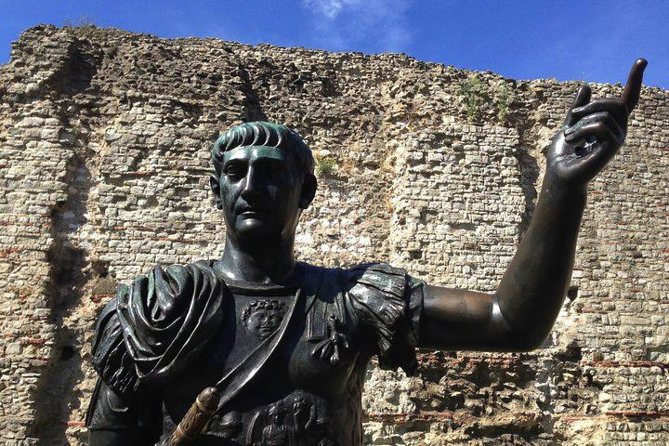
Near the Tower of London, you see a statue of Emperor Trajan. The Tower itself is not the main subject here. Instead, the statue provides a clear link to the wider Roman Empire and to the emperor associated with major building works and expansion.
Another section of London Wall follows, with around 15 minutes devoted to the remains. By this point, you have seen enough separate sections to understand the wall as a real boundary rather than a series of unrelated stones.
The itinerary includes several churches and civic sites, but admission rules vary. Some stops are free, some include entry, and some list admission as not included. Ask your guide at the start which interiors are open that morning, since access can depend on timing and operating conditions.
All Hallows, St Dunstan, and the Roman baths
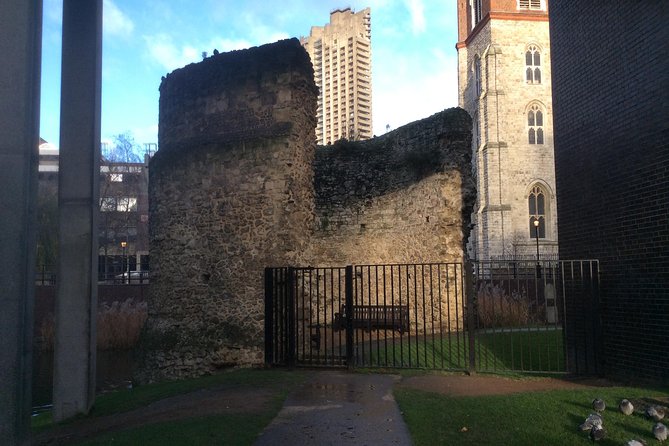
All Hallows by the Tower offers one of the route’s more unusual mixtures of history. Inside or near this old church, you can see the oldest archway in London along with the remains of a Roman house.
The church stop lasts about 15 minutes and is included. It is a good example of how Roman traces survived within later religious buildings rather than in a purpose-built archaeological site.
St Dunstan in the East is not strictly Roman, but it may be the most peaceful stop of the day. The church ruins provide a quiet break among the City’s stone and glass. It also gives the tour breathing room after the steady sequence of walls, gates, and streets.
At Billingsgate, you visit the location of London’s Roman bathhouse. The stop is short, around five minutes, and admission is not included. Do not expect a long bathing complex visit here. The value is in placing the baths within the old city and adding daily Roman life to the military and civic story.
The old London Bridge and the Great Fire
At St Magnus the Martyr, the tour points out what may be the only remaining part of the original Roman London Bridge. Admission is included, and the stop lasts about five minutes.
This is a useful reminder that Londinium was a river city. The bridge was not just a crossing. It helped connect the settlement on the north bank with routes leading south.
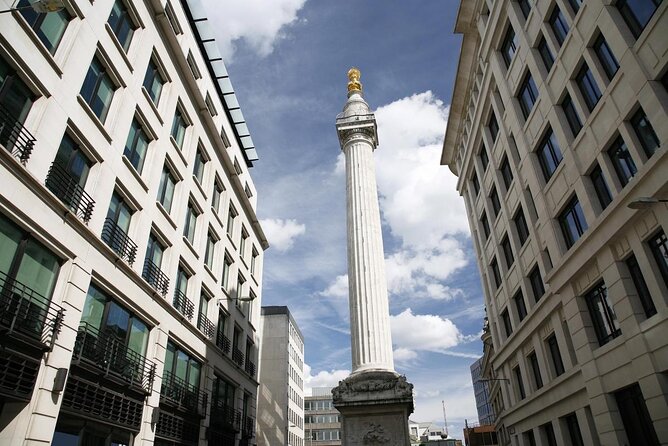
The Monument to the Great Fire of London comes next. You stand near the place where the 1666 fire began and see visual material that presents Roman London as it may have looked 2,000 years ago.
The juxtaposition is excellent: a Roman city, a devastating early modern fire, and the rebuilt City all meet within a short walk. Admission to the Monument is not included, and the listed stop is brief, so the emphasis is on location and explanation rather than climbing the column.
The Mithraeum makes the best finish
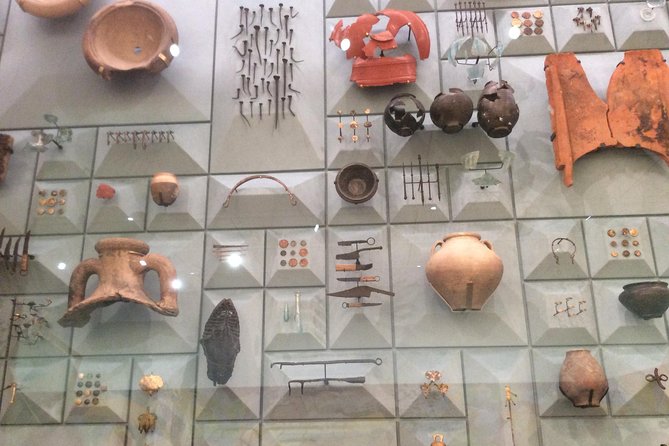
The final major stop is the London Mithraeum Bloomberg SPACE on Walbrook. You first see hundreds of Roman artifacts, then go below street level to the Temple of Mithras.
The visit lasts about 20 minutes and admission is included. The temple is the natural climax because it combines archaeology, religion, architecture, and atmosphere in one place.
Access to the temple is guaranteed only when booked ahead for busy periods. This detail matters. If visiting the Mithraeum is the main reason you want the tour, confirm that the required advance arrangement has been made, especially for peak times.
The tour also includes the London Stone, a free stop near the end of the route. Its age and legends make it a fitting final note, linking Roman London with the long, sometimes uncertain story of the city itself.
The official endpoint is the London Mithraeum at Walbrook, close to Bank Underground Station. It is also only a few minutes from the starting area, which makes it easy to continue sightseeing or return to your hotel.
What the $254.93 price means
At $254.93 per person, this is not a budget walking tour. The price becomes easier to justify if you are sharing it with a small private group, since group discounts are offered and the guide can focus on your questions.
You are paying for more than entrance to one site. The cost covers a professional local guide, private service, route planning, hotel pickup in Central London, and access to several included locations, including the amphitheater, sections of London Wall, All Hallows by the Tower, and the Mithraeum.
Still, value depends on your interests. If you only want to see the Mithraeum and a few wall fragments, you can spend less by visiting selected sites on your own. If you want the full Roman city explained in order, with obscure locations found behind buildings and down side streets, the private format offers a clear advantage.
The guides also add value through personal conversation. Kevin and Stephen are repeatedly praised for answering questions, changing the discussion naturally, and adding later London history without losing the Roman thread.
Walking conditions, timing, and who should book
Plan on smart-casual clothing and good walking shoes. The experience operates in all weather, so bring water and dress for the forecast. You need a moderate fitness level, and you should be comfortable walking for three solid hours or longer.
The official duration is about three to four hours, but the route includes many stops and may cover a lot of ground. One account describes more than seven miles, so do not book this immediately before a formal event unless you are happy arriving with tired feet.
The private setup suits couples, families, and small groups with a strong interest in history. It can also work well for teenagers, since the route includes gladiators, temples, underground spaces, wartime discoveries, and surprising remains rather than only dates and names.
I would be more cautious if you have limited mobility, dislike city walking, or want a slow museum day. The tour moves through working streets, and some sites are brief viewing points rather than long visits.
Free cancellation is available up to 24 hours before the start time. Changes or cancellations made inside that window are not refunded.
Should you book the Roman London walk?
Book it if you want London’s Roman past explained as a connected city, not as isolated ruins. The strongest reasons are the private guide, the hard-to-find remains, the amphitheater, and the underground finish at the Mithraeum.
I would choose Kevin or Stephen if available, based on their warm style and strong command of Roman and later London history. Ask about Mithraeum access when booking, wear serious walking shoes, and allow enough time for the route.
Skip it if you want a short, easy walk or a tour focused only on famous landmarks. For history-minded visitors willing to put in the miles, this is an unusually rewarding way to see the oldest part of London.
FAQ
Where does the Roman London Private Walking Tour start?
The listed meeting point is Panyer Alley, London EC2V 6AA, near St Paul’s Cathedral. The start time is 9:30 am.
Can the guide pick me up at my hotel?
Yes. Pickup can be arranged at any Central London hotel before traveling by Tube to the starting point.
Where does the tour end?
The tour ends at the London Mithraeum Bloomberg SPACE, 12 Walbrook, near Bank Underground Station. The endpoint is also a few minutes from the starting area.
Is the London Mithraeum included?
Yes, admission to the London Mithraeum Bloomberg SPACE is included. Guaranteed access to the Temple of Mithras requires advance booking during busy periods.
How much walking is involved?
The tour lasts about three to four hours and requires a moderate fitness level. You should be prepared to walk continuously for around three hours, and some outings have covered more than seven miles.
What happens if I need to cancel?
You can receive a full refund if you cancel at least 24 hours before the local start time. Cancellations or changes made less than 24 hours before the experience are not refunded.
Just added in London
- Private Transfer From London to Southampton Cruise Terminal★ 4.0 · 2 reviews
- Layover Tour of London from LHR Executive Luxurious Vehicle Private Tour 6 hour★ 4.5 · 9 reviews
- Pub & History Tour London (History & Beers)★ 5.0 · 3 reviews
- eSIM for UK (34 EU countries) | 3 to 30 days. Up to 40GB of data★ 4.0 · 18 reviews
- Young Victoria’s London: Windsor Castle & Kensington Palace★ 5.0 · 1 review
- Zombie Scavengers Game – Southend-on-Sea, UK★ 4.5 · 2 reviews
- Women of Whitechapel 2 hour Walking Tour★ 5.0 · 15 reviews
- Working Women of the East End Walking Tour★ 5.0 · 85 reviews
Walking Tours, compared.

Oxford University Walking Tour With University Alumni Guide
Read our review →
Tour for Muggles The Ultimate Harry Potter Walking Tour in London
Read our review →
Cambridge University Walking Tour by Alumni™ Kings College Option
Read our review →
Blackbeard to Banksy – The Ultimate Walking Tour of Bristol
Read our review →
Air Raid Shelter + St. Nicholas Market Walking Tour
Read our review →
Walking Tour of Bath with Blue Badge Tourist Guide
Read our review →
Changing of the Guard Guided Walking Tour in London
Read our review →Browse the lists this tour appears in