

Reviewed · CITY TOURS
Private Sightseeing Walking Tour of The City Of London
London keeps its oldest stories in plain sight. This private walk turns streets, ruins, churches, and markets into a clear three-hour introduction to the City of London, the capital’s historic financial core. I especially like the chance to see at least 16 landmarks with one local guide, and the route’s mix of famous sights and easy-to-miss places such as the London Stone and St. Dunstan in the East. The main limitation is simple: this is an outside sightseeing tour, so you do not enter the Tower of London or St. Paul’s Cathedral.
The private format also matters. Your guide can give undivided attention to your group of up to 15, answer questions, and respond to requests. One review gives particular praise to Dewi, described as funny, accommodating, and willing to show places visitors might otherwise miss. At $171.09 per group, the price can be good value for a family or group, but less so for a solo visitor or a pair.
In This Review
- Key points at a glance
- Why this City of London walk works well
- Trinity Square and the wartime story of London’s port
- Outside the Tower of London
- St. Dunstan in the East, a church turned garden
- Leadenhall Market and Roman Londinium
- London Bridge, Tower Bridge, and the Thames
- The Monument and the rebuilding after 1666
- St. Magnus the Martyr and the old bridge
- The London Stone and Oxford Court
- Mansion House, the Royal Exchange, and the Bank of England
- Ye Olde Watling and One New Change
- The College of Arms and the final approach to St. Paul’s
- Price, pace, and practical value
- Who should book this walking tour?
- FAQ
- How long is the private City of London walking tour?
- How many people can join the private tour?
- Where does the tour start?
- Where does the tour finish?
- Are admission tickets to the Tower of London and St. Paul’s Cathedral included?
- Can I cancel the tour for a full refund?
Key points at a glance
- Sixteen or more landmarks in about three hours: The route packs Roman, medieval, royal, wartime, religious, and financial history into one walk.
- Private attention from a local guide: Your group alone takes part, with morning and afternoon departures available.
- A strong selection of lesser-known stops: St. Dunstan in the East, the London Stone, St. Magnus the Martyr, and the College of Arms add depth beyond the standard photo stops.
- No admission tickets included: The Tower of London and St. Paul’s Cathedral are viewed from outside, making this an orientation tour rather than an interior sightseeing visit.
- A useful finish at St. Paul’s: The walk ends beside the cathedral, close to several major City sights and the free rooftop terrace at One New Change.
- Moderate physical fitness is required: Expect several hours on foot through the City, with brief stops and an itinerary that keeps moving.
Why this City of London walk works well
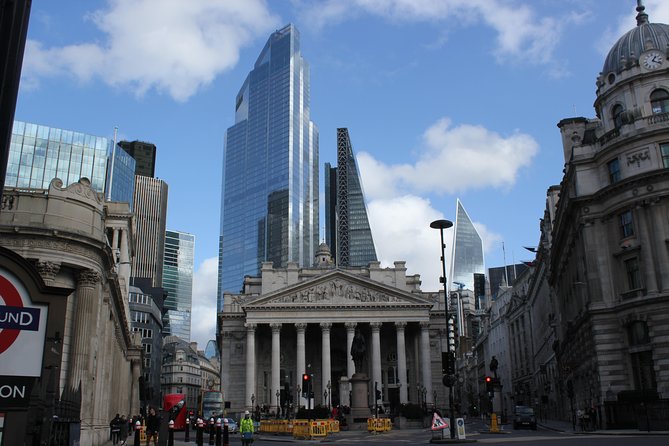
The City of London is a compact area with an unusually dense past. Roman Londinium, the Great Fire of 1666, the rebuilding led by Christopher Wren, Britain’s financial institutions, wartime memorials, and film locations all sit within a short walking route.
That density can be confusing on your own. A modern office tower may occupy a site with Roman roots, while a narrow lane may lead to a church rebuilt after the Great Fire. I like this tour because the guide supplies the connections. You are not simply ticking off St. Paul’s, London Bridge, and the Tower. You are learning how the City changed after fire, flood, war, redevelopment, and shifts in trade.
The route also gives you a good first look at London before you decide which places deserve a longer visit. You can return later to the Tower of London, enter St. Paul’s Cathedral, explore HMS Belfast, or spend more time around the Thames.
The meeting point is The Monument at 18 Fish Street Hill, London EC3R 6DB. The walk finishes outside St. Paul’s Cathedral in St. Paul’s Churchyard. A central start and a clear end point make this practical for a first or second day in London. Hotel pickup can be requested, although the supplied details do not specify where pickup is available or whether it costs extra.
More Walking Tours in London
- Tour for Muggles The Ultimate Harry Potter Walking Tour in London
★ 5.0 · 4,684 reviews - London Jack The Ripper Guided Walking Tour
★ 5.0 · 3,131 reviews - Changing of the Guard Guided Walking Tour in London
★ 5.0 · 1,793 reviews
Trinity Square and the wartime story of London’s port
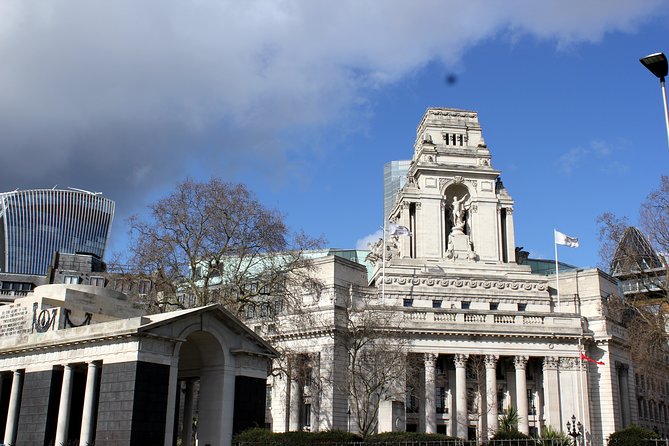
The tour includes Trinity Square, where you can view 10 Trinity Square, the former home of the Port of London Authority. The building dates from a period when London was one of the world’s busiest ports, so this is a useful place to consider the city as a trading and shipping center rather than only a royal capital.
The site also hosted the United Nations’ inaugural reception, giving the building a place in modern international history. Your guide can connect that diplomatic episode with the much older work of the port, which brought food, fuel, materials, and goods into Britain.
Nearby, the Merchant Navy memorial honors sailors who suffered heavy losses during the First and Second World Wars. This stop adds a sober note early in the walk. It also explains why merchant shipping mattered to Britain’s survival and still matters to the country’s supply network.
Outside the Tower of London
The Tower of London is one of the route’s major visual highlights, but you will not go inside. That is important to understand before booking. The guide instead explains how the Tower served as a royal palace, prison, execution site, and secure home for the Crown Jewels.
The stories here range well beyond the usual Tudor drama. You hear about the Tower’s links to London Zoo, the imprisonment of the Kray Twins, and Rudolf Hess, deputy to Adolf Hitler, who was held there during the Second World War.
I see this stop as a preview rather than a replacement for admission. If you want the Crown Jewels, the medieval interiors, and a longer look at the fortress, plan a separate visit. If your schedule is tight, the outside explanation gives you useful context without using up several hours inside.
St. Dunstan in the East, a church turned garden
St. Dunstan in the East is one of the best stops for photographs and atmosphere. The site began as a 12th-century church, and its tower was later added by Sir Christopher Wren in the late 17th or early 18th century.
Bomb damage left the church in ruins, and the remains now form a public garden. Ivy, stone arches, and open sky give the place a very different feel from the surrounding offices. The stop lasts about 20 minutes and is free.
This is also a good lesson in London’s repeated rebuilding. Fires, floods, and bombings altered the City again and again. Instead of treating the ruins as a decorative backdrop, your guide explains how each disaster changed the shape of London.
A completely different sort of day out:
- Stonehenge, Windsor Castle, and Bath from London
★ 4.5 · 18,662 reviews - London Big Bus Hop-On Hop-Off Tour with Optional River Cruise
★ 3.5 · 10,803 reviews - London Small Group Tour of Historical Pubs
★ 5.0 · 10,422 reviews - Stonehenge, Windsor Castle and Bath with Pub Lunch in Lacock
★ 4.5 · 7,402 reviews
Leadenhall Market and Roman Londinium
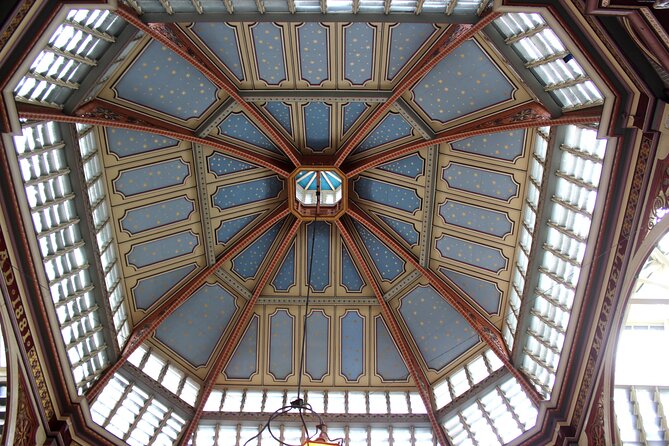
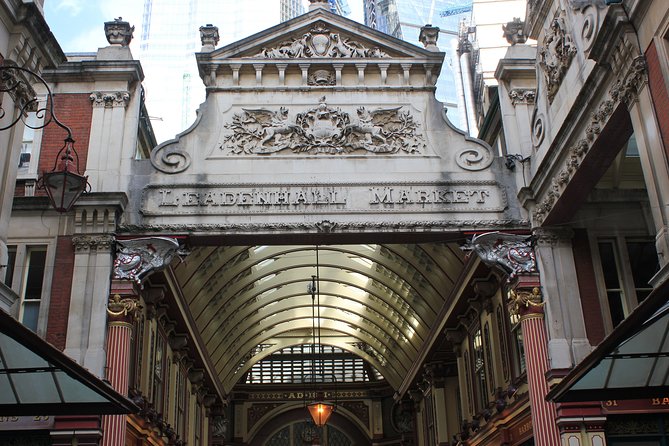
Leadenhall Market occupies the site associated with the Roman Forum of Londinium. The market’s name comes from the lead roof that once covered the hall, while its current Neo-Gothic design reflects Victorian London.
Sir Horace Jones created the market’s ornate look, with strong crimson, green, gold, and silver decoration. The result feels theatrical, and it is easy to understand why the market appeared in Harry Potter and the Philosopher’s Stone.
The guide also explains how the market was used over time. This makes the stop more useful than a quick photo break. You see a working urban site shaped by Roman planning, Victorian design, and modern popular culture. Admission is free, and the visit lasts about 20 minutes.
London Bridge, Tower Bridge, and the Thames
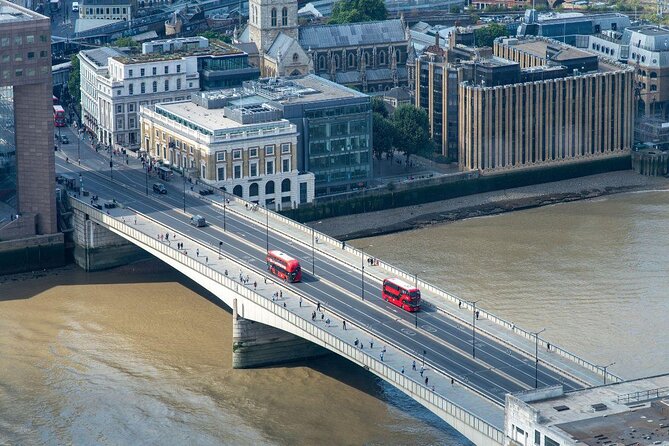
London Bridge has a long and complicated story. For centuries it was the only bridge across the Thames in London, and an early pontoon version helped the Romans invade Britain.
The guide also explains the theory that the 18th-century bridge influenced Britain’s custom of driving on the left. It is an unusual detail, the sort of story that helps you remember a place after the tour ends.
From the bridge area, you receive broad views along the Thames. These include the Tower of London, Tower Bridge, and HMS Belfast, the former Royal Navy cruiser that served during the D-Day landings and the Korean War.
The stop lasts about 10 minutes, so do not expect a full visit to HMS Belfast or Tower Bridge. Instead, use this as a visual orientation. Your guide explains why HMS Belfast belongs to the UK’s Historic Fleet, while the river gives you a clear sense of how closely London’s trade, defense, and growth depended on the Thames.
The Monument and the rebuilding after 1666
The Monument to the Great Fire of London commemorates the fire of 1666 and the rebuilding that followed during the reign of Charles II. The guide covers why the fire spread, the conspiracy theories attached to it, and the practical problems Christopher Wren faced when trying to rebuild the City.
This stop is especially valuable because the rebuilding was not as simple as replacing wooden buildings with stone ones. Property lines, ownership, money, streets, and competing interests all made the work difficult.
You also learn a famous nursery rhyme connected to the Great Fire. The stop lasts around 10 minutes. It is brief, but the subject gives you a framework for understanding many later churches and streets on the route.
St. Magnus the Martyr and the old bridge
St. Magnus the Martyr was rebuilt after the Great Fire under the supervision of Christopher Wren. The church is also linked to Charles Dickens, who included it among the City churches mentioned in Oliver Twist.
The interior is the main reason to pause here. The church contains a replica of the old London Bridge, showing how cramped and difficult the former crossing was to navigate. That model makes the bridge’s past easier to picture than a plaque or a date alone.
With about 20 minutes here, the stop has enough time for the church’s design and the bridge replica to register. As with other churches on the walk, access can depend on opening arrangements, so the guide’s explanation remains the reliable part of the visit.
The London Stone and Oxford Court
The London Stone is easy to miss. It is now kept behind glass, but it has attracted attention for at least 500 years. The stone was associated with the center of Roman Londinium, where public announcements and important celebrations took place.
Later stories claimed it was connected with King Arthur and Excalibur. Another old belief held that London’s prosperity depended on keeping the stone safe. These legends show how ordinary objects can gather meaning over time.
The stop takes about 10 minutes. I like it because it rewards attention rather than size. You would probably walk past without a guide pointing it out.
Oxford Court marks another lesser-known story. The site once held St. Swithin’s Church, where the wife of Edmund Mortimer, daughter of the last Welsh Prince of Wales, Owain Glyndwr, was held with her children until her death in 1413.
Today, a memorial garden occupies the area. The guide uses this quiet site to explain how London drew people from across England, Wales, Scotland, Ireland, and beyond. The supplied details do not give a separate time allowance for this stop, so expect it to be a short explanation along the route.
Mansion House, the Royal Exchange, and the Bank of England
Mansion House is the official home of the Lord Mayor of London. Its Georgian exterior is considered one of the finest in the city, although the interior is not open to the public on this tour.
The building also matters to modern British finance. The Chancellor of the Exchequer gives the annual Mansion House speech here, linking the old ceremonial building with current economic policy.
From Mansion House, you can view the Royal Exchange. Elizabeth I opened the original exchange, which became one of the world’s oldest stock exchanges. It is also described as one of the oldest shopping centers still operating, an interesting reminder that trade and retail have long shared this part of London.
The Bank of England follows naturally. The guide discusses its role as Britain’s central bank and the huge quantity of gold held in its vaults. You also hear how the vault was accidentally broken into and how old and modern security systems work together.
The Bank stop lasts only about five minutes, so expect a compact explanation rather than a long financial lecture. That is probably the right pace on a walking tour. The value comes from seeing the institutions in their real setting.
Ye Olde Watling and One New Change
Ye Olde Watling is a 17th-century pub associated with the builders who worked on nearby St. Paul’s Cathedral. Local tradition connects the building with Christopher Wren and suggests that he used a room there for drawing.
The pub is said to have been built by Wren, which would make it one of the few public houses linked to Britain’s best-known architect. The stop lasts roughly 10 minutes and adds an everyday setting to the grander churches and financial buildings.
One New Change provides a useful modern contrast. This shopping center sits close to St. Paul’s, and its free rooftop terrace gives views of the cathedral, The Shard, Tate Modern, Shakespeare’s Globe, and the Thames.
Allow about 15 minutes here. It is the best planned photo opportunity on the walk, and your guide will take a group picture if you want one. Since the terrace is free, you can also return later for another look, provided access is available.
The College of Arms and the final approach to St. Paul’s
The College of Arms is the world’s oldest heraldic college. Founded by Richard III, it researches family lines and creates coats of arms for new members of the British aristocracy.
The guide explains how new coats of arms are produced and points out the building’s role in On Her Majesty’s Secret Service. Nearby streets have also appeared in James Bond, Doctor Who, Mission: Impossible, and Harry Potter productions.
This stop lasts about 10 minutes. Film connections are a bonus, but the heraldic work is the more unusual subject. You get a look at an institution that many people pass without understanding.
The walk ends outside St. Paul’s Cathedral, designed by Christopher Wren. You see the cathedral from the exterior, but admission is not included. That makes the ending visually satisfying while leaving you free to return for the interior, crypt, galleries, and other paid areas on your own schedule.
Price, pace, and practical value
The price is $171.09 for a private group of up to 15 people. For a full group, that works out to less than $12 per person, which is strong value for three hours of personal guiding. For two people, the per-person price is much higher, but the private format still offers flexibility and direct access to the guide.
The tour is booked an average of 46 days in advance, so you should not leave it until the last moment if the timing matters to you. Morning and afternoon departures offer useful choice, especially if you want to pair the walk with a separate Tower of London or St. Paul’s visit.
Wear comfortable shoes and expect a moderate level of physical effort. Service animals are allowed, and the route is near public transportation. The mobile ticket is convenient, and confirmation is provided when you book.
Free cancellation is available up to 24 hours before the start time. Changes or cancellations inside that window are not accepted for a refund.
Who should book this walking tour?
I would recommend it to first-time London visitors who want to understand the City quickly, families who need a guide to keep several generations interested, and small groups that value private attention.
It is also a good choice if you have already seen central London’s major royal sights and want a closer look at Roman Londinium, the Great Fire, Wren’s churches, British finance, and wartime connections.
You should choose something else if your main goal is to spend time inside the Tower of London or St. Paul’s Cathedral. Those sites require separate admission and more time. This walk shows you where they fit into the City and gives you the background to make a later visit more rewarding.
FAQ
How long is the private City of London walking tour?
The tour lasts approximately three hours.
How many people can join the private tour?
The private group can include up to 15 people.
Where does the tour start?
The meeting point is The Monument, at 18 Fish Street Hill, London EC3R 6DB.
Where does the tour finish?
The walk finishes outside St. Paul’s Cathedral in St. Paul’s Churchyard, City of London, London EC4M 8AD.
Are admission tickets to the Tower of London and St. Paul’s Cathedral included?
No. The tour views both major landmarks from outside, and admission to St. Paul’s Cathedral is not included.
Can I cancel the tour for a full refund?
Yes. You can cancel at least 24 hours before the experience start time for a full refund. Cancellations or changes made less than 24 hours before the start time are not accepted.
Just added in London
- Private Tour: Royal High Tea At Kensington Palace Gardens★ 5.0 · 39 reviews
- Private Tour: Personal Travel Photographer Tour in London★ 4.5 · 27 reviews
- London East End Private Walking Food Tour – Secret Food Tours★ 5.0 · 26 reviews
- Private Tour: Night Photography Tour in London★ 5.0 · 48 reviews
- London Like a Local, Private & Personalized (2-3 hrs)★ 4.5 · 11 reviews
- British Museum & National Gallery of London – Exclusive Guided Combo Tour★ 5.0 · 48 reviews
- Private Tour: Tower of London and St Paul’s Cathedral★ 5.0 · 1 review
- London Soho District – Exclusive Guided Walking Tour★ 5.0 · 2 reviews
City Tours, compared.


Liverpool City Sights Hop On Hop Off City Tour – 24hr Ticket
Read our review →
1.5-hour Oxford City and University Walking Tour
Read our review →
City Sightseeing London Hop-On Hop-Off Bus Tour & Bookable Extras
Read our review →
City Sightseeing Oxford Hop-On Hop-Off Bus Tour
Read our review →
Browse the lists this tour appears in