
Reviewed · CYCLING TOURS
Oxford Bike and Walking Tour
Oxford rewards slow travel. This tour adds two wheels.
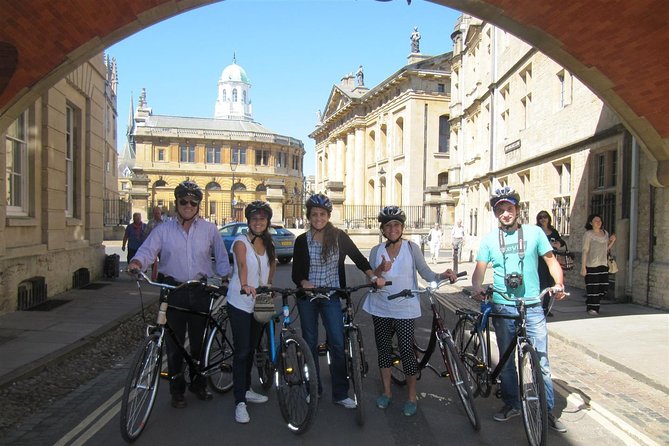
The Oxford Bike and Walking Tour combines college courtyards, medieval streets, and bicycle paths in one three-hour outing. I like the useful mix of walking and cycling, and I like the way the tour connects famous buildings with people such as Tolkien, C.S. Lewis, Oscar Wilde, and Albert Einstein. The main drawback is that the experience asks for a moderate amount of walking and biking, and equipment quality may vary.
I also like the small group size, capped at nine people, which gives you a better chance to ask questions and request a focus on subjects such as Harry Potter or Oxford’s literary past. Guides Tim and Spencer have earned especially warm praise for their humor and personal knowledge of the city. Still, rain can make the cycling less pleasant, and one report described a bike without gears, a faulty bell, and no helmet.
In This Review
- Key points to know before booking
- Why Oxford works so well on foot and by bike
- The opening walk through Oxford’s colleges
- Balliol, Trinity, and the people behind the buildings
- Cycling to Radcliffe Square and the Narnia Door
- Literary Oxford and the Eagle and Child
- Port Meadow, Oxford’s ancient open ground
- What the price includes, and where value depends
- Bikes, weather, and the practical side
- Who should book this Oxford tour?
- Should you book the Oxford Bike and Walking Tour?
- FAQ
- Where does the Oxford Bike and Walking Tour start?
- How long does the tour last?
- Where does the tour finish?
- Is the bicycle included?
- How large is the group?
- Does the tour enter the Bodleian Library?
- Is Christ Church included?
- How physically demanding is the tour?
Key points to know before booking
- Two ways to see Oxford: Walk through the central colleges, then cycle to Radcliffe Square, Magdalen, Jericho, and Port Meadow.
- Bodleian Library access: The tour includes a visit inside the Bodleian Library, with the Divinity School included when available.
- Strong literary connections: See the Eagle and Child pub, Exeter College, Magdalen College, and the Narnia Door.
- Small-group format: The maximum group size is nine people, a useful advantage on narrow streets and inside historic sites.
- Moderate physical effort: Expect about three hours of walking and cycling, with comfortable shoes and reasonable fitness needed.
- Weather matters: Poor weather can cancel the tour, while rain may make the bike portion less enjoyable.
Why Oxford works so well on foot and by bike
Oxford is compact, but its sights are spread across a maze of lanes, college entrances, squares, museums, and river-side paths. A walking tour handles the tight medieval center well. A bicycle then lets you cover more ground without turning the afternoon into a march.
The tour begins at 10:00 a.m. at 15 Broad Street, close to the center of Oxford. You meet your professional guide there, start on foot, and return to the same general meeting point at the end. The bike is provided for the tour only, so you cannot keep it for independent sightseeing afterward.
The format matters. Oxford’s most famous college buildings are often best understood from close range, where a guide can point out details in stonework, gates, ceilings, and courtyards. Cycling works better for the wider circuit, including Magdalen College, the Botanic Garden, the Examinations Schools, Jericho, and Port Meadow.
With only nine people, you should find it easier to hear the guide and keep the group together. It also creates room for questions. If Tolkien, C.S. Lewis, or Harry Potter interests you, tell the guide early. The tour specifically aims to adapt its commentary to the group when possible.
More Walking Tours in Oxford
- Oxford University Walking Tour With University Alumni Guide
★ 5.0 · 6,905 reviews - 1.5-hour Oxford City and University Walking Tour
★ 4.5 · 1,383 reviews - Harry Potter Walking Tour of Oxford Including New College
★ 4.5 · 930 reviews
The opening walk through Oxford’s colleges
The first section introduces the University of Oxford and its long institutional story. Oxford’s university tradition reaches back roughly 1,000 years, but this is not simply a parade of old stone buildings. Each college has its own foundation date, customs, famous pupils, and architectural character.
New College is one early stop. Its formal name is the College of St Mary of Winchester, and it was completed in 1386. The word new helped distinguish it from the older college of St Mary, now known as Oriel College. You may spend about 10 minutes here, likely learning more from the guide than from a quick photograph outside.
The route then reaches the Radcliffe Camera, Oxford’s most familiar postcard view. Its name can confuse first-time visitors. Camera means room, not photographic camera, and the building functions as a reading room for the Bodleian Library. You get about 10 minutes to take in the circular building and surrounding Radcliffe Square.
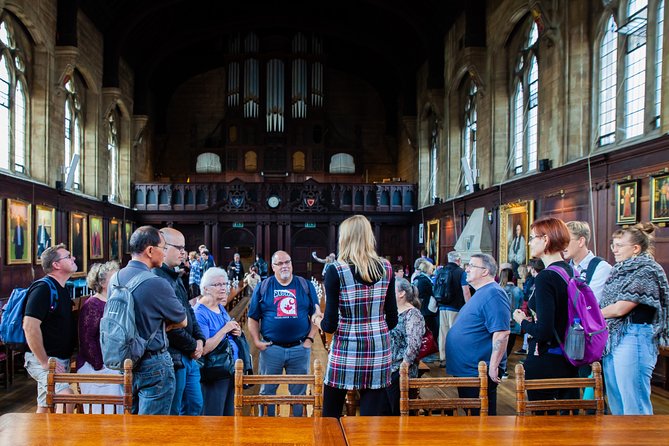
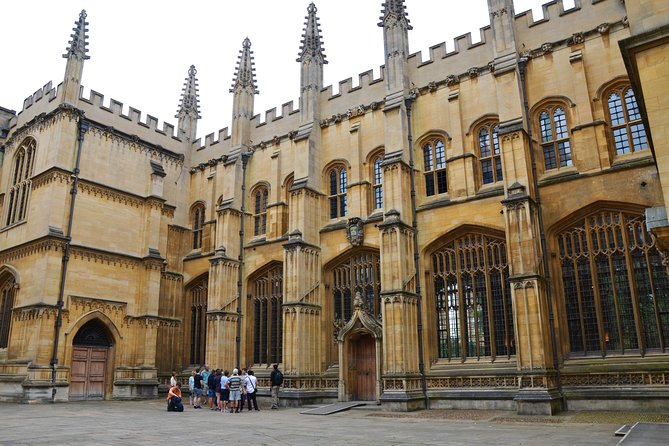
The Bodleian Library provides one of the tour’s strongest historical moments. Founded in 1602, it now holds more than 12 million books and documents, including material reaching back to ancient Egypt. The visit puts Oxford’s academic identity into focus: this is not just an attractive university with clever traditions, but a working center of study and research.
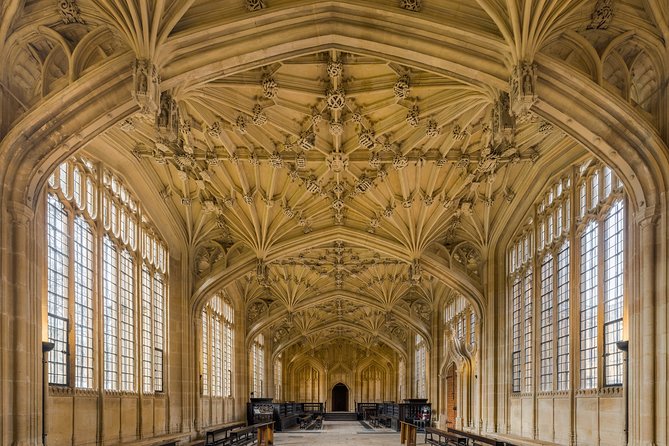
The Divinity School may be included, depending on availability that day. Its rib-vaulted ceiling is one of Oxford’s finest interior features, and this is the sort of detail that can justify taking a guided tour rather than simply walking past college gates.
Balliol, Trinity, and the people behind the buildings
Balliol College is often argued to be Oxford’s oldest college. That claim comes with the usual Oxford qualifications, but it gives the guide an opening to explain how the university grew through separate colleges rather than one unified campus.
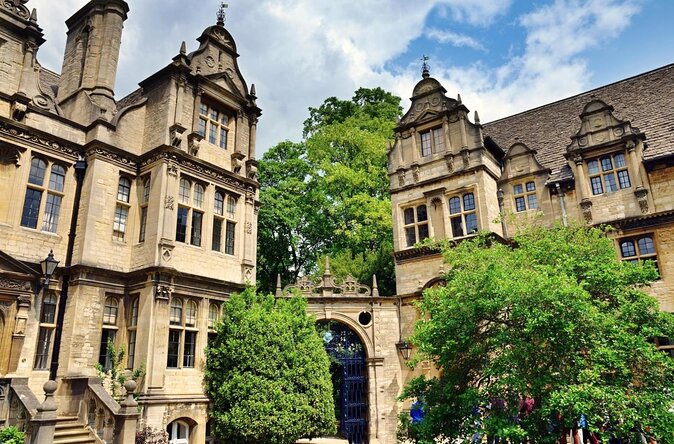
Trinity College follows, founded in 1555. It is noted for its attractive buildings and grounds, though the stop may be an exterior viewing rather than a full interior visit. The itinerary includes many colleges in this way, so you should not assume every named college offers entry.
Rhodes House adds a different layer. It was built as a memorial to Cecil Rhodes and is associated with Rhodes Scholars. The stop also connects Oxford with Albert Einstein, who gave a series of lectures in Oxford.
Pitt Rivers Museum is another worthwhile landmark on the route. Founded in 1884, it is known for unusual collections from around the world. The tour allows only around 10 minutes here, so think of this as an introduction rather than a museum visit. If you enjoy objects with strange, surprising, or far-flung origins, mark it for a longer return visit.
St John’s College is associated with Tony Blair and is described as Oxford’s wealthiest college. All Souls College brings a more exclusive academic tradition, along with links to T.E. Lawrence, often called Lawrence of Arabia. Exeter College, founded in 1314, connects directly to J.R.R. Tolkien, who studied there.
This run of stops can feel dense with names and dates. That is where the guide’s style matters. Tim is described as friendly, funny, and well informed about Oxford, with the added advantage of having been born and raised in the city. Spencer is also praised for handling questions and keeping the tour conversational.
Cycling to Radcliffe Square and the Narnia Door
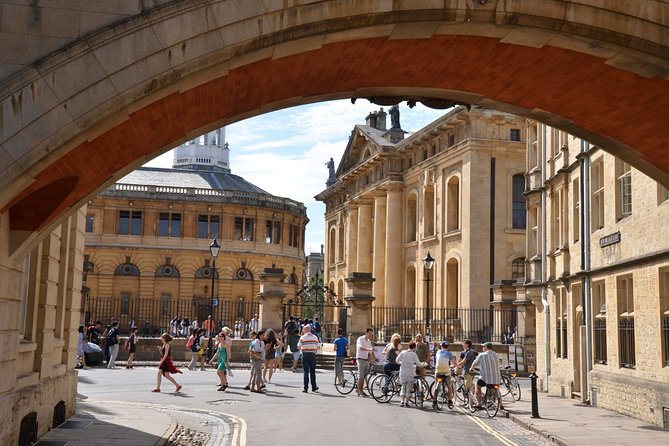
After the walking portion, you get on a bike and see Oxford from a wider angle. The exact cycling sequence can vary, but Radcliffe Square is a central highlight. You see the Radcliffe Camera again, this time as part of the city’s larger pattern of colleges, lanes, and open spaces.
The tour also points out unusual gargoyles and the Narnia Door, said to have inspired the entrance in C.S. Lewis’s The Lion, the Witch and the Wardrobe. The detail is a good example of Oxford’s appeal: real architecture and literary imagination sit side by side, and the guide helps you separate established fact from local association.
Magdalen College is another major stop. Founded in 1458, it is one of Oxford’s largest colleges and is known for substantial grounds and a deer park. It is linked with both C.S. Lewis and Oscar Wilde. You also get views toward the University of Oxford Botanic Garden, founded in 1621 and recognized as the oldest botanic garden in Great Britain.
One particularly good possibility comes from the guide. Tim was able to take a group into Magdalen College, his own college, even in rainy weather. That kind of access cannot be promised, but it shows the value of having a local guide with a personal connection to the university.
The route continues past the Examinations Schools, where you learn about Oxford’s entrance exams and academic traditions. Hertford College, known for a more progressive outlook, offers a useful counterpoint to the stereotype of Oxford as frozen in the past.
The Blavatnik School of Government supplies a modern architectural contrast. Founded in 2010, it is a school of public policy and a reminder that Oxford is still expanding and changing.
A completely different sort of day out:
- Oxford Official University & City Tour
★ 5.0 · 1,134 reviews - City Sightseeing Oxford Hop-On Hop-Off Bus Tour
★ 4.5 · 1,042 reviews - Oxford Sightseeing River Cruise Along The University Regatta Course
★ 4.5 · 652 reviews - Afternoon Tea Sightseeing River Cruise in Oxford
★ 5.0 · 583 reviews
Literary Oxford and the Eagle and Child
The Eagle and Child pub is one of the tour’s most appealing literary stops. It was a regular meeting place for C.S. Lewis and J.R.R. Tolkien, who gathered there to discuss their writing.
You should not expect a full literary lecture here, but the setting gives the stories a physical anchor. Tolkien and Lewis were not just names attached to book covers. They studied, taught, walked, ate, and argued in the same city you are exploring.
Exeter College strengthens the Tolkien connection. Magdalen adds C.S. Lewis and Oscar Wilde. The Narnia Door adds a touch of literary folklore. For anyone interested in Oxford’s writers, these stops form a satisfying thread through the tour.
If your main goal is Harry Potter, Christ Church is the important stop. It is nearly 500 years old and has a strong connection with the films. It is also one of Oxford’s most visited attractions, so you should expect a more popular, less quiet atmosphere than at some smaller college stops.
The tour can include Christ Church as part of the walking section, but entry conditions and availability can affect what you see. The same practical rule applies to the Bodleian Library and Divinity School: the experience includes stated admissions, but historic colleges sometimes control access on the day.
Port Meadow, Oxford’s ancient open ground
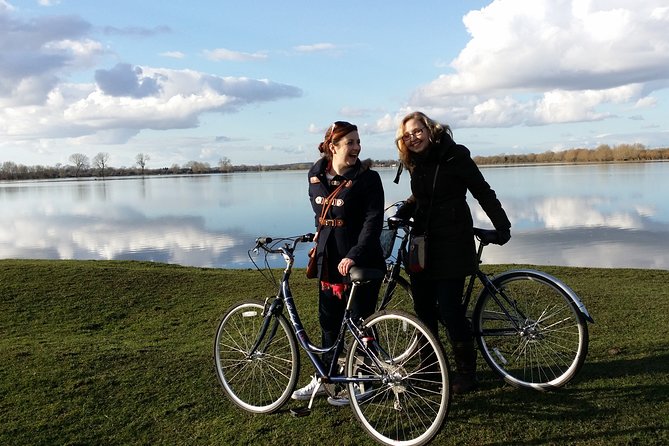
The cycling portion eventually reaches Jericho and Port Meadow. This shifts the mood from college architecture to open common land.
Port Meadow is ancient grazing land still used by horses and cattle. According to local tradition, it has never been ploughed for around 4,000 years. The tour calls it Oxford’s oldest monument, a useful reminder that the city’s story is not limited to scholars, libraries, and grand quadrangles.
You get around 15 minutes here, enough to see why the area matters and take a break from the denser center. This is also where the bike becomes especially useful. Walking from the central colleges to Port Meadow and back would take more time and energy.
The route through Jericho and the meadow may be especially appealing if you want a less formal side of Oxford. It gives the tour some breathing room after the succession of college names and architectural details.
What the price includes, and where value depends
The listed price is $68.53 per person. For about three hours, that is reasonable if you value guided access, local storytelling, and the convenience of having a bike supplied for the longer circuit.
The price includes the professional guide, taxes, fees, and use of the bike during the tour. Entrance fees are also included in the tour description, though several college stops are listed as admission not included or may be viewed from outside. In practical terms, you are paying for selected access rather than a pass allowing entry to every college named along the route.
The strongest value comes from combining several kinds of sightseeing:
- A guided introduction to Oxford’s university and architecture
- Entry to the Bodleian Library and, when available, the Divinity School
- A bicycle for the longer route to Magdalen and Port Meadow
- Literary connections involving Tolkien, C.S. Lewis, Wilde, and Harry Potter
- A small group limited to nine people
If you plan to enter many colleges or spend serious time at Pitt Rivers or the Ashmolean Museum, you may need separate visits after the tour. The 10-minute stops at museums are useful for orientation, not enough for a proper museum visit.
Bikes, weather, and the practical side
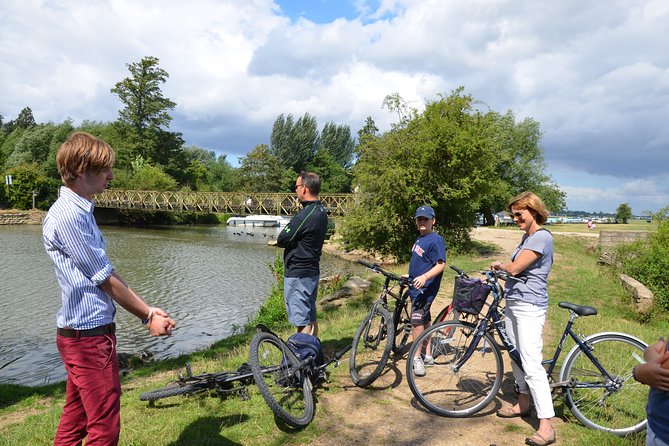
You need a moderate level of fitness. The tour includes a moderate amount of walking and biking, so comfortable shoes are important. You should also be ready for some stop-and-start cycling in an urban setting.
Equipment is worth checking before setting off. One person received a bike without gears and with a bell that did not work, and a helmet was not provided in that account. Another person found an older bike manageable until a hill. These reports do not prove every bike has a problem, but they give you a sensible tip: inspect the bike, ask about the brakes and gears, and speak up immediately if something feels unsafe.
Weather can shape the experience. Several people enjoyed the tour despite rain because Tim kept the history lively and amusing, but wet cycling is still less comfortable than dry cycling. The activity requires good weather and may be canceled if conditions are poor. In that case, you are offered another date or a full refund.
The tour usually sells about eight days ahead, so advance planning is sensible. Confirmation arrives at booking, and the activity runs near public transportation. It is non-refundable if you cancel or request a change, so book only when your plans and the forecast are reasonably firm.
Who should book this Oxford tour?
I would choose this tour if you want a first look at Oxford that mixes major sights with local stories. It suits readers who like architecture but do not want three hours of standing in one place, and it works well for people who want to connect the university with Tolkien, C.S. Lewis, or Harry Potter.
It is also a good fit for a small family group or friends who prefer questions and conversation over a fixed speech. The nine-person limit is useful, and guides such as Tim and Spencer appear to add warmth and humor to the historical material.
I would hesitate if you dislike cycling, need a fully predictable indoor itinerary, or want long visits inside museums and colleges. The route is active, weather-dependent, and partly shaped by access on the day. Anyone hoping to explore the Ashmolean or Pitt Rivers properly should plan extra time afterward.
At 93 percent recommended and a 4.7 rating from 27 reviews, the overall record is strong. The praise centers on the guides, the combination of sights, and the fun of seeing Oxford by bike. The main cautions are the weather and the possibility of an older or poorly equipped bicycle.
Should you book the Oxford Bike and Walking Tour?
Book it if you want an efficient, story-led introduction to Oxford and like the idea of covering more ground by bicycle. The Bodleian Library, Radcliffe Camera, Christ Church, Magdalen College, literary landmarks, and Port Meadow give you a broad first taste of the city.
Bring comfortable shoes, check the bike before leaving, and dress for changeable weather. If you do that and accept that college access can vary, the tour offers good value and a lively way to get your bearings before exploring Oxford at your own pace.
FAQ
Where does the Oxford Bike and Walking Tour start?
The tour starts at 15 Broad Street, Oxford OX1 3AS, UK, at 10:00 a.m.
How long does the tour last?
The experience lasts approximately three hours.
Where does the tour finish?
The activity ends back at the meeting point in central Oxford.
Is the bicycle included?
Yes. Use of the bicycle during the tour is included, but the bike cannot be used after the tour ends.
How large is the group?
The maximum group size is nine people.
Does the tour enter the Bodleian Library?
Yes. The tour includes a visit inside the Bodleian Library. The Divinity School visit depends on availability on the day.
Is Christ Church included?
Christ Church is part of the tour route, but access to historic sites can depend on availability and conditions on the day.
How physically demanding is the tour?
A moderate amount of walking and biking is involved. Comfortable shoes are recommended, and you should have a moderate level of physical fitness.
More Bike Tours in Oxford
- Oxford Bike Tour with Student Guide
★ 5.0 · 22 reviews - Oxford Scenic Cycle Tour- 2 persons minimum summer season
★ 5.0 · 8 reviews - Cotswolds One Day Guided Cycle Tour – Private Groups
★ 5.0 · 7 reviews - London Classic Landmarks Bike Tour with Local Guide
★ 5.0 · 1,401 reviews
Just added in Oxford
- Oxford’s Famous Alumni: Self-Guided Story Puzzle Walk★ 4.0 · 2 reviews
- Undiscovered Cotswolds Private Tour★ 5.0 · 87 reviews
- Natural History Museum Tour – by Uncomfortable Oxford™★ 4.5 · 17 reviews
- History of Medicine Tour – by Uncomfortable Oxford™★ 4.5 · 8 reviews
- Tours of Oxford private walking tours for the Discerning Traveler★ 5.0 · 70 reviews
- Women and Queer Histories Tour – by Uncomfortable Oxford™★ 5.0 · 60 reviews
- Multi Day Cotswold Village Trail★ 5.0 · 1 review
- The Inklings Oxford Writers Tour – Private Groups Daily★ 5.0 · 107 reviews
Cycling Tours, compared.

London Classic Landmarks Bike Tour with Local Guide
Read our review →
London Bike Tour: Landmarks, Secret Gems, Pub Stop & Street Art
Read our review →
Highlights of Royal London Bike Tour including Hyde Park
Read our review →


Private Bike or eBike Gold Classic Tour London
Read our review →Browse the lists this tour appears in