
Reviewed · HISTORICAL TOURS
Liverpool Heritage, History, Culture Walking Tour-Shore Excursion
Liverpool reveals itself on foot.
This 2-hour-15-minute shore excursion begins inside the cruise terminal and links the waterfront, old commercial streets, maritime memorials, Beatles landmarks, and medieval corners of the city. I like the easy port meeting point and the way the route mixes major sights with less obvious details. I also like the local guides, especially Carl, Michael, Pam, and Peter, who have been praised for their stories, patience, and helpful advice. The main consideration is balance: this is a Liverpool heritage tour with Beatles content, not a dedicated Beatles tour.
You cover a fair amount of ground, roughly four miles according to one account, mostly on city streets and cobbles. Comfortable, non-slip shoes matter, and the pace may not suit anyone who finds extended walking difficult. The group can reach 20 people, so your experience may depend partly on the guide leading that particular departure.
In This Review
- Key points to know before you book
- Starting at Cruise Liverpool with no port-day guesswork
- The Titanic Memorial and Liverpool’s seafaring identity
- The Three Graces and Liverpool’s grand waterfront
- Film locations, waterfront streets, and the Beatles statue
- Royal Albert Dock and the city’s maritime rebirth
- Thomas Steers Way and a modern Liverpool photo stop
- Sailors, golden Liver birds, and the vanished castle
- Mathew Street and the Cavern Club
- Castle Street, Town Hall, and Exchange Flags
- The parish church, slavery, and the final walk back
- What $37.10 buys you on a port day
- Who will enjoy this Liverpool walking tour?
- Should you book this Liverpool shore excursion?
- FAQ
- Where does the tour begin?
- Where does the tour finish?
- How long does the walking tour last?
- Is this a dedicated Beatles tour?
- How much walking is involved?
- What is included in the price?
- Can the tour be canceled because of weather?
Key points to know before you book
- Start at the cruise terminal: You meet your guide inside Cruise Liverpool, avoiding a rushed search for a meeting point after leaving the ship.
- Four miles of city walking: The route is easy to moderate, but cobbles, busy streets, and the total distance call for sensible footwear.
- Liverpool comes before the Beatles: You see Beatles statues and Mathew Street, but the tour also covers shipping, civic buildings, wartime history, religion, and the slave trade.
- The Three Graces anchor the waterfront: The Cunard Building, Port of Liverpool Building, and Liver Building provide the clearest introduction to the city’s maritime power.
- The route ends near the port: The walk finishes at Our Lady and Saint Nicholas Church, about two minutes from the cruise terminal. Your guide can escort you back, or you can continue exploring.
- The cost is reasonable for a guided port day: At $37.10 per person, the tour gives you more than two hours of commentary without extra admission fees, though food and drinks are not included.
Starting at Cruise Liverpool with no port-day guesswork
For a cruise stop, the first practical question is often not what will I see? but how do I get there and back without worrying about the ship? This tour handles that part neatly. You meet your guide at Cruise Liverpool, at the terminal gate on 2 Princes Parade, and set off after a short introduction.
Liverpool’s cruise port does not use tenders. Passengers leave the ship by walkways into the cruise welcome area on land, which makes this a simpler shore excursion than one involving small boats or a long transfer. That direct start is especially useful if you want to use your time well but do not want to navigate an unfamiliar city alone.
The walk returns close to the same port area, though the formal ending point is Our Lady and Saint Nicholas Church. It is about a two-minute walk from the terminal, and your guide can take you back. You can also stay in town for shopping or more waterfront time, then return on your own.
Guides named in the feedback include Carl, Michael, Pam, and Peter. Carl was praised for clear storytelling, a friendly manner, and answering questions. Michael was described as enthusiastic and willing to offer suggestions after the scheduled walk. Pam made a point of finding shade and seating when the group stopped, a small detail that can make a difference on a warm day or for anyone who needs a short rest.
More History Tours in Liverpool
- A Walk Through Time: History of Liverpool Walking Tour
★ 5.0 · 911 reviews - Best Of Liverpool Heritage, History & Culture Guided Walking Tour
★ 5.0 · 539 reviews - History Guided Tour of Liverpool and the Beatles
★ 5.0 · 408 reviews
The Titanic Memorial and Liverpool’s seafaring identity
Your first sightseeing stop is the Memorial to the Marine Engine Room Heroes, often called the Titanic Memorial. It honors the engineers and firemen who kept ships moving, and it gives your guide a natural opening into Liverpool’s connection with the Titanic.
The stop is brief, about five minutes, but its value lies in context. Liverpool was closely tied to the maritime world through shipping companies, port workers, shipbuilding, and ocean travel. The Titanic did not sail from Liverpool, yet the city’s people and businesses were closely linked to the ship’s story.
You will not spend the morning inside a museum, so the guide’s explanation carries much of the weight here. If you enjoy learning how a city’s working life shaped its identity, this is a useful beginning. If you want a long, detailed Titanic presentation, you will find this portion too short.
The Three Graces and Liverpool’s grand waterfront
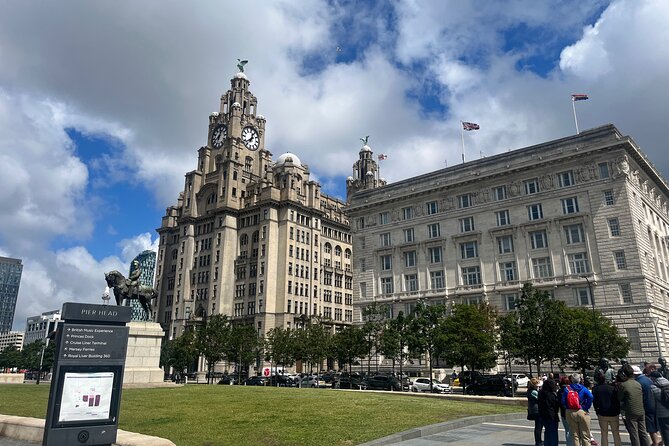
The Three Graces are the visual heart of the tour. They are the Cunard Building, the Port of Liverpool Building, and the Liver Building, a group of grand structures facing the Mersey.
Your guide explains the role and design of each building, including the Cunard connection to ocean liners and the port’s commercial importance. The Liver Building is the most recognizable of the three, crowned by its famous Liver birds. The pair has become a symbol of Liverpool, and the waterfront view makes clear why the city once projected such confidence to ships arriving from across the Atlantic.
Allow about ten minutes here. That sounds short, but the Three Graces work best as a group. You can look up at the façades, hear how the port operated, and understand the relationship between business, shipping, and civic pride without getting bogged down in architectural jargon.
Bring your camera, but keep your eyes up too. The scale of these buildings is easy to miss if you only stop for a quick photograph.
Film locations, waterfront streets, and the Beatles statue
From the Three Graces, the route follows the waterfront and nearby streets. Liverpool is often used for films and television, sometimes appearing as itself and sometimes filling in for another city. Your guide points out locations and asks you to recognize scenes and settings.
This part adds a modern layer to the older port story. Liverpool is not only a place with preserved buildings. It is also a working city used by filmmakers because its streets can suggest different periods and places.
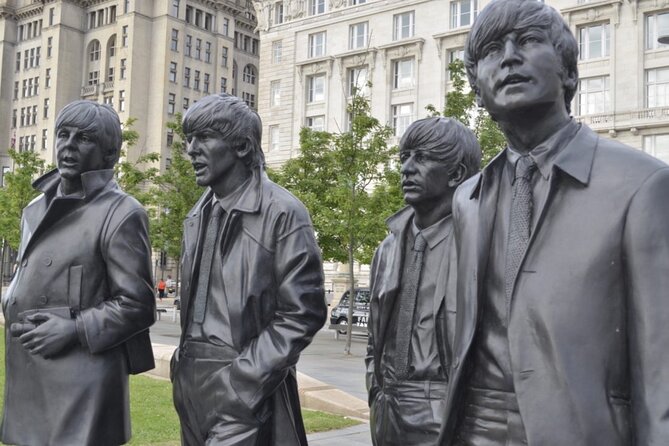
Next comes the Beatles Statue, sculpted by Andrew Edwards. It is a straightforward photo stop and a good chance to stand beside the four figures near the waterfront. Access to the statue can occasionally be restricted. If that happens, the group visits alternative statues instead, so Beatles fans should treat this as a likely feature rather than an absolute guarantee.
The Beatles material is present, but it does not take over the tour. That is good news if you want a broad introduction to Liverpool. It may disappoint you if your main aim is recording studios, childhood homes, or a detailed account of the band’s career. For that, a dedicated Beatles tour would be a better match.
More Walking Tours in Liverpool
- Liverpool Ghost Walking Tour
★ 5.0 · 862 reviews - Beatles Famous Walking Tour Of Liverpool- Fully Guided
★ 5.0 · 751 reviews - Downtown Liverpool Walking Tour – In Spanish
★ 5.0 · 591 reviews - Tales from the Necropolis – A Ghost Walk Through St. James Cemetery
★ 5.0 · 263 reviews
Royal Albert Dock and the city’s maritime rebirth
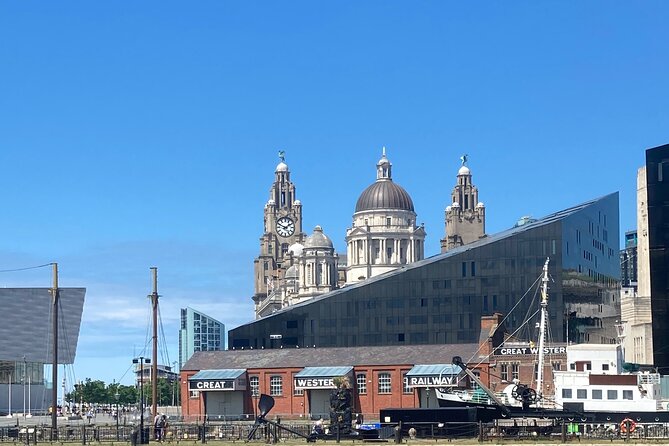
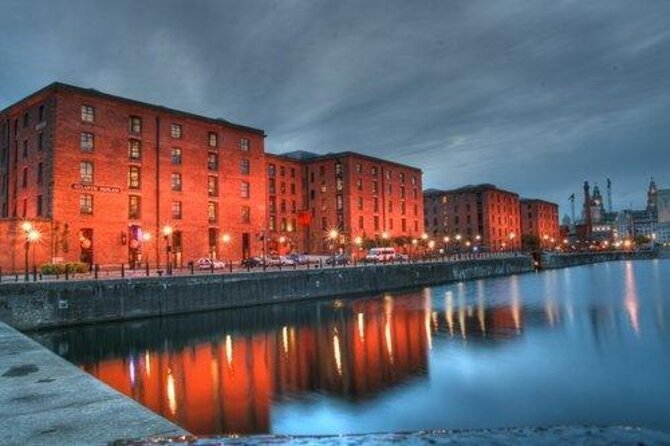
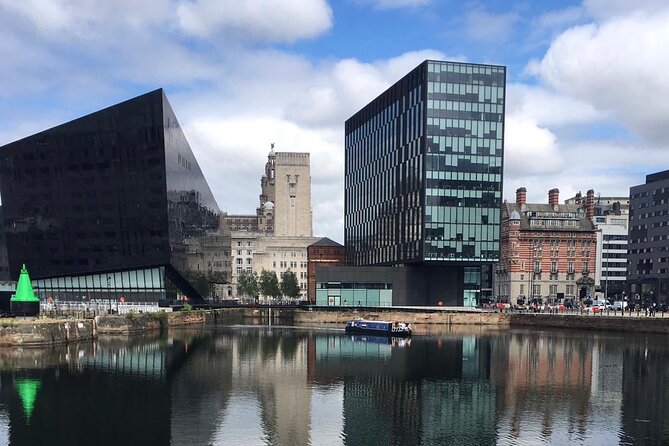
Royal Albert Dock receives about 20 minutes, making it one of the longer stops. Your guide connects the dock to Liverpool’s shipping past and to the Titanic story, then points out old and new architecture around the waterfront.
The dock is one of the best places on the route to see how Liverpool has reused its maritime spaces. Massive brick warehouses and open dockside areas now form a public district with museums, restaurants, galleries, and shops. You can sense the old working port while also seeing how the waterfront serves a different purpose today.
You will also pass the bronze statue of Billy Fury, a Liverpool-born singer. Fans have turned it into a small shrine, adding another musical thread beyond the Beatles. This is one of the tour’s useful traits: it treats Liverpool culture as wider than one famous group.
The dock area is a good place to ask questions. Guides have been praised for answering them and for sharing details beyond the most familiar facts. Still, remember that the schedule is tight. You are seeing the area with a guide, not taking a relaxed afternoon to visit its museums.
Thomas Steers Way and a modern Liverpool photo stop
At Thomas Steers Way, the tour shifts from grand warehouses and historic offices to a more contemporary public space. The site occupies the location of Liverpool’s first dry dock, and the water fountain carries a reminder of that maritime past.
There is also a quick look through a port hole, plus the large LIVERPOOL sign. Its colors change for seasons and events, making it a popular photo stop. This portion may feel less historic than the Three Graces or Castle Street, but it shows how the city presents its identity today.
One criticism in the feedback was that time spent in a major shopping area felt unnecessary. That is worth keeping in mind. The route includes modern public spaces and shopping-side streets because they connect the waterfront to the city center, but anyone seeking nonstop old buildings may find this part less rewarding.
Sailors, golden Liver birds, and the vanished castle
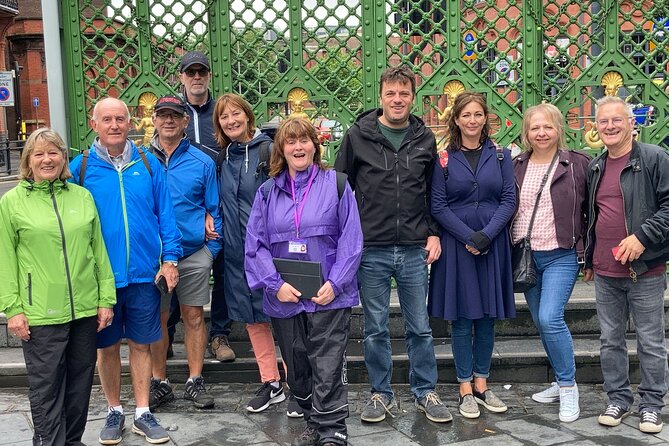
The Liverpool Sailors Home Gateway gives you another maritime memorial and a photo opportunity with a golden Liver bird. The gateway recalls the Sailors Home, which served people connected to the port.
This is a small stop, yet it helps explain that Liverpool’s seafaring story was not only about wealthy shipping firms and grand buildings. Sailors needed lodging, support, and services when they came ashore. Short stops like this give the city’s port history a human scale.
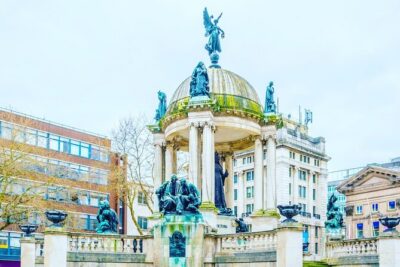
At Derby Square, your guide explains where Liverpool Castle once stood. The castle has disappeared, and Queen Victoria’s monument now dominates the square. This is a useful reminder that the city’s story reaches further back than the age of ocean liners and industrial growth.
Do not expect surviving castle walls. The value is in understanding how Liverpool developed from a medieval settlement into a major port, and how later monuments covered or replaced earlier traces.
Mathew Street and the Cavern Club
Mathew Street is the tour’s main music stop. In the Cavern Quarter, you walk through a street linked with the Cavern Club and the musicians who made Liverpool famous around the world.
You have time for a photograph outside the Cavern Club and for stories about the street’s musical past. The guide also points out other links along the route, helping you see Mathew Street as more than a single Beatles photo location.
This is likely to be one of the liveliest parts of the walk, with busy foot traffic and plenty to look at. Keep close to the group, since one guide had to spend time patiently gathering people who wandered away.
The Beatles story here works best as part of the wider city narrative. Liverpool gave the band its clubs, audiences, and early musical setting, but the street also reflects the city’s broader cultural energy. If you want a detailed musical pilgrimage, book a specialist tour. If you want a well-rounded introduction with a solid Beatles section, this stop should satisfy you.
Castle Street, Town Hall, and Exchange Flags
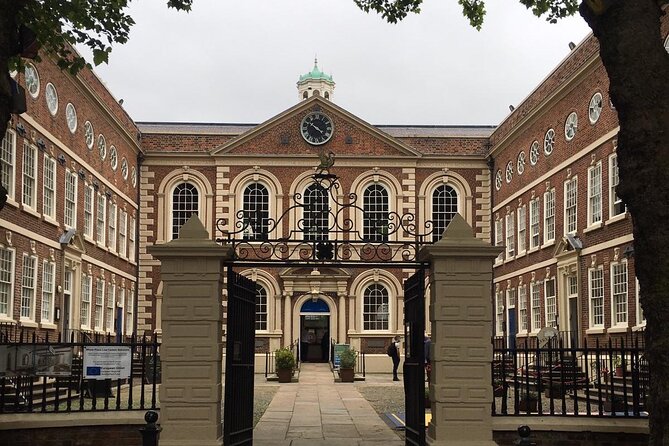
Castle Street provides a change of mood. Its buildings and layout retain a link to Liverpool’s medieval past, while later architecture frames the route toward the Town Hall.
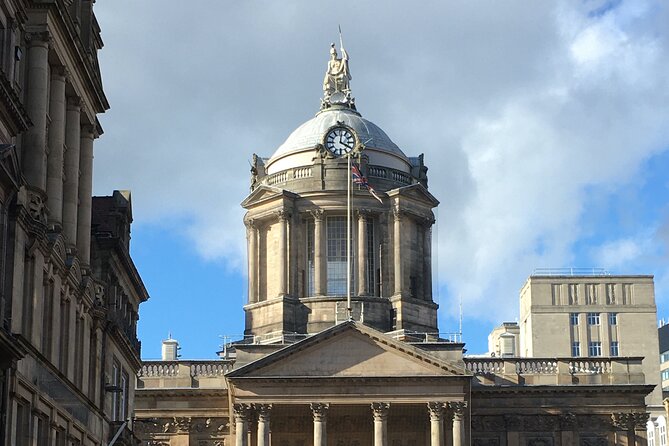
Liverpool Town Hall is a Grade I listed building, recognized as one of England’s finest surviving 18th-century town halls. Your guide also explains the story of earlier town halls dating back to the 1500s. The stop itself is brief, around five minutes, but the building gives you a strong sense of the city’s civic ambition.
At Exchange Flags, the route enters a courtyard facing the Town Hall. The area has a wartime connection, and it also contains the large bronze Nelson Monument, dating from the early 1800s.
This stretch is particularly useful if you like architecture but do not want to spend the day inside formal buildings. You see how trade, government, military memory, and public ceremony occupied the same central spaces.
The parish church, slavery, and the final walk back
The final stop is Our Lady and Saint Nicholas Church and its surrounding garden. A place of worship has occupied this site for more than 750 years, and the area includes old tombstones and sculptures.
Here, the guide also discusses Liverpool’s links to the slave trade and North American history. That subject matters because the port’s prosperity came from global trade, and a fair account of Liverpool cannot tell only the comfortable parts of the story.
The tour ends here, close to the cruise terminal. You can return with your guide or continue into the city for shopping and waterfront time. Since the walk has already covered major landmarks, this flexibility is useful. You can also use the final moments to ask for suggestions, something Michael was especially praised for doing.
What $37.10 buys you on a port day
At $37.10 per person, I consider this a sensible price for a local, fully guided walk lasting about two hours and 15 minutes. There are no entrance fees built into the route, but that is not a weakness here. The point is to understand Liverpool’s streets, buildings, monuments, and public spaces rather than rush through paid attractions.
The value comes from orientation and explanation. Without a guide, you can photograph the Liver Building, the Beatles statue, Royal Albert Dock, and Town Hall. What you may miss is how they connect: shipping created the city’s wealth, civic buildings expressed it, music reshaped its image, and modern redevelopment gave old docklands a new purpose.
The group maximum is 20 people. That is not a private tour, but it is small enough for questions if the guide keeps everyone together. The quality can vary by guide. The strongest feedback praises Carl, Michael, Pam, and Peter for clear stories, warmth, patience, and enthusiasm. One poor experience described the guide as disorganized and boring, while another felt the Beatles portion lasted too long. Those comments point to the tour’s main risk: the route is set, but the feel of the walk depends on presentation and group management.
You should carry water. No food or drink is included, and there is little reason to expect a formal refreshment stop during the walk.
Who will enjoy this Liverpool walking tour?
I would recommend it most strongly to cruise passengers visiting Liverpool for the first time, especially if you want a broad introduction without arranging transport. It also suits families with older children, Beatles fans who want more than Beatles history, and anyone who prefers buildings, memorials, and city stories to a single-subject tour.
Children under 16 must be accompanied by an adult. Service animals are allowed, and well-behaved dogs are welcome, though busy streets and group walking may not suit every dog.
You need moderate physical fitness. The walk is described as easy to moderate, but the distance, uneven surfaces, and cobbles are real factors. Wear shoes with good grip, stay with the group, and consider bringing water and a small rain layer even though the activity requires good weather.
Free cancellation is available up to 24 hours before the start time. If poor weather cancels the tour, you are offered another date or a full refund. Last-minute cancellations are not refundable, so cruise schedules and weather plans deserve attention.
Should you book this Liverpool shore excursion?
Book it if you want Liverpool in one useful sweep: the Titanic connection, Three Graces, waterfront, Royal Albert Dock, Beatles landmarks, old civic center, and churchyard history. The convenient port meeting point and close finish make it a practical choice on a limited cruise stop.
Skip it if you want an in-depth Beatles pilgrimage, museum visits, or a slow architectural tour with long stops. Also think twice if four miles of street walking sounds tiring.
For most first-time cruise passengers, the price is fair and the route gives you a strong sense of place. Just book it for Liverpool’s full story, not only for the Fab Four.
FAQ
Where does the tour begin?
It begins inside the Cruise Liverpool Cruise Terminal at the gate on 2 Princes Parade, Liverpool L3 1DL.
Where does the tour finish?
The guided walk finishes at Our Lady and Saint Nicholas Church. The church is about a two-minute walk from the cruise terminal, and the guide can escort you back.
How long does the walking tour last?
The tour lasts approximately two hours and 15 minutes.
Is this a dedicated Beatles tour?
No. Beatles sites and stories are included, including the Beatles Statue and Mathew Street, but the tour also covers Liverpool’s maritime, civic, architectural, religious, and cultural history.
How much walking is involved?
The walk is described as easy to moderate street-level walking, and one account measured the route at about four miles. You will encounter uneven surfaces and cobbles.
What is included in the price?
The price includes an experienced local Liverpool guide and a fully guided shore excursion from the cruise terminal. Food and drinks are not included.
Can the tour be canceled because of weather?
Yes. The experience requires good weather. If it is canceled because of poor weather, you can choose another date or receive a full refund.
More Shore Excursions in Liverpool
- Ultimate Beatles Ticket To Ride Shore Excursion-Small Groups
★ 5.0 · 67 reviews - Beatles Famous Walking Tour Of Liverpool-Shore Excursion
★ 5.0 · 50 reviews - Ultimate Ticket To Ride Beatles Half-Day Shore Excursion- Private
★ 5.0 · 6 reviews - Shore Excursion: Lake District Adventure Sightseeing Day Trip from Liverpool
★ 4.0 · 5 reviews
Just added in Liverpool
- Scouse Safari private 3 hour authentic Liverpool experience★ 5.0 · 2 reviews
- LIVERPOOL: Yorkshire Adventure – Sightseeing Day Trip Tour★ 5.0 · 13 reviews
- The Story of Liverpool 2-Hour Walking Tour★ 5.0 · 3 reviews
- Half Day Welcome to Liverpool Walking Tour★ 5.0 · 17 reviews
- Liverpool City Scavenger Hunt Excursion by Zombie Scavengers★ 5.0 · 1 review
- Fun, Flexible Treasure Hunt Around Liverpool with Cryptic Clues & Hidden Gems★ 5.0 · 141 reviews
- Beatles Ticket To Ride Half Day Tour Small Groups★ 5.0 · 60 reviews
- Small-Group: Experience Local Food Tour in Liverpool★ 5.0 · 32 reviews
Historical Tours, compared.
Shadows of York: Ghost Walk and Horrible History.
Read our review →
A Walk Through Time: History of Liverpool Walking Tour
Read our review →
Royal Historic Pubs Walking Guided Tour in London
Read our review →
Private Group: Historical Pub Walking Tour of London
Read our review →
Best Of Liverpool Heritage, History & Culture Guided Walking Tour
Read our review →Browse the lists this tour appears in