
Reviewed · STREET ART
Guided Tour of Street Art in Birmingham
Look up, Birmingham has stories on its walls. This 5km street-art walk leads you from the canals near the Eagle & Ball into Digbeth, the city’s main street-art district, with stops for murals, local artists, social causes, and Birmingham’s changing creative scene. You can also choose a faster 1.5-hour run instead of the roughly two-hour walk.
I like the focus on home-grown artists and the way the tour connects murals to real events, from the Banksy work that appeared in 2019 to a piece created during Black History Month. I also like the route itself: canals, old industrial buildings, car parks, creative venues, and the Custard Factory give you more than a parade of painted walls.
The main drawback is the fixed, non-refundable booking policy. The tour also needs good weather and a minimum number of participants, so you should keep your plans flexible. At $54.74 per person, the value depends on how much you want the stories and local context, rather than simply seeing the art.
In This Review
- Key points to know before you book
- Why Birmingham’s street art deserves a closer look
- Meeting at the Eagle & Ball and following the canals
- Digbeth: the main stage for Birmingham street art
- The Lock Keepers Cottage and a female Birmingham artist
- Meeting Pongo the orangutan on Lower Trinity Street
- The Custard Factory and the argument over public art
- Suki10c, Black History Month, and public memory
- What the $54.74 price buys you
- Walk or run: choosing the right version
- Weather, group size, and the booking decision
- Who will get the most from this tour
- Should you book the Birmingham street-art tour?
- FAQ
- Where does the tour begin?
- Where does the tour finish?
- How long is the street-art tour?
- How far do you travel?
- Can I choose between walking and running?
- What places are included on the route?
- Is admission included at the stops?
- What happens if the weather is poor?
Key points to know before you book

- A 5km route through Birmingham’s art districts: You walk from the canalside to Digbeth and finish back at the Eagle & Ball.
- A choice of walking or running: The walk takes about two hours, while the run takes around 1.5 hours.
- Local artists get the attention: The tour looks closely at Birmingham artists and the ideas behind their work.
- Social issues are part of the story: Expect discussion of animal rights, Black History Month, young Black creatives, and the public response after George Floyd’s murder.
- A small-group format: The maximum group size is 25 people, which should make it easier to hear the guide and ask questions.
- A practical but strict booking policy: Confirmation arrives at booking, but cancellations and changes are not refundable.
Why Birmingham’s street art deserves a closer look
Birmingham’s street art is not limited to one painted alley. It appears along canals, beside old industrial buildings, in car parks, and around creative venues. That spread is one reason a guided route helps. You are not just looking at a wall. You are learning why it was painted there and what the artist wanted it to say.
The tour begins with the local story of graffiti and street art. That opening matters because it puts Birmingham first. The discussion of the Banksy mural that appeared in the Jewellery Quarter in 2019 is used as a doorway into a larger point: Birmingham had an active street-art culture long before a famous name arrived.
I like that angle. A Banksy sighting can pull people in, but it should not swallow the local scene. Here, the focus remains on Birmingham and the artists who work there.
The art is also described as ever-changing. You should expect a city where murals can be painted over, altered, or replaced. That makes the experience less like visiting a fixed gallery and more like taking a snapshot of a living part of Birmingham.
A few more to weigh up in Birmingham
- Entry ticket to Hoo Zoo and Dinosaur World in Telford
★ 5.0 · 591 reviews - Cadbury World Entry Ticket
★ 3.0 · 524 reviews - Birmingham Walking Tour: Canals, Victorians & Today (1:30pm)
★ 5.0 · 346 reviews
Meeting at the Eagle & Ball and following the canals
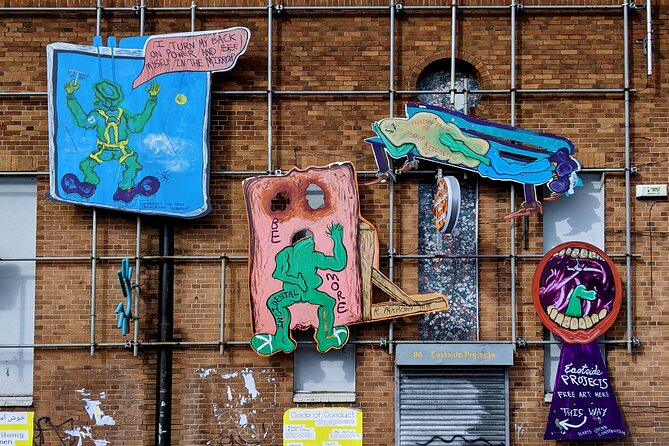
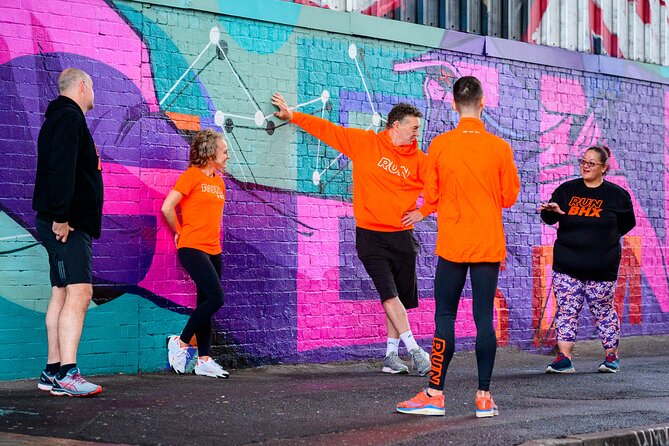
The meeting point is the historic Eagle & Ball on Gopsal Street, Birmingham B4 7RJ. Look for the guide wearing orange. That is a small but useful detail, especially if several people are gathering near the pub.
The first section follows Birmingham’s canals toward Digbeth. The route uses a less obvious canal path rather than simply taking the quickest city street. You begin with an explanation of how Birmingham’s graffiti and street-art scene developed, then move into the city with that background in mind.
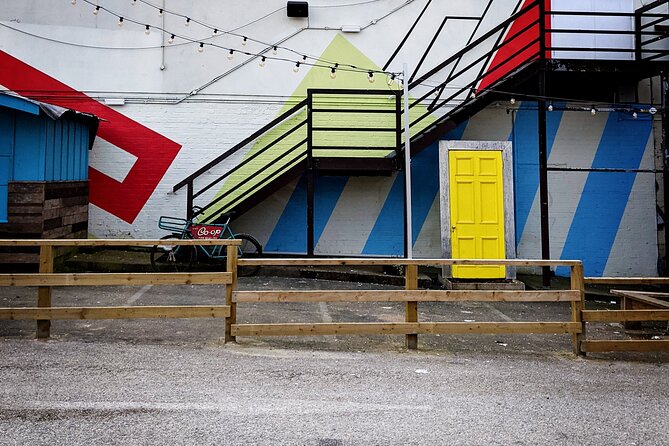
The canalside setting adds contrast. Water, brick, old industrial structures, and painted surfaces create a good visual introduction to the tour. You will not be standing in a gallery with carefully controlled lighting. The art belongs to working parts of the city, and the route shows how it sits alongside Birmingham’s older built environment.
This first section takes about 15 minutes. Admission is included, since the tour takes place in public areas. Wear shoes you can walk in comfortably. The route covers about 5km, and the experience includes outdoor walking in weather that may change.
Digbeth: the main stage for Birmingham street art
Digbeth is the heart of the route. Once you arrive, the tour moves through several sights and murals, with time to stop, take photographs, and hear the stories behind the work.
This is where the tour earns much of its price. You could walk around Digbeth on your own and spot plenty of striking images, but you would not necessarily know who made them, what issue they address, or how they fit into Birmingham’s street-art scene.
The guide also looks at the difference between graffiti and street art. Those terms are often treated as if they mean the same thing, but the tour considers how ownership, permission, style, and public reaction shape the way people judge painted work.
The Digbeth section lasts about 25 minutes, followed by stops in nearby areas. You should expect the pace to be fairly active. The tour is not designed as a long, leisurely photo session at every wall. Instead, it gives you a series of focused stops and keeps the route moving.
The color and scale should work well for families. One parent’s account described children enjoying the colors and the information about the murals. That is useful guidance: this can suit families who want a city walk with visual interest, especially if children are curious about how and why public art is made.
The Lock Keepers Cottage and a female Birmingham artist
One stop is the Lock Keepers Cottage along Birmingham’s canals. The cottage has its own story, and it is decorated by one of Birmingham’s female artists.
This stop helps show that street art is not only about giant walls. A smaller canal building can become part of the city’s visual identity when an artist and a site come together. The canal location also ties the artwork to Birmingham’s industrial past without turning the tour into a conventional history walk.
You spend about 10 minutes here. That is long enough to hear the story and take photographs, but not so long that the route loses momentum.
Because the supplied information does not name the artist, you should not expect a particular artist-focused discussion in advance. The value comes from the guide’s explanation on the day and from seeing how art can change an otherwise easy-to-miss building.
A completely different sort of day out:
- Discovering Birmingham 2 hour Walking Tour to the Jewellery Quarter
★ 5.0 · 333 reviews - Birmingham Slogging Gangs Walking Tour with Edward Shelby
★ 4.5 · 306 reviews - Birmingham City Centre Daily Walking Tour (10:30am & 2pm)
★ 5.0 · 265 reviews - SEA LIFE Birmingham Admission Ticket
★ 3.0 · 218 reviews
Meeting Pongo the orangutan on Lower Trinity Street
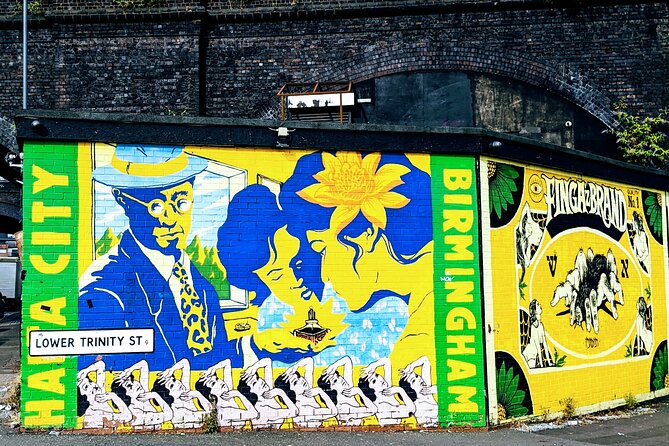
At a car park on Lower Trinity Street, you meet Pongo, an orangutan created by Louis Masai. The work was made for animal-rights activism, so the image carries a clear purpose beyond decoration.
This is one of the more memorable stops because the subject is easy to understand at a glance. The tour uses it to show how street art can carry a campaign into an everyday public space. A car park is not a polished art venue, yet it can give a message plenty of visibility.
You have about 10 minutes here. That makes the stop compact, but it should give you time to look at the details, photograph the mural, and hear about Louis Masai’s work.
I like the balance this adds to the route. Some pieces are valued for their color or design. Pongo also asks you to think about the cause behind the image and the role public art can play in advocacy.
The Custard Factory and the argument over public art
The Custard Factory occupies 15 acres of restored Victorian factories near the Bullring. The former home of Bird’s Custard powder is now a creative quarter with independent shops, cafés, bars, restaurants, and art.
You spend about 20 minutes here, making it one of the longer stops. The site gives the guide a useful setting for a broader question: when a private venue supports graffiti and street art, does the artwork improve the area or degrade it?
That question is more useful than a simple list of favorite murals. Public art can attract people, support local identity, and make an old industrial setting feel active. It can also divide opinion, especially when people disagree about permission, maintenance, or who controls public space.
The Custard Factory works well for this discussion because it combines old buildings with a modern creative use. You can see how art forms part of a larger commercial and cultural setting, rather than existing on an isolated wall.
It is also the easiest place to add your own time before or after the tour. The route itself allows about 20 minutes for the art and discussion, but the wider complex includes places to eat and browse. One short account specifically linked the experience with an excuse to eat at OPM, so that may be a useful plan if you want to turn the outing into part of a longer Digbeth visit. The tour does not include food, so budget separately.
Suki10c, Black History Month, and public memory
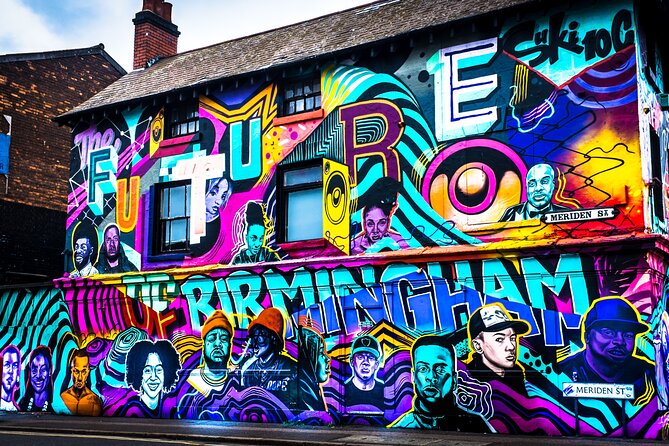
The final named stop is suki10c, an eco-friendly live music venue covered by a mural made during Black History Month. The artwork celebrates Birmingham’s young Black creatives.
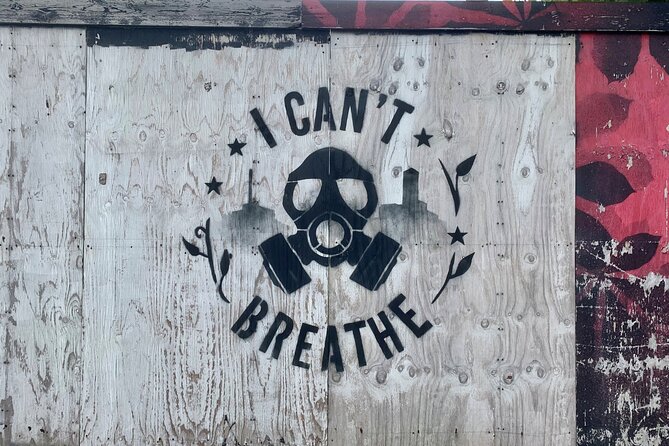
This stop gives the tour a direct connection to the people and communities shaping the city now. It also looks at how the venue was used after George Floyd’s murder. That makes the discussion about more than artistic technique. It considers how a wall, a venue, and a public gathering place can respond to a major social event.
The stop lasts about 10 minutes. Admission is not included, although the tour visits the venue area and discusses the mural. You should think of this as a short guided explanation, not a separate concert or interior venue visit.
For me, this is one of the strongest parts of the route because it places Birmingham’s street art in a current social setting. The art is not treated as decoration alone. It can celebrate local talent, express grief, and support public discussion.
What the $54.74 price buys you
At $54.74 per person, this is not the cheapest way to see murals in Birmingham. You can walk through parts of Digbeth without paying for admission, and all named stops are in public areas or places where no separate admission is listed.
The price makes more sense if you value interpretation. You are paying for the route, the organization, the local background, and the stories linking the art to Birmingham’s artists and wider events. You are also paying for a route that connects several areas in one outing instead of asking you to find them yourself.
The maximum group size is 25 people. That is not a private tour, but it is limited enough to keep the guide’s explanation practical. If the full group attends, you may need to move closer at each stop to hear clearly, especially outdoors.
The average booking point is 10 days ahead. That suggests you should reserve before your Birmingham visit rather than count on finding a place at the last moment. Since the booking cannot be refunded or changed, check the forecast and your schedule before paying.
Walk or run: choosing the right version
The walking tour lasts about two hours. That is the better choice if you want time to take photographs, listen to the stories, and look carefully at the murals.
The running version covers the same general 5km route in about 1.5 hours. Choose it only if you are comfortable keeping an active pace and do not need as long at each stop. The information provided does not describe the running format in further detail, so you should not assume it includes a separate athletic program or a different route.
For most people, I would choose the walk. Street art is full of small details, and the extra half-hour gives you more time to look. The run may suit people who want to combine exercise with sightseeing and are happy with shorter pauses.
The activity returns to the Eagle & Ball, so you do not need to arrange transport from a distant final stop. It is near public transportation, and service animals are allowed. Most people can take part, although you should be ready for a 5km outdoor route.
Weather, group size, and the booking decision
Good weather is required. If poor weather forces a cancellation, you will be offered another date or a full refund. The same applies if the minimum number of participants is not reached, with the option of another date, another experience, or a full refund.
That protection applies to cancellations by the operator, not to your own change of plans. If you cancel or request an amendment, the payment is not refunded. This is the biggest practical risk, so book when your schedule is firm.
The tour has a maximum of 25 people and is confirmed at booking. It is near public transportation, service animals are allowed, and most people can participate. No separate accessibility details are provided, so contact the provider if you need specific information about the canal route, surfaces, or pace.
Who will get the most from this tour
I would recommend it to you if you want to see Birmingham through local art rather than only through major museums and historic buildings. It is especially useful if you are new to Digbeth and want a clear introduction to the area’s murals.
Families may like the strong colors, outdoor setting, and short stops. The children’s response described in the supplied feedback suggests the information can hold younger attention, although the 5km distance still matters.
It also suits visitors interested in public issues. Animal rights, Black History Month, young Black creatives, and the public response to George Floyd’s murder all form part of the route.
You may want to skip it if you only want a quick collection of photo stops, dislike fixed group schedules, or cannot risk a non-refundable booking. Independent exploration will cost less, but it will not provide the same organized context.
Should you book the Birmingham street-art tour?
Book it if you want the stories behind Birmingham’s murals, not just the murals themselves. The strongest parts are the home-grown focus, the canalside route into Digbeth, Louis Masai’s Pongo, and the discussion of art as activism and urban change.
At $54.74, I see it as a specialist guided walk rather than a cheap sightseeing add-on. Choose the walking version for the fullest experience, plan extra time around the Custard Factory, and make sure the weather and your schedule are dependable.
If that sounds like your kind of city exploration, this tour offers a colorful and thoughtful way to meet Birmingham beyond its standard sights.
FAQ
Where does the tour begin?
It begins at the Eagle & Ball, Gopsal Street, Birmingham B4 7RJ, United Kingdom. Look for the guide wearing orange.
Where does the tour finish?
The activity ends back at the Eagle & Ball meeting point.
How long is the street-art tour?
The walking version takes about two hours. The running version takes about 1.5 hours.
How far do you travel?
The route covers about 5km.
Can I choose between walking and running?
Yes. The experience is offered as a roughly two-hour walk or a faster run of about 1.5 hours.
What places are included on the route?
The route includes Birmingham’s canalside, Digbeth, the Lock Keepers Cottage, Lower Trinity Street, the Custard Factory, and suki10c.
Is admission included at the stops?
The listed stops have no admission charge, except suki10c, where admission is not included. The tour takes place mainly around public areas and venues.
What happens if the weather is poor?
If poor weather causes the experience to be canceled, you will be offered a different date or a full refund.
Just added in Birmingham
- Fun, Flexible Treasure Hunt Around Birmingham with Cryptic Clues & Hidden Gems★ 5.0 · 167 reviews
- Birmingham Gangs Nighttime Historical Walking Tour with Pub Stops★ 5.0 · 53 reviews
- Jewellery Quarter of Birmingham: A Walking Adventure★ 4.5 · 2 reviews
- Taste of Shrewsbury Food and Drink Tour with Guide★ 5.0 · 22 reviews
- Pride History of Birmingham Tour★ 5.0 · 3 reviews
- Private Birmingham Ghosts and Gallows Walking Tour★ 5.0 · 5 reviews
- Birmingham Ghost Hunt: Haunted Self-Guide Tour & Quest★ 4.5 · 37 reviews
- Private Birmingham Arrival Transfer – Airport to Hotel / Accommodation★ 5.0 · 1 review
Street Art, compared.
London Bike Tour: Landmarks, Secret Gems, Pub Stop & Street Art
Read our review →
Street Art Tour and Spray Painting Workshop in London
Read our review →
Bristol Street Art: Banksy Exploration Game and Tour
Read our review →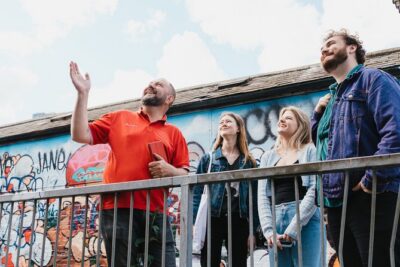
East End London Instagrammable Street Art and Graffiti Tour
Read our review →
3-Hour Private Tour of East London Graffiti & Street Art
Read our review →Browse the lists this tour appears in