
Reviewed · STREET ART
East End London Instagrammable Street Art and Graffiti Tour
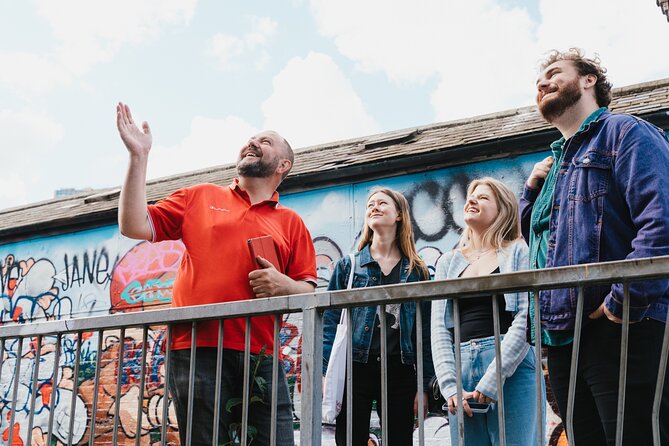
East London turns ordinary walls into open-air galleries. This two-hour walk takes you through Brick Lane, Shoreditch, and nearby streets to find giant murals, tiny stickers, Banksy works, and art that can vanish within days. I like the way it combines major artists and lesser-known work, and I like that you get a chance to make your own street art rather than only take pictures.
The $49 price is fair if you want context, efficient routing, and access to tucked-away courtyards you could easily miss alone. The main consideration is pace: with roughly 17 stops in about two hours, most visits are brief, and the exact art can change before your tour date.
In This Review
- Five things to know before you book
- Why East London works so well for street art
- Heneage Street reveals the quieter side
- Brick Lane rewards a closer look
- Princelet and Hanbury streets connect art with community
- Broccoli Lane and Allen Gardens show art in motion
- Buxton and Ebor streets shift from rough to polished
- Rivington Street brings Banksy into the conversation
- Thierry Noir and the old Curtain Theatre
- The final walls lead toward Liverpool Street
- What $49 gets you
- Who should take this walk
- Should you book the East End street art tour?
- FAQ
- How long is the East End London street art tour?
- How much does the tour cost?
- Where does the tour begin?
- What time does the tour start?
- Where does the tour finish?
- Is Banksy included on the tour?
- Can I make my own street art?
- How large is the tour group?
- Can I cancel for a full refund?
Five things to know before you book
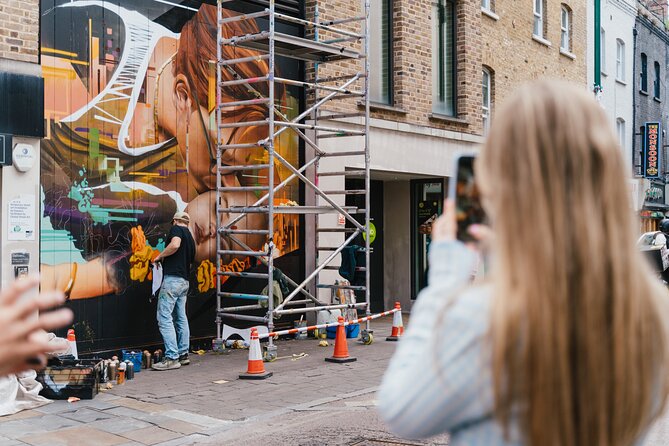
- You see far more than Banksy: The route covers work by Phlegm, ROA, Martin Ron, Stik, Thierry Noir, Ben Eine, Otto Schade, and many others.
- The art changes constantly: Allen Gardens can look different every few days, while some older works have survived for about 20 years.
- The route mixes big murals with tiny details: Bring your attention close to doors, stickers, tags, and narrow yards, not only building-sized paintings.
- The walk ends near Liverpool Street Station: The finish is within walking distance of the station, though the precise endpoint may shift with changing artwork.
- A small group keeps the walk manageable: Numbers are capped at 20, which matters when you are stopping in tight lanes and crowded art spots.
- It is built for photographs: Several stops offer strong backdrops, but you will also hear the social and political stories behind the pictures.
Why East London works so well for street art
This is not a tour of polished galleries. It is a walk through ordinary streets where walls, doors, yards, shutters, and old building surfaces become part of the artwork.
That setting is the point. You are seeing art in the places where it was painted, pasted, protected, altered, or covered. Some pieces have a long life. Others may disappear under fresh paint almost immediately. A good guide helps you look at both kinds with equal interest.
The route begins at 80 Whitechapel High Street at 11 a.m. and moves through East London toward Liverpool Street Station. The walk is listed at about two hours, so you should expect a steady outing rather than a slow photography session at every stop.
I would wear comfortable shoes and keep your camera ready. Many pieces are large, but some of the best details are easy to pass if you keep looking only at eye level.
A few more to weigh up in London
- Stonehenge, Windsor Castle, and Bath from London
★ 4.5 · 18,662 reviews - London Big Bus Hop-On Hop-Off Tour with Optional River Cruise
★ 3.5 · 10,803 reviews - London Small Group Tour of Historical Pubs
★ 5.0 · 10,422 reviews
Heneage Street reveals the quieter side
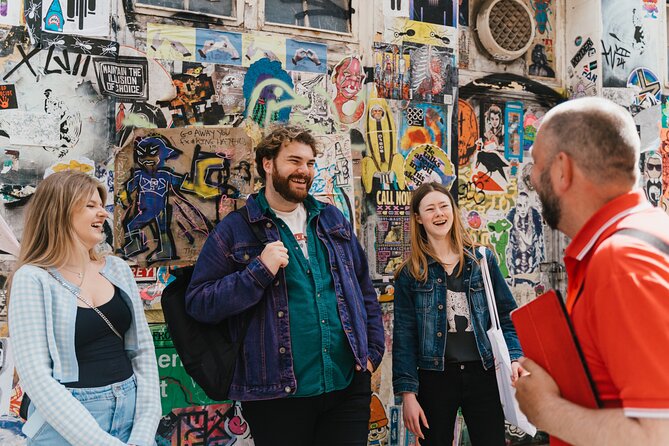
The first stop at Heneage Street shows why a guide is useful here. Two large works are tucked away in small backyards, where you might walk past without knowing to look.
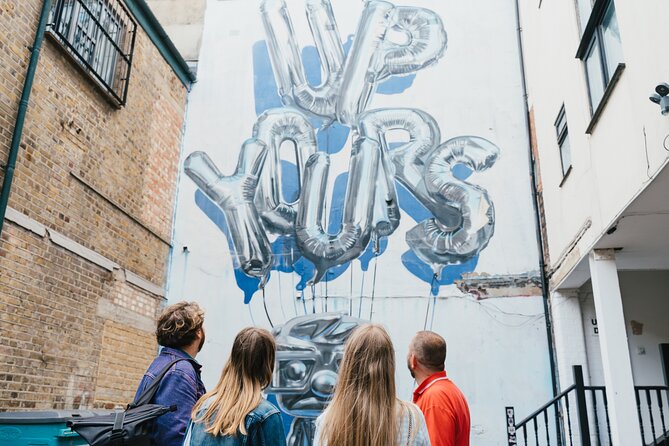
Phlegm’s mural features his familiar thin, elongated creatures moving above layers of tags. The height and detail reward a few minutes of looking upward. Across the street, FanakaPan uses silver balloon imagery based on an animated classic, but with his own strange twist.
This is a strong opening because it introduces two important parts of East London street art: recognizable artist signatures and the way work can hide in plain sight. The stop lasts about 10 minutes, and there is no admission fee.
Brick Lane rewards a closer look
Brick Lane is the famous spine of this part of the walk, but the tour does not treat it as one long photo stop. At one point, you begin from a distance to study works by Dan Kitchener and Perspicere on doors. As you move closer, details and technique become easier to see.
That change in viewpoint matters. A small door can hold as much visual interest as a giant wall if you take the time to inspect it.
The route then turns into a narrow, dirty yard known as The Seven Stars. Stickers dominate this space, giving you a quick lesson in a street art form that is often overlooked beside murals. You also get the chance to leave a small piece of your own art, making this one of the more playful stops.
At only about five minutes, The Seven Stars is brief. Still, it helps explain that street art is not one style. It can be a carefully planned mural, a tiny paste-up, a sticker, a stencil, or a quick tag.
Princelet and Hanbury streets connect art with community
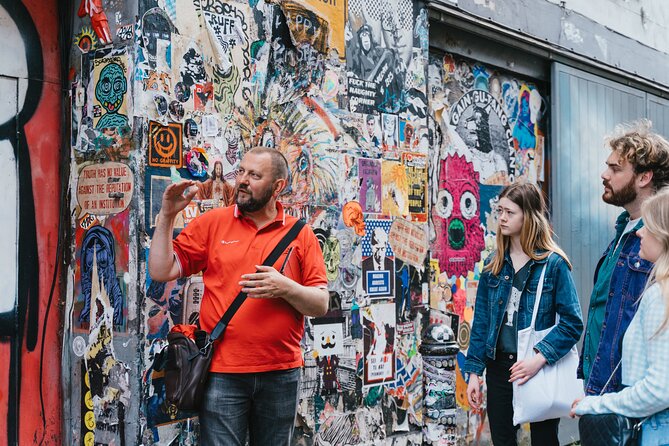
On Princelet Street, a work by Stik shows a simple form with strong color and a clear local meaning. It honors the Muslim community and reflects Shoreditch’s long connection with refugees and immigrants.
The piece has been defaced and repainted more than once. That detail gives the work extra force. Its value is not only visual. It has become important to people in the area, and repainting it shows how public art can be defended by a community.
The Hanbury Street stop brings a different mood. A huge bird by ROA shares the area with an upside-down man by Martin Ron, smaller colorful works, stickers, and black and white slogans by Wrdsmth.
The Martin Ron piece uses the building itself as part of the image. Look at how the upside-down figure works with the architecture instead of simply sitting on top of it. Both large works have been present for about 20 years, which is a very long time in the world of graffiti.
A completely different sort of day out:
- Stonehenge, Windsor Castle and Bath with Pub Lunch in Lacock
★ 4.5 · 7,402 reviews - Tower of London and Crown Jewels Exhibition Ticket
★ 4.5 · 6,677 reviews - Thorpe Park Admission Ticket
★ 4.0 · 5,915 reviews - Stonehenge, Windsor Castle and Bath Full Day Guided Tour
★ 4.5 · 5,346 reviews
Broccoli Lane and Allen Gardens show art in motion
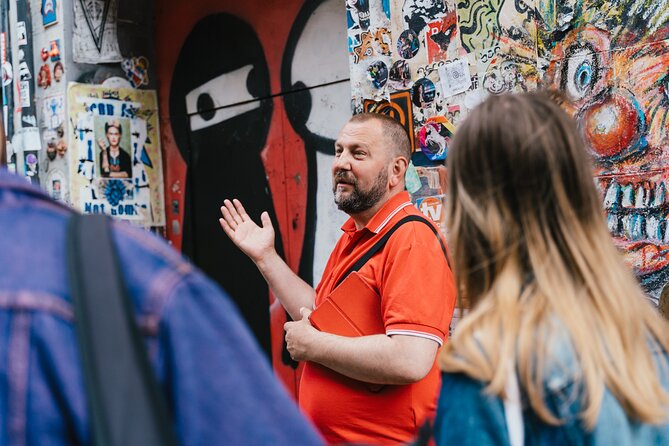
On Dray Walk, look for broccoli. Adrian Boswell began placing broccoli images around Brick Lane, and the idea spread until part of the street became known informally as Broccoli Lane.
Some versions are fairly realistic. Others appear in bright colors. Boswell now has a gallery and sells framed broccoli, a reminder that street art can move from walls into the commercial art world.
That shift is worth discussing because the tour does not treat street art as a simple battle between good and bad. It gives you room to think about galleries, public walls, art markets, and personal taste.
Allen Gardens takes you to a small graffiti park surrounded by walls. Much of the work changes every few days, so the pieces you see may not be there for long. If a particular wall catches your eye, take the photograph when you have the chance.
Many artists here focus on letters rather than pictures. The lettering can be so complex that it becomes nearly impossible to read. That is part of the challenge: the work aims for visual force even when the original word becomes unclear.
Buxton and Ebor streets shift from rough to polished
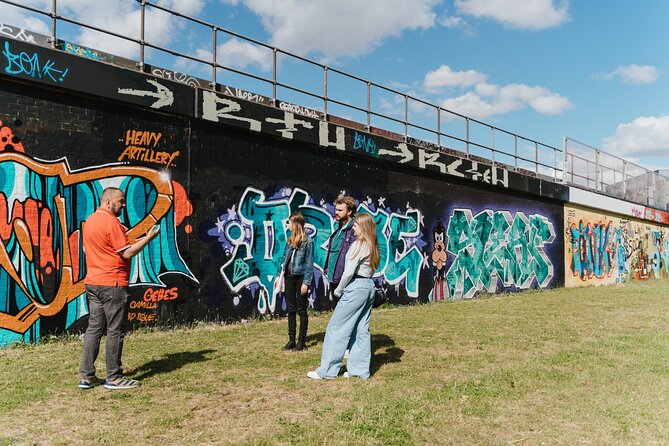
As you leave Allen Gardens, look up for the number 5 on Buxton Street. It leads into a discussion of recognizable artist marks and collaborative walls, where two or more artists combine different styles.
The route then moves toward Ebor Street and a more modern part of the neighborhood. Large painted adverts sit alongside smaller works, including Neon’s pink portraits. These faces are made with a light spray effect that gives them a soft, misty quality.
A second Ebor Street stop introduces Ben Eine. His bold letters are easy to read from a distance, unlike the complicated graffiti writing at Allen Gardens. He keeps a recognizable style but changes the fonts, moving between curved, decorative forms and sharper modern designs.
This contrast is one of the tour’s best teaching moments. You see how artists can use letters in opposite ways: one style asks you to solve a visual puzzle, while the other welcomes you from across the street.
Rivington Street brings Banksy into the conversation
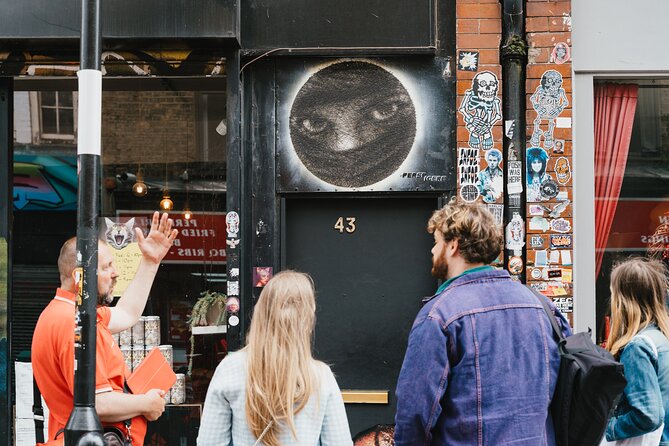
No East London street art walk can ignore Banksy, but the surviving works are limited. On Rivington Street, the tour visits a protected area where older Banksy pieces sit behind glass panels alongside work by other artists.
The glass raises a useful question. Does protection preserve street art, or change its meaning? You are encouraged to discuss art markets, public access, changing trends, and your own preferences rather than simply accept the work as famous and therefore important.
Nearby, Otto Schade’s work gives you another clear artist signature. His images look as if they are formed from ribbons, with stencil techniques pushed into lively, energetic shapes. A partial view of a soldier becomes complete when you move to the correct corner.
That is a recurring lesson on this walk: the best angle is not always the obvious one. Some murals need distance. Others need a side view. A few make sense only when the building’s edges are included.
Thierry Noir and the old Curtain Theatre
Further along Rivington Street, you encounter the colorful heads of French artist Thierry Noir. He is known for painting bright characters on the Berlin Wall in the 1980s, and his London works bring the same cheerful energy to the route.
The colors offer a welcome lift after the more complicated lettering and darker subjects. Even if you do not know the artist beforehand, the repeated style is easy to recognize.
At art’otel London Hoxton, a section of wall connected with an older Banksy work has been removed from its original location and placed at the hotel. It is now visible from the street, so you do not need a hotel reservation to see it.
This stop opens another question about ownership and public art. Moving a wall can preserve a piece, but it also removes it from the setting that helped give it meaning. That kind of discussion makes the tour more than a hunt for famous names.
At Hewett Street, the route takes an unexpected turn into Shakespeare’s world. A statue of William Shakespeare sits on a bench marking the site of the Curtain Theatre. You can sit beside him, then look nearby for a Romeo and Juliet mural connected with the place where the play was first heard.
It is a clever pairing of theater history and modern wall art. The stop also gives the tour a change of rhythm after so many painted surfaces.
The final walls lead toward Liverpool Street
New Inn Broadway returns to large-scale graffiti. One building is covered by a mix of artists, with different colors, techniques, and subjects joined into a single wall of images. A small policeman is tucked among the larger works.
The route then heads toward Shoreditch High Street and the glass-and-metal buildings of the City. Before the walk ends, you hear one final story about the Graffiti Wars, the disputes that helped shape this area’s art culture.
The finish is within walking distance of Liverpool Street Station. Since the endpoint can change as artwork changes, you should allow a little flexibility if you have a tight connection afterward.
What $49 gets you
At $49 per person, this is not the cheapest way to walk around Brick Lane. You can see many walls without paying for a tour, and the outdoor artwork itself has no admission charge.
The value comes from the route and the interpretation. In about two hours, you visit courtyards, side streets, parks, and protected works that would be hard to organize efficiently on your own. You also learn how to identify artists by recurring images, lettering, colors, and techniques.
The group maximum of 20 is helpful. Street art stops often happen in narrow yards or beside busy streets, and a smaller group makes it easier to hear the guide and get into position for photographs.
Still, you should not expect a long lecture at each piece. With so many stops, visits range from about five to 10 minutes. If you prefer to sit quietly with one mural for half an hour, an independent walk may suit you better.
The tour has a 5 out of 5 rating based on 16 ratings, with 100 percent recommending it. The praise centers on its fun introduction to London’s contemporary art scene and the cultural background of this eclectic neighborhood. That fits the design of the tour: it is lively, visual, and easy to enjoy even if you are not already an art expert.
Who should take this walk
I would choose this tour if you want to:
- Photograph large murals and smaller pieces in strong urban settings
- Learn the visual signatures of artists such as Banksy, ROA, Stik, Ben Eine, and Thierry Noir
- Understand why some graffiti lasts for decades while other work disappears quickly
- See East London beyond the standard central London sights
- Add a creative activity to your day with the chance to make your own street art
- Walk with a local guide instead of searching for every location yourself
It is also a good match for people who like cultural history but do not want a museum-heavy outing. The route links immigration, community identity, theater, commercial art, graffiti disputes, and changing neighborhoods through the walls around you.
You should think twice if you dislike walking, need a slow pace, or want a guaranteed list of specific murals. Street art changes. The exact final stop can shift, and some pieces may be painted over before your visit.
The tour is near public transportation, service animals are allowed, and most people can participate. Confirmation arrives when you book. Free cancellation is available up to 24 hours before the start time, while later cancellations do not receive a refund.
Should you book the East End street art tour?
Book it if you want a compact, well-planned introduction to East London’s creative side, especially if photographs and artist stories matter to you. The Banksy stops may attract attention, but the best value is the variety: giant animals, colorful heads, political symbols, coded letters, stickers, Shakespeare, and art that may not survive until your next visit.
At $49, you are paying for access, context, and a route that makes two hours count. Go with comfortable shoes, a charged phone, and enough curiosity to look above doors, behind corners, and into narrow yards. If you want to experience the London many first-time visitors miss, this is a strong choice.
FAQ
How long is the East End London street art tour?
The tour lasts approximately two hours.
How much does the tour cost?
The price is $49 per person.
Where does the tour begin?
The tour starts at 80 Whitechapel High Street, London E1 7QX, United Kingdom.
What time does the tour start?
The scheduled start time is 11 a.m.
Where does the tour finish?
The tour finishes within walking distance of Liverpool Street Station. The exact endpoint may change depending on the artwork available along the route.
Is Banksy included on the tour?
Yes. The route includes older Banksy works on Rivington Street and another preserved section of a Banksy wall at art’otel London Hoxton.
Can I make my own street art?
Yes. The experience includes an opportunity to make your own street art, including a chance to leave a small piece in the sticker area at The Seven Stars.
How large is the tour group?
The tour has a maximum of 20 participants.
Can I cancel for a full refund?
Yes. You can cancel at least 24 hours before the start time for a full refund. Changes or cancellations made less than 24 hours before the start time are not accepted for a refund.
Just added in London
- Private Tour: Royal High Tea At Kensington Palace Gardens★ 5.0 · 39 reviews
- Private Tour: Personal Travel Photographer Tour in London★ 4.5 · 27 reviews
- London East End Private Walking Food Tour – Secret Food Tours★ 5.0 · 26 reviews
- Private Tour: Night Photography Tour in London★ 5.0 · 48 reviews
- London Like a Local, Private & Personalized (2-3 hrs)★ 4.5 · 11 reviews
- British Museum & National Gallery of London – Exclusive Guided Combo Tour★ 5.0 · 48 reviews
- Private Tour: Tower of London and St Paul’s Cathedral★ 5.0 · 1 review
- London Soho District – Exclusive Guided Walking Tour★ 5.0 · 2 reviews
Street Art, compared.
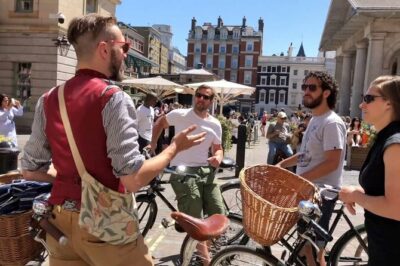
London Bike Tour: Landmarks, Secret Gems, Pub Stop & Street Art
Read our review →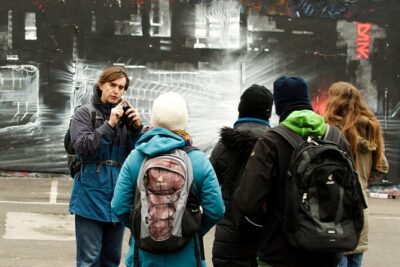
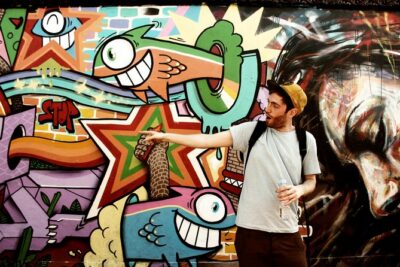
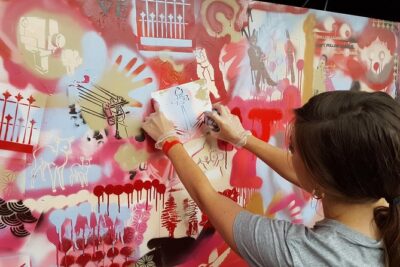
Street Art Tour and Spray Painting Workshop in London
Read our review →
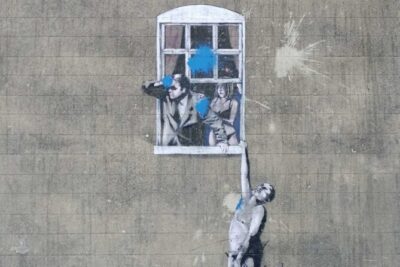
Bristol Street Art: Banksy Exploration Game and Tour
Read our review →
3-Hour Private Tour of East London Graffiti & Street Art
Read our review →
Browse the lists this tour appears in