
Reviewed · BIRMINGHAM TOURS
Best of Birmingham 12km Running Tour
See Birmingham at running pace. This private 12km tour links canals, industrial landmarks, lively districts, grand civic squares, and the Bullring in about two and a half hours. I like the way it turns sightseeing into an active city introduction, and I especially like the chance to see areas such as Digbeth and the Jewellery Quarter that many short walking tours skip.
The tour also gives you a local guide, warmup, snacks, landmark photos, and plenty of Birmingham stories along the route. The main drawback is the price: at $548.51 per person, it is a serious splurge, especially for solo runners or small groups.
The pace is designed for runners of different abilities, but you still need a moderate level of fitness. Bring your own water, wear sensible running shoes, and remember that the tour is non-refundable unless poor weather or low numbers force the operator to cancel.
In This Review
- Key points at a glance
- Why running may be Birmingham’s best sightseeing pace
- Starting beside the canals at Roundhouse Birmingham
- Centenary Square and Birmingham’s civic story
- The Jewellery Quarter, Banksy, and the FA Cup
- Digbeth and the canals that powered industry
- The Gay Village, China Town, and Theatreland
- The Bull, Selfridges, and the old market
- Victoria Square and Birmingham’s grand centre
- The Mailbox and the return to Roundhouse
- What the $548.51 price means
- Fitness, weather, and practical planning
- Who should book the Birmingham running tour?
- Should you book it?
- FAQ
- Where does the Birmingham running tour start?
- Where does the tour finish?
- How long is the tour?
- How far do you run?
- Is water included?
- Is the tour private?
- What happens if bad weather cancels the tour?
Key points at a glance
- A 12km route with real variety: You run beside canals, through historic districts, past civic buildings, and into the city centre.
- A private experience: Only your group takes part, so the guide can keep the outing more personal than a large sightseeing tour.
- Birmingham beyond the usual postcard sights: Digbeth, the Jewellery Quarter, the Gay Village, and canal paths receive proper attention.
- A useful start at Roundhouse Birmingham: The tour begins with a warmup, introduction, and short history talk before you set off.
- Snacks are provided, but water is not: Carry your own bottle or hydration pack.
- A guide-led city lesson: Lucy is praised for being friendly, enjoyable, and full of useful local insight.
Why running may be Birmingham’s best sightseeing pace
Birmingham is a large city with its main sights spread across several districts. On foot, you can cover them, but you may spend much of the day walking between them. This tour gives you a way to connect a wide range of places in one outing.
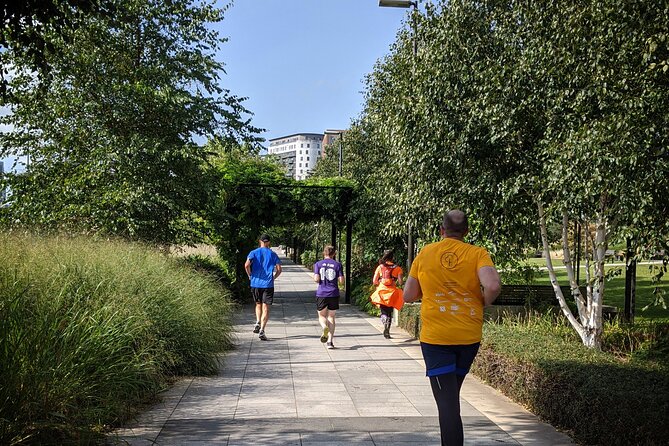
The route is not simply a long run with a few facts added. You stop regularly for short talks and breathing breaks. The listed stops usually last from five to fifteen minutes, giving you time to listen, look around, and take photographs before moving on.
I like this format because it respects both parts of the experience. You get exercise, but you also get context. The canals explain Birmingham’s industrial growth. The Jewellery Quarter shows how manufacturing still shapes the city’s identity. Digbeth gives you a rougher, more creative side of Birmingham, while Victoria Square brings you back to its grand civic centre.
The tour is private, which matters at this price. You are not trying to keep up with a crowd or waiting for a large group to cross roads and paths. The guide can work with your party’s pace, though this is still a running tour, not a gentle walking excursion.
A few more to weigh up in Birmingham
- Entry ticket to Hoo Zoo and Dinosaur World in Telford
★ 5.0 · 591 reviews - Cadbury World Entry Ticket
★ 3.0 · 524 reviews - Birmingham Walking Tour: Canals, Victorians & Today (1:30pm)
★ 5.0 · 346 reviews
Starting beside the canals at Roundhouse Birmingham
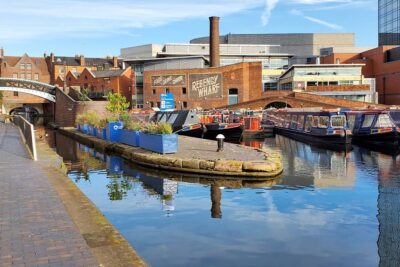
Meet at Roundhouse Birmingham, at 1 Sheepcote Street, Birmingham B16 8AE. This heritage building sits beside the canals and makes a fitting starting point for a tour built around Birmingham’s waterways and industrial past.
Before the running begins, your England Athletics Run Leader gives an introduction, leads a warmup, and sets up a group ice-breaker. You also hear a short account of the building’s history. That opening is useful for two reasons: it helps you get physically ready, and it gives you a first clue about how closely Birmingham’s story is tied to transport and industry.
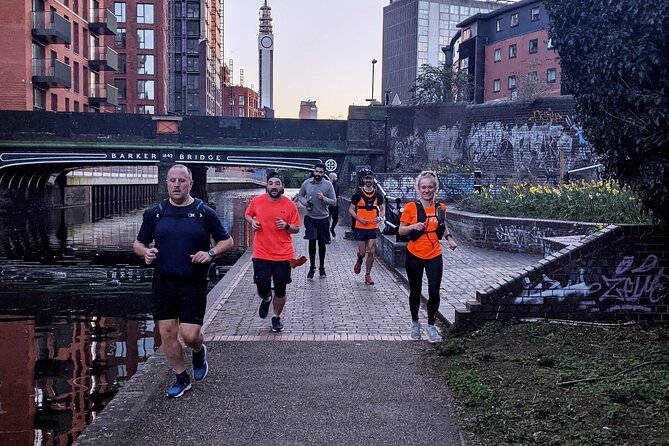
The first run covers about half a mile along the canal to Centenary Square. This is an easy way to settle into the route. You are not thrown straight into a hard road section, and the canal path provides an immediate change from ordinary city streets.
You should arrive ready to run. The tour is offered in English, and the guide is a licensed England Athletics Run Leader. Service animals are allowed, and the meeting point is near public transport, but the tour details do not specify a particular station or transit route.
Centenary Square and Birmingham’s civic story
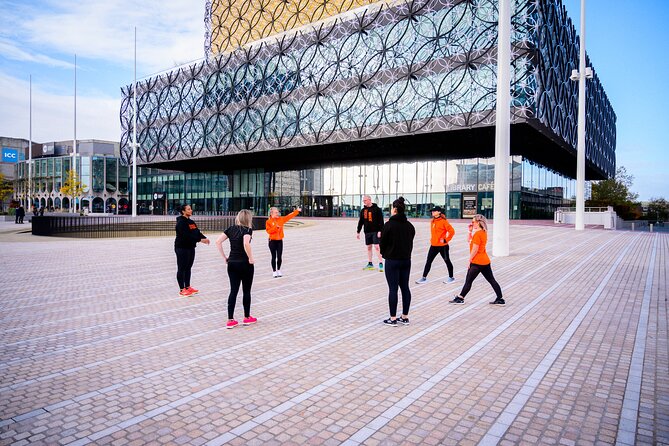
Centenary Square gathers several of the city’s best-known modern and historic buildings. You stop near Birmingham Library, the Hall of Memory, and Baskerville House, with the guide explaining what these places reveal about the city.
The square also has a large water feature that locals have given a humorous nickname. It is an amusing detail, but the larger point is that Birmingham’s public spaces often mix grand civic design with a distinctly local sense of fun.
This is also where the guide introduces Birmingham’s beginnings as a city, described on the tour as reaching back 1,620 years. A ten-minute stop gives you enough time to absorb the main points without turning the run into a lecture.
For photographers, this should be a good early pause. The square places several major landmarks close together, and you will not need to choose between seeing them and keeping up with the group. If you prefer detailed museum visits, remember that the tour only passes these places. Admission is not part of the experience.
The Jewellery Quarter, Banksy, and the FA Cup
From Centenary Square, you run about one mile in a straight section before reaching the Jewellery Quarter. This is one of the strongest parts of the route, especially if you want to see a part of Birmingham with a clear working identity rather than only its central shopping streets.
The Jewellery Quarter produces a large share of the United Kingdom’s jewellery, and English Heritage has described it as a national treasure. You see Victorian cemeteries, unusual residential buildings, independent food and drink businesses, small hotels, museums, and creative workshops.
The tour also points out the area’s connection with Banksy street art. You hear the story of the mural and learn why the Jewellery Quarter remains important to Birmingham’s past and present.
The guide also shares the story of the FA Cup made here. That kind of detail is one reason a local running tour can be more rewarding than a route map. You are not only ticking off buildings. You are learning how manufacturing, sport, art, and neighbourhood life overlap.
This is a fifteen-minute stop, the longest listed pause on the route. You may find yourself wanting to return later, especially for the independent food and drink scene or the museums. The tradeoff is that the run gives you an introduction, not time to explore inside.
A completely different sort of day out:
- Discovering Birmingham 2 hour Walking Tour to the Jewellery Quarter
★ 5.0 · 333 reviews - Birmingham Slogging Gangs Walking Tour with Edward Shelby
★ 4.5 · 306 reviews - Birmingham City Centre Daily Walking Tour (10:30am & 2pm)
★ 5.0 · 265 reviews - SEA LIFE Birmingham Admission Ticket
★ 3.0 · 218 reviews
Digbeth and the canals that powered industry
The route then uses a less obvious canal path before reaching Digbeth. This section explains how Birmingham’s waterways helped turn the city into a powerhouse of the Industrial Revolution.
You hear about the inventors who shaped that period, including both the celebrated and the less admirable figures. That balance is welcome. Industrial progress created wealth and jobs, but it also brought hard working conditions and major social change. A short talk cannot cover everything, but it can give you a useful frame for the streets and waterways around you.
Digbeth has a very different mood from the Jewellery Quarter. It is presented as a creative district filled with independent businesses and street art. The description is deliberately playful, and the area is treated as an open-air gallery with a strong personality.
I like that Digbeth is included because many city tours stay close to the polished centre. Here, you see a more unusual side of Birmingham. The ten-minute stop is short, so keep your eyes open while running in and out. The best details may be on walls, bridges, and side streets rather than in one single landmark.
The Gay Village, China Town, and Theatreland
The next section brings together Birmingham’s Gay Village, China Town, and Theatreland along one colourful stretch. Your guide explains how the local scene developed and why this part of the city matters.
This is another stop where a guide adds value. The area is not simply a collection of restaurants, bars, theatres, and colourful streets. It also reflects changing attitudes, community life, and the way different city districts overlap.
The stop lasts about ten minutes before you run back toward the centre. You may notice food smells and busy-looking venues along the way, but the tour is not built around eating or drinking. Snacks are supplied, yet you should not expect a food tour.
The run from here leads toward the Bullring and includes an uphill section. That climb is worth noting. You are not jogging on a flat canal path for the whole route, so your legs and breathing will need to handle changes in grade.
The Bull, Selfridges, and the old market
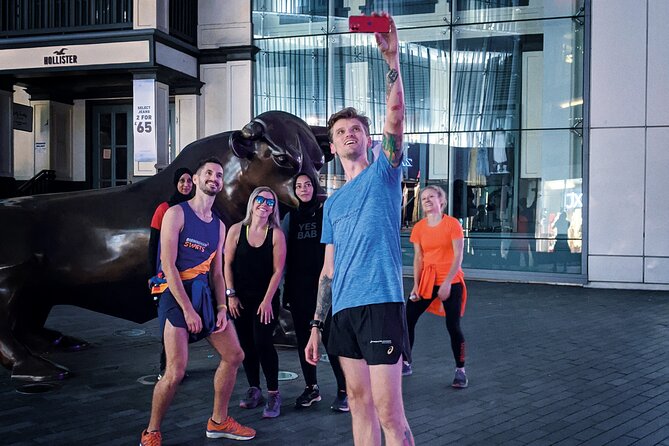
The uphill running brings you to one of Birmingham’s most recognisable sights, the bronze Bull. This is the classic photo stop, and the guide takes a picture of you beside it. You can also rub the Bull’s nose for luck.
The guide explains why bulls became such an important symbol for Birmingham. The stop lasts about ten minutes, which should give you enough time for photos and a short talk without creating a long delay.
Near the Bull, the route passes the curved Selfridges building at the Bullring. Its exterior is covered with 15,000 aluminium discs, making it one of the city’s most striking modern buildings. You see it from outside during the run, but you can return later if shopping is part of your Birmingham plans.
The route also passes a market dating from the twelfth century, still operating today. This is a useful contrast to Selfridges. In a short stretch, you see an old market tradition beside bold modern retail architecture.
The Bullring section is good for first-time visitors because it combines three easy-to-recognise Birmingham symbols: the Bull, the market, and Selfridges. It is also one of the more public parts of the route, so expect a city-centre setting rather than a quiet run.
Victoria Square and Birmingham’s grand centre
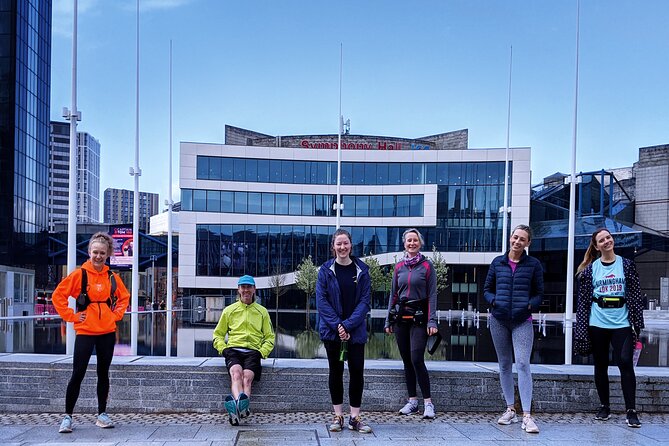
Victoria Square provides another change of scene. Here, you stop near the Town Hall, Council House, Birmingham Museum and Art Gallery, Chamberlain Fountain, the Queen Victoria statue, and a river-style water feature.
The guide explains the local nickname for the water feature and shares stories about Queen Victoria’s poor feelings toward Birmingham. These small stories help make a civic square easier to remember than a list of dates and building names.
The architecture around the square can feel surprisingly grand. The comparison to Rome is part of the tour’s light touch, but it also points to the ambition behind Birmingham’s public buildings. This was a city eager to present itself as important, modern, and wealthy.
The ten-minute stop is enough for a quick look and photographs. It is not enough for the museum or art gallery, so plan a separate visit if those interiors interest you. The running format works best when you treat each stop as a preview, then choose one or two places to revisit at a slower pace.
The Mailbox and the return to Roundhouse
After Victoria Square, you run a short 0.2 miles downhill to the Mailbox. This large red building is one of Birmingham’s well-known shopping and leisure venues, and the guide covers its past along with some underground secrets.
The downhill section should offer a welcome break after the earlier climb. From the Mailbox, you face another uphill trot back toward the canals and the starting point at Roundhouse Birmingham.
A canal-side bridge near the route offers another photo opportunity, with public art and water views. The tour finishes back where it began, which simplifies your plans for the rest of the day. You do not need to arrange a separate pickup or find your way back from a distant ending point.
The final stop is only about five minutes, so the guide’s stories remain brief. That is sensible at the end of a 12km run, when you may be more interested in water and recovery than a long speech.
What the $548.51 price means
At $548.51 per person, this is not an inexpensive way to see Birmingham. The value depends heavily on your group size and how much you want a private, active experience.
The price is easier to justify if you are booking with a group that wants a dedicated run leader, a flexible private outing, and a broad city route in one morning or afternoon. It is harder to justify if you are alone, mainly interested in sightseeing, or happy to use a free city walk and run independently.
You are paying for more than mileage. The price includes a trained run leader, route planning, local stories, regular stops, a group photo at the Bull, snacks, and recommendations for your stay in Birmingham. Still, major attractions are viewed from outside, and there are no stated admission tickets or bottled water included.
The strongest value comes from the combination of exercise and orientation. If you have only limited time in Birmingham and want to cover several districts quickly, the route does a lot in two and a half hours. If you want museum interiors, shopping time, or a relaxed look at each neighbourhood, you will need extra time and perhaps a different tour.
Fitness, weather, and practical planning
You need a moderate level of physical fitness. The route covers roughly 12km, includes uphill running, and lasts about two and a half hours. The guide can work with runners of different abilities, but the tour is still active from start to finish.
Bring your own water. Bottled water is not included, while snacks are provided to help keep your energy up. Comfortable running shoes are an obvious choice, and weather-appropriate clothing will make the canal sections and city streets more pleasant.
The tour requires good weather. If poor weather cancels it, you are offered another date or a full refund. If the minimum number of participants is not reached, you are offered another date or experience, or a full refund.
Your own cancellation terms are strict: the experience is non-refundable and cannot be changed for any reason after booking. Check your plans carefully before paying, especially because the price is high.
The tour has a five-out-of-five rating from twelve reviews, with 100 percent recommending it. The most specific praise focuses on the experience being enjoyable for runners of different abilities and on Lucy, who is described as friendly, insightful, and pleasant company. That is important here. A running guide must manage pace, conversation, safety, and atmosphere at the same time.
Who should book the Birmingham running tour?
I would recommend it most to:
- Runners who want sightseeing built into their exercise.
- First-time visitors who want a fast introduction to several Birmingham districts.
- Private groups willing to share the cost.
- Active couples, friends, or families with moderate fitness.
- Repeat visitors who want stories and neighbourhoods beyond the usual centre.
- People who prefer a guide with a warm, social style.
I would think twice if you dislike running, need a flat route, want long museum visits, or are travelling on a tight budget. A walking tour, self-guided route, or ordinary city sightseeing option may suit you better.
Should you book it?
Book this tour if you want Birmingham in motion: canals, industry, jewellery, street art, civic buildings, shopping architecture, and local stories tied together by a serious run. The private format and guide-led storytelling make it more personal than running a route alone.
The price is the big question. For a group that values a dedicated guide and an active way to cover 12km, it can be a memorable use of time. For one person paying the full per-person rate, the cost is difficult to overlook.
Bring water, allow extra time to revisit the places that catch your eye, and book only if you are comfortable with the fitness demands and strict cancellation terms. If that sounds like your kind of city day, this is a lively and unusually thorough introduction to Birmingham.
FAQ
Where does the Birmingham running tour start?
It starts at Roundhouse Birmingham, 1 Sheepcote Street, Birmingham B16 8AE, United Kingdom.
Where does the tour finish?
The tour ends back at the Roundhouse Birmingham meeting point.
How long is the tour?
It lasts approximately two hours and thirty minutes.
How far do you run?
The experience is described as a 12km running tour.
Is water included?
No. Bottled water is not included, so you should bring your own water to stay hydrated.
Is the tour private?
Yes. Only your group participates in the activity.
What happens if bad weather cancels the tour?
You are offered a different date or a full refund if poor weather causes the cancellation.
Just added in Birmingham
- Fun, Flexible Treasure Hunt Around Birmingham with Cryptic Clues & Hidden Gems★ 5.0 · 167 reviews
- Birmingham Gangs Nighttime Historical Walking Tour with Pub Stops★ 5.0 · 53 reviews
- Jewellery Quarter of Birmingham: A Walking Adventure★ 4.5 · 2 reviews
- Taste of Shrewsbury Food and Drink Tour with Guide★ 5.0 · 22 reviews
- Guided Tour of Street Art in Birmingham★ 5.0 · 2 reviews
- Private Birmingham Ghosts and Gallows Walking Tour★ 5.0 · 5 reviews
- Pride History of Birmingham Tour★ 5.0 · 3 reviews
- Birmingham Ghost Hunt: Haunted Self-Guide Tour & Quest★ 4.5 · 37 reviews
Birmingham Tours, compared.

Entry ticket to Hoo Zoo and Dinosaur World in Telford
Read our review →
Birmingham Walking Tour: Canals, Victorians & Today (1:30pm)
Read our review →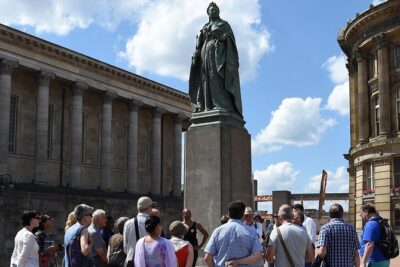
Discovering Birmingham 2 hour Walking Tour to the Jewellery Quarter
Read our review →
Birmingham Slogging Gangs Walking Tour with Edward Shelby
Read our review →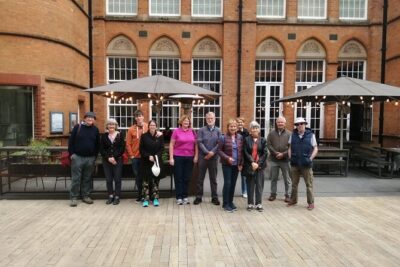
Birmingham City Centre Daily Walking Tour (10:30am & 2pm)
Read our review →
Fun, Flexible Treasure Hunt Around Birmingham with Cryptic Clues & Hidden Gems
Read our review →Browse the lists this tour appears in