Reviewed · TOURS
The Great Plague & Black Death Tour of London
London’s darkest stories live beneath ordinary streets. I like this tour for its private format, which lets you ask questions freely, and for the way it links plague sites with Samuel Pepys, the Peasants’ Revolt, and the Great Fire of London. The plague pits, old churches, and surviving memorials give the past a physical presence.
The main drawback is the price: $218.97 per person is a serious spend for a two to three-hour walking tour, especially since Tube travel costs about £5 extra. You also need moderate fitness, and much of the appeal depends on listening closely as you move through central London.
In This Review
- Key points at a glance
- Why this London history tour feels different
- St Giles-in-the-Fields and the first Great Plague cases
- Charterhouse Square and the scale of the Black Death
- The Charterhouse skeleton and a face from 1348
- William Wallace, revolt, and punishment in Smithfield
- The old hospital and the Great Plague
- The Golden Boy of Pye Corner and the end of the Great Fire
- Aldgate Underground Station and a grisly connection
- Aldgate Square and Daniel Defoe’s plague account
- Aldgate Pump and the medieval church steeple
- St Olave’s Church and Samuel Pepys
- Seething Lane Garden and Pepys’s daily life
- Tower Hill, Pudding Lane, and the Monument
- Is $218.97 per person good value?
- Practical details before you book
- Who will enjoy this tour most?
- Should you book The Great Plague and Black Death Tour?
- FAQ
- How long is The Great Plague and Black Death Tour?
- What time does the tour start?
- Where does the tour begin?
- Where does the tour end?
- Is this a private tour?
- Is Tube travel included in the price?
- Is admission to the Monument included?
- Are the tour stops free?
- Can I cancel for a full refund?
- Is the tour suitable for everyone physically?
Key points at a glance
- A private walk through two plague eras: The tour covers both the Black Death of the 14th century and the Great Plague of 1665.
- Charterhouse Square marks a mass burial site: You visit the location of the largest known plague pit, believed to contain tens of thousands of victims.
- Samuel Pepys gives the Great Plague a human voice: His burial place and former home connect the tour to one of London’s most important eyewitness accounts.
- The Great Fire becomes part of the plague story: The route ends near Pudding Lane and the Monument, showing how the 1666 fire affected the city after the Great Plague.
- Several stops are free to see: Churches, plaques, memorials, gardens, and street locations form most of the experience.
- The route uses the Tube: A short underground journey connects parts of the walk, with that fare paid separately.
Why this London history tour feels different
Many London history walks focus on kings, grand buildings, or famous crimes. This one takes you into a less polished side of the city, where small churchyards, plaques, street corners, and buried remains carry the story.
You begin at the Dominion Theatre on Tottenham Court Road at 9:30 a.m. From there, the route moves east through places connected with disease, punishment, revolt, religion, fire, and daily life. That range keeps the tour from becoming a simple list of plague facts.
The private format matters here. Plague history raises plenty of questions, from burial methods to public fear and the role of the Great Fire. With only your own group taking part, you can ask for more detail or spend a little longer at a place that catches your attention.
The tour lasts about two to three hours, though the listed stops add up to a fairly full route. You should expect regular walking, time on your feet, and one Tube journey. Wear comfortable shoes, and do not treat this as a quick sightseeing loop.
A few more to weigh up in London
- Stonehenge, Windsor Castle, and Bath from London
★ 4.5 · 18,662 reviews - London Big Bus Hop-On Hop-Off Tour with Optional River Cruise
★ 3.5 · 10,803 reviews - London Small Group Tour of Historical Pubs
★ 5.0 · 10,422 reviews
St Giles-in-the-Fields and the first Great Plague cases
The first stop is St Giles-in-the-Fields Church, a useful reminder that London was once much smaller and more rural. Seven hundred years ago, this area was a village beyond the main city. Today, busy streets surround it, so the contrast is part of the lesson.
The church is connected with the first detected cases of the Great Plague in the spring of 1665. That detail gives the tour an immediate sense of place. The disease did not begin as an abstract national disaster. It appeared in a particular neighborhood and then spread through a city that was already crowded and vulnerable.
You have about 15 minutes here, and there is no admission charge. The church is not simply a photo stop. It sets up the central question of the tour: how did a city respond when familiar streets became places of fear?
Charterhouse Square and the scale of the Black Death
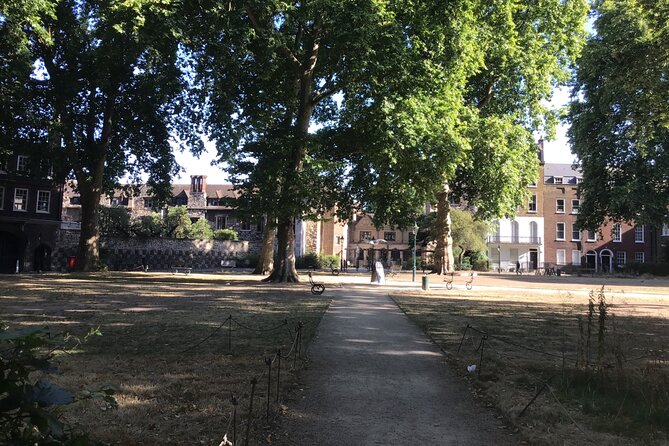
Charterhouse Square brings you back to the Black Death, the 14th-century pandemic that caused enormous loss across Europe and London. This is the location of the largest plague pit ever discovered, containing tens of thousands of victims.
The scale is difficult to picture. A plague pit can sound like a grim historical footnote, but the number connected with this site makes the human cost impossible to ignore. You are looking at an urban place that now functions as a normal London square, yet it is tied to mass death on a staggering scale.
The stop lasts about 10 minutes and is free. Do not expect an elaborate attraction or a large display. The value comes from the guide’s explanation and from understanding what lies beneath an ordinary part of the city.
The Charterhouse skeleton and a face from 1348
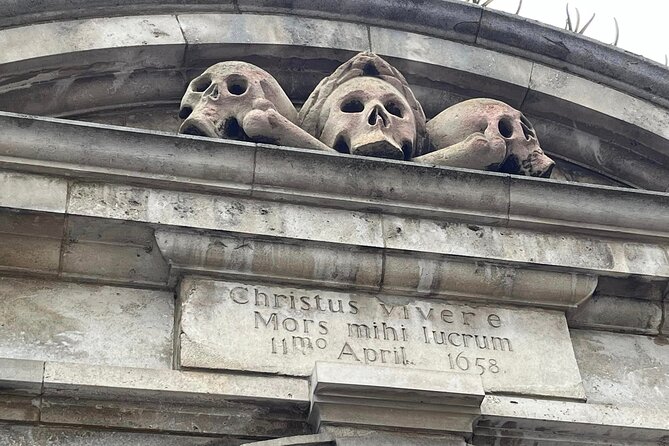
At The Charterhouse, you come face to face with the skeleton of a young man who died from the Black Death around 1348. This is one of the most affecting moments on the route because it turns a distant date into an individual life.
A mass burial site tells you about numbers. A skeleton tells you about one person. That change in scale helps you think about the Black Death as a collection of private tragedies rather than only a major event in a textbook.
You spend about 15 minutes here. The visit adds useful contrast to Charterhouse Square, moving from the size of the burial pit to the remains of one young victim. If you prefer lighter sightseeing, this is a serious and sometimes grim stop. That is also the reason it feels so memorable.
A completely different sort of day out:
- Stonehenge, Windsor Castle and Bath with Pub Lunch in Lacock
★ 4.5 · 7,402 reviews - Tower of London and Crown Jewels Exhibition Ticket
★ 4.5 · 6,677 reviews - Thorpe Park Admission Ticket
★ 4.0 · 5,915 reviews - Stonehenge, Windsor Castle and Bath Full Day Guided Tour
★ 4.5 · 5,346 reviews
William Wallace, revolt, and punishment in Smithfield
The route then widens its focus beyond disease. At the William Wallace Memorial, you see where Wallace was executed not long before the Black Death. The stop is brief, about five minutes, but it places the plague years within a city already familiar with public violence and political conflict.
Next comes the Peasants’ Revolt plaque. London suffered from more than epidemics, and the revolt became a major turning point in the city’s story. Here, the guide connects unrest, social pressure, and the streets where the movement came to a head.
These two stops may appeal most to readers who enjoy wider medieval history. They do not add another plague pit or hospital room, but they show that London’s crises overlapped. Disease was one disaster among several, not the city’s only source of fear.
At Smithfield Martyrs’ Memorial, you stand at the place where bishops were martyred in the 16th century. Again, the stop lasts only about five minutes. Its purpose is to show how Smithfield gathered layers of punishment, religion, rebellion, and death across different periods.
The old hospital and the Great Plague
The route also passes a very old hospital that had recently celebrated its 901st anniversary. The hospital features heavily in the story of the Great Plague in London.
The supplied details do not give the hospital’s name, so you should confirm the exact stop when booking or meeting your guide. What matters for the tour is its role in explaining how illness was treated, observed, and managed in a city under pressure.
This is one point where a private guide can add real value. A building can look impressive without revealing why it matters. The guide’s job is to connect the hospital to the wider story of the Great Plague, rather than leaving you to admire its age and move on.
The Golden Boy of Pye Corner and the end of the Great Fire
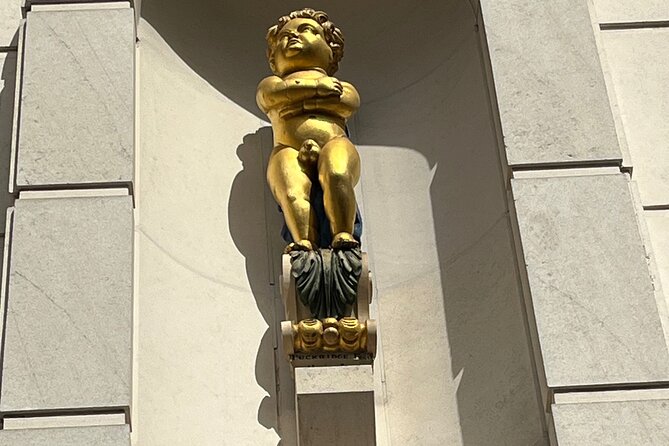
The Golden Boy of Pye Corner is a small, unusual memorial marking where the Great Fire of London was extinguished. It is easy to pass without knowing its meaning, so this stop rewards close attention.
You learn about the design of the memorial and see some of the houses connected with both the Great Plague and the Great Fire. That combination gives the route one of its most useful lessons: the two disasters followed close together, and Londoners experienced them as part of one extraordinary period.
The Great Fire has a complicated place in the plague story. It destroyed large sections of the city, but it also changed the conditions that had allowed disease to spread. The tour explains the relationship without turning the fire into a simple happy ending.
You spend about five minutes here. It is a short stop, but the surrounding streets help you picture how much of London was made of old, tightly packed buildings.
Aldgate Underground Station and a grisly connection
Aldgate Underground Station is an unusual stop for a history tour. Stations are usually places you pass through, not places you visit for the story attached to them.
This one has a grim connection with the Great Plague. You take the Tube to Aldgate, with the fare costing about £5 and not included in the tour price. That transport break changes the rhythm of the experience and lets the route cover more ground than a single continuous walk.
Do not expect the Tube journey itself to be a major attraction. Its value is practical and historical. The station helps connect the earlier stops with the eastern part of the route, where several more plague-related locations appear.
Aldgate Square and Daniel Defoe’s plague account
At Aldgate Square, you hear about the plague pit beneath the area, including its connection with Daniel Defoe’s memorable writing about the epidemic. The stop lasts about five minutes, but it adds a literary angle to the story.
Defoe’s account helps show how the plague was remembered and described, not only how it was experienced at the time. The square also has other plague-related details nearby, along with a connection to one of Jack the Ripper’s victims.
That last detail is not central to the tour, but it reinforces the character of this part of London. The route keeps revealing how different layers of death and crime can occupy the same few streets.
Aldgate Pump and the medieval church steeple
Aldgate Pump has long been a London institution, but its connection with this tour is not cheerful. The guide explains why the pump belongs in a story about the Great Plague.
The stop takes about five minutes. You should not expect a large monument or a long visit. Like several locations on this route, the attraction is an ordinary object with an extraordinary history attached to it.
The tour also pauses at a beautiful medieval church steeple surrounded by modern London. The church itself is no longer there, which raises an obvious question: what happened to it? This is a fine example of how the walk uses fragments rather than grand interiors to tell its story.
St Olave’s Church and Samuel Pepys
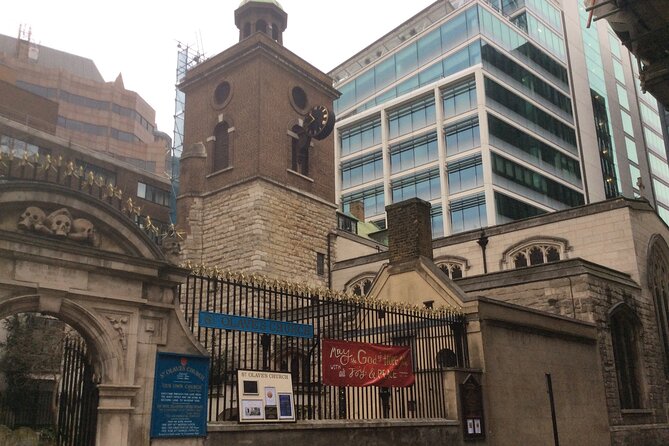
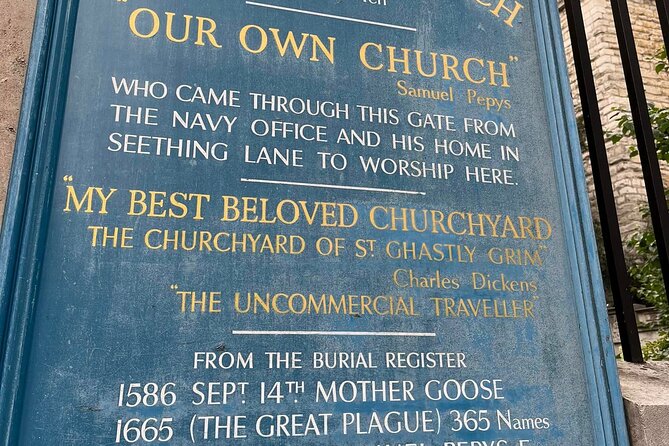
St Olave’s Church is one of the route’s strongest stops. It is the resting place of Samuel Pepys and his wife, and Pepys provides perhaps the best contemporary evidence of everyday London during the Great Plague and Great Fire.
Pepys matters because he recorded ordinary reactions alongside major events. His diary helps you picture a London of rumors, fear, work, household decisions, public danger, and sudden change. Standing at his burial place gives the written account a physical setting.
You spend about 15 minutes here, with no admission charge listed. The church adds a quieter moment after the more severe plague-pit stops. I especially like this part of the tour because it links the public story of disease with the private observations of one person.
Seething Lane Garden and Pepys’s daily life
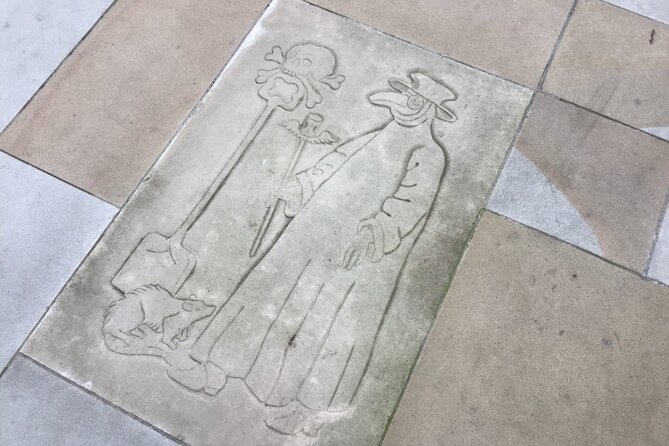
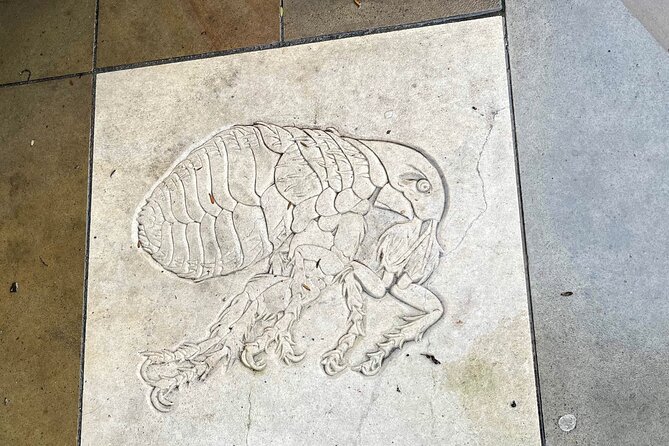
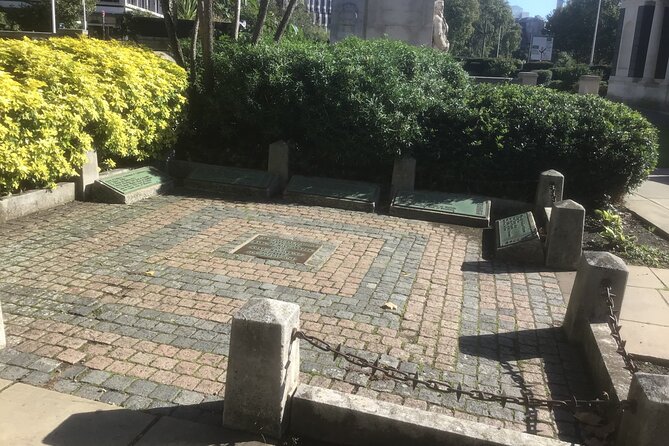
Seething Lane Garden was recently redeveloped and occupies the place where Pepys lived and worked. The garden’s footpath carries etched references to important events in his life.
This stop gives the tour a more personal pace. Instead of hearing only about burial grounds and mass suffering, you are shown where a major historical witness spent his days. You can test your own knowledge against the events marked along the path.
The garden visit lasts about 15 minutes. It is also a useful place to pause and gather the threads of the tour: plague, fire, public office, writing, and the changing city around Pepys.
Tower Hill, Pudding Lane, and the Monument
At Tower Hill Memorial, the guide discusses the famous figures who met grisly ends there. The stop lasts about five minutes and continues the route’s interest in execution, punishment, and public memory.
Pudding Lane is next. This is the exact spot where the Great Fire of London began, and the guide explains what some people regard as its one redeeming feature in relation to the plague.
The tour finishes at the Monument to the Great Fire of London. You have a chance to take photographs there, though admission to the Monument itself is not included. The end point is practical as well as symbolic, since Monument Underground Station is only a few feet away, with taxis easy to find nearby and places to continue for a drink or meal.
Finishing here gives the tour a clear shape. You begin with the first Great Plague cases and finish at the memorial for the fire that reshaped London soon afterward.
Is $218.97 per person good value?
At $218.97 per person, this is not a budget walking tour. The price makes the most sense for people who care strongly about London’s plague history and want a private guide rather than a large scheduled group.
You are paying for interpretation, route planning, and the ability to ask as many questions as you like. Most stops are free, but that does not mean the experience is free to reproduce on your own. The historical connections are scattered across London, and the Tube transfer adds another layer of planning.
The value is weaker if you mainly want famous sights or grand interiors. Several stops last only five minutes, and some are plaques, street locations, or ordinary urban spaces. The tour succeeds through storytelling and context, not through elaborate visitor facilities.
Group discounts may improve the cost for a larger party. Since only your own group takes part, the per-person price can feel more reasonable when shared among several people who already know they enjoy the subject.
Practical details before you book
The meeting point is the Dominion Theatre at 268 to 269 Tottenham Court Road. The tour starts at 9:30 a.m. and ends at Monument Station on King William Street.
Pickup is offered, but confirm the arrangements when booking. A mobile ticket is available, and confirmation is sent within 48 hours, subject to availability.
You need moderate physical fitness. The route includes walking, standing, and a Tube journey. Service animals are allowed, and the tour begins near public transportation.
The cancellation policy is friendly if your plans are not fixed. You can receive a full refund by canceling at least 24 hours before the start time. Changes or cancellations inside that 24-hour window are not accepted.
Who will enjoy this tour most?
I would choose this tour if you already know some London landmarks and want a more unusual historical thread. It suits readers who enjoy social history, disease history, Samuel Pepys, medieval London, and the Great Fire.
It is also a good fit for a couple, family, or small private group that prefers conversation over a fixed lecture. The two available written ratings praise the atmosphere and the guide’s ability to bring forgotten places into focus. One particularly strong point is the feeling of walking through neighborhoods where people actually lived and died, rather than viewing the events from a museum distance.
I would think twice if you dislike grim subjects, have difficulty walking, or want lots of time inside major attractions. This is an atmospheric street tour, not a museum visit, and the subject matter can be bleak.
Should you book The Great Plague and Black Death Tour?
Book it if the idea of seeing plague pits, Pepys’s church, Pudding Lane, and the Great Fire Monument in one private route appeals to you. The strongest parts are the Charterhouse skeleton, the mass burial site at Charterhouse Square, and the connection between Pepys’s diary and the streets around St Olave’s and Seething Lane.
Skip it if the price feels too high for a tour with many brief outdoor stops. For the right audience, though, the private format and unusual route make this a thoughtful way to see London’s past beneath its modern surface.
FAQ
How long is The Great Plague and Black Death Tour?
The tour lasts approximately two to three hours.
What time does the tour start?
The tour starts at 9:30 a.m.
Where does the tour begin?
It begins at the Dominion Theatre, 268 to 269 Tottenham Court Road, London W1T 7AQ.
Where does the tour end?
It ends at Monument Station on King William Street, close to the Monument to the Great Fire of London.
Is this a private tour?
Yes. Only your group participates in the private guided walking tour.
Is Tube travel included in the price?
No. Tube travel costs about £5 and is paid separately.
Is admission to the Monument included?
No. Admission to the Monument to the Great Fire of London is not included.
Are the tour stops free?
Most listed stops have no admission charge, including the churches, squares, gardens, memorials, and street locations.
Can I cancel for a full refund?
Yes, if you cancel at least 24 hours before the experience start time. Cancellations or changes made less than 24 hours beforehand are not accepted.
Is the tour suitable for everyone physically?
You should have a moderate level of physical fitness because the experience includes walking and a Tube journey. Service animals are allowed.
Just added in London
- Private Transfer From London to Southampton Cruise Terminal★ 4.0 · 2 reviews
- Layover Tour of London from LHR Executive Luxurious Vehicle Private Tour 6 hour★ 4.5 · 9 reviews
- Pub & History Tour London (History & Beers)★ 5.0 · 3 reviews
- eSIM for UK (34 EU countries) | 3 to 30 days. Up to 40GB of data★ 4.0 · 18 reviews
- Young Victoria’s London: Windsor Castle & Kensington Palace★ 5.0 · 1 review
- Zombie Scavengers Game – Southend-on-Sea, UK★ 4.5 · 2 reviews
- Women of Whitechapel 2 hour Walking Tour★ 5.0 · 15 reviews
- Working Women of the East End Walking Tour★ 5.0 · 85 reviews
Tours, compared.
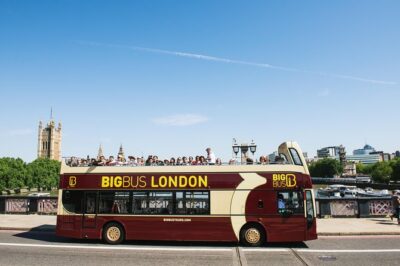
London Big Bus Hop-On Hop-Off Tour with Optional River Cruise
Read our review →

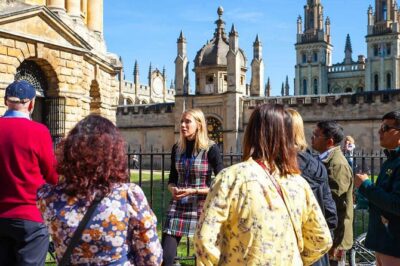
Oxford University Walking Tour With University Alumni Guide
Read our review →
Stonehenge, Windsor Castle and Bath Full Day Guided Tour
Read our review →
London Jack the Ripper Guided Tour with Ripper-Vision
Read our review →