
Reviewed · 1-DAY TOURS
London in One Day: Tour Royal Westminster and the Square Mile
London rewards walkers.
This private six-hour tour links Buckingham Palace, Westminster, and the Tower of London in one long, story-filled route. I like the clever west-to-east design, which lets you watch London change from royal ceremony and national politics to medieval streets and modern finance. I also like that a guide handles the route, timing, and many small historical connections. The main drawback is simple: you will walk a lot, and every major attraction is viewed from outside unless you buy separate admission.
At $514.18 for a private group of up to 15, the price can be fair for a family or full group, but it is costly for one or two people. The tour runs in English, begins at 10 a.m., and includes a one-hour lunch break, but lunch and all entrance tickets cost extra.
In This Review
- Key details that shape the day
- Why this route works for a first London day
- Buckingham Palace, royal courts, and St. James’s Park
- Trafalgar Square and the power center of Whitehall
- Lunch on Villiers Street and the River Thames
- From RAF history to London’s legal quarter
- Fleet Street, Dr. Johnson, and an old London pub
- Wren’s St. Paul’s and the heart of the City
- Bank of England, London Bridge, and Tower Bridge
- The Tower of London finale
- Price, pace, and practical value
- Who should book this London walking tour?
- FAQ
- How long does the London in One Day tour last?
- Where does the tour begin and end?
- Is lunch included in the price?
- Does the tour enter the major attractions?
- When can I see the Changing of the Guard?
- Can I cancel for a full refund?
Key details that shape the day
- A west-to-east crossing of central London: You begin among palaces and royal parks and finish beside the Tower of London.
- A private tour for up to 15 people: Your group gets one guide rather than joining a large public crowd.
- Changing of the Guard on selected days: The ceremony is planned for Mondays, Wednesdays, and Fridays, but weather and royal events can change the schedule.
- More than famous sights: Fleet Street, Dr. Johnson’s House, St. Clement Danes, and the City of London add lesser-known stops to the usual landmarks.
- Lunch comes midway through the walk: You get about an hour around Villiers Street, with pubs, cafes, sandwich shops, and restaurants.
- The guide makes or breaks the experience: Maggie received especially warm praise for linking landmarks with amusing stories and practical food and tea suggestions.
Why this route works for a first London day
London is not one city in the usual sense. It is a collection of old districts, royal precincts, political spaces, financial streets, and river crossings pressed together. This tour makes that contrast easy to see.
You begin at the Constance Fund fountain near Buckingham Palace and finish at the official ticket office of the Tower of London. That route gives the day a clear shape. You are not repeatedly doubling back, and you get a useful sense of how Westminster connects to the City.
I like this approach for a first or second day in London. You see the buildings that define the city, while a guide explains why they matter. The tradeoff is that this is a sightseeing walk, not a series of museum visits. The advertised stops are generally brief, often around 10 minutes, so you should expect explanations, photographs, and exterior views rather than long interior visits.
A few more to weigh up in London
- Stonehenge, Windsor Castle, and Bath from London
★ 4.5 · 18,662 reviews - London Big Bus Hop-On Hop-Off Tour with Optional River Cruise
★ 3.5 · 10,803 reviews - London Small Group Tour of Historical Pubs
★ 5.0 · 10,422 reviews
Buckingham Palace, royal courts, and St. James’s Park
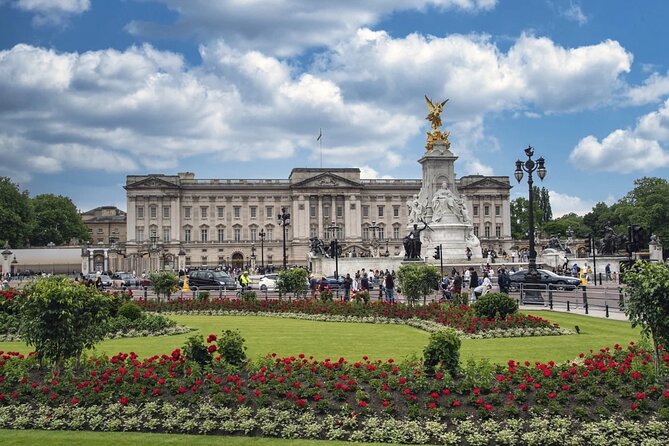
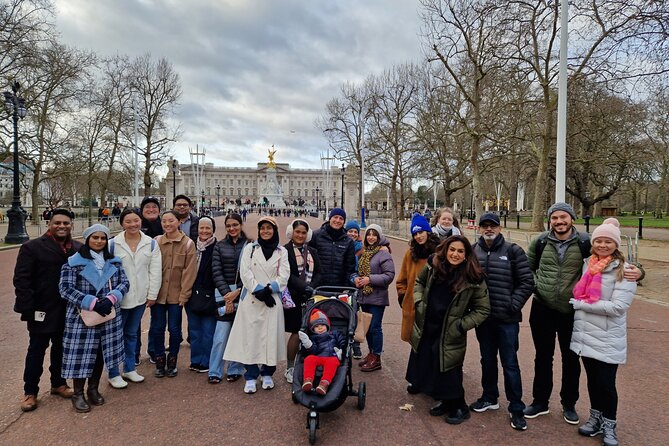
The morning opens at Buckingham Palace, where your guide positions you for photographs of the famous facade. The palace has been the home of the British monarchy for nearly two centuries, so this is a natural place to begin a royal-themed tour.
Do not expect palace admission. The stop is about the setting, the architecture, and the ceremonial role of the building. If you want to tour the State Rooms, you will need a separate visit and ticket.
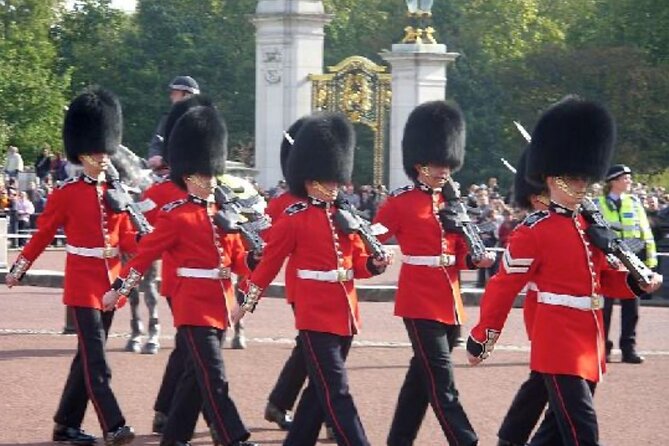
On Mondays, Wednesdays, and Fridays, the route may include the Changing of the Guard. The guide uses a tried-and-tested viewing point intended to give you a close look at the ceremony. This is one of the tour’s most appealing features, but it comes with a clear warning: the schedule can change because of weather, London events, or official royal business.
You then look through the gates at Clarence House, the former home of Queen Elizabeth the Queen Mother and current residence of King Charles III and Queen Camilla. It is a short stop, but it gives you a glimpse of a working royal neighborhood rather than only the grandest palace.
Nearby St. James’s Palace was built by Henry VIII and remains an important center of the Royal Court. It is less visually famous than Buckingham Palace, yet that makes the explanation especially useful. This is the kind of place you might walk past without realizing its importance.
The path through St. James’s Park gives your feet a brief change of pace. King Charles II opened the park to the public in the 17th century, and it remains a pleasant green corridor between royal buildings. Look for the park’s swans and pelicans, which belong to the King. Ten minutes is not enough for a slow park stroll, but the break helps before the denser streets ahead.
Trafalgar Square and the power center of Whitehall
Trafalgar Square is presented as London’s common room, a fitting description for a place used for celebrations, protests, public gatherings, and major events. Nelson’s Column and the four lions offer obvious photographs, but the real value here is understanding the square as a civic stage.
From there, the route moves along Whitehall to Horse Guards Parade. This open space is home to the King’s Life Guard and their horses, and it forms the setting for Trooping the Colour, the monarch’s annual birthday celebration. If the Changing of the Horse Guards happens during your visit, your guide will try to place you close to the action.
You also pass the gates of Number 10 Downing Street. You will not enter, but the heavily protected entrance gives you a look at the practical side of British government. The guide connects the address to the office of the prime minister, a job that has occupied the house for centuries.
The Churchill War Rooms are another important Whitehall sight, though this tour keeps you above ground. Your guide explains that the wartime rooms beneath the Treasury were where Winston Churchill directed Britain during World War II. I think this is a useful recommendation even if you do not enter during the tour. The museum requires its own admission, and it deserves more time than a quick exterior stop.
Westminster Abbey follows. You see the exterior of the church where monarchs are crowned, royal weddings take place, and state funerals are held. It is also the burial place of many kings, queens, and notable figures. The guide aims to give you the best exterior view, but you should know that the interior is not part of the tour price.
The Palace of Westminster brings together the Houses of Parliament and the famous Gothic riverfront often called the Houses of Parliament. The building is mainly Victorian, but Westminster Hall within it dates to 1097. Its past includes trials, coronation banquets, executions, and ceremonial occasions.
That short stop provides strong context for British politics and architecture. It also shows the limits of the format. Ten minutes can introduce the building, but it cannot explain every chamber or constitutional detail.
Lunch on Villiers Street and the River Thames
The tour includes a one-hour lunch break around Villiers Street. This is a practical choice because the lane has pubs, sandwich shops, cafes, and restaurants. Your guide can recommend a place, but you choose and pay for your own meal.
This is one of the better points in the schedule. A long walking tour needs a proper pause, and an hour gives you time to eat rather than simply grab something while standing. The guide can also point you toward an 18th-century underground cellar or a small park for a drink or a quiet break.
After lunch, you get views of the River Thames. The river has shaped London’s trade, transport, industry, and recreation for centuries, running for 215 miles from the Cotswolds to the North Sea. This riverside section helps you connect the separate districts you have crossed during the morning.
A completely different sort of day out:
- Stonehenge, Windsor Castle and Bath with Pub Lunch in Lacock
★ 4.5 · 7,402 reviews - Tower of London and Crown Jewels Exhibition Ticket
★ 4.5 · 6,677 reviews - Thorpe Park Admission Ticket
★ 4.0 · 5,915 reviews - Stonehenge, Windsor Castle and Bath Full Day Guided Tour
★ 4.5 · 5,346 reviews
From RAF history to London’s legal quarter
St. Clement Danes Church offers a different kind of historical stop. Designed by Christopher Wren in the late 17th century, it is now the official church of the Royal Air Force. The building still shows damage from World War II bombing, left unaltered as a reminder of the conflict.
I like this stop because it is more personal and visible than a date-heavy history lesson. The marks on the church give the past a physical presence, even from outside.
The Royal Courts of Justice brings you into London’s legal quarter. Opened by Queen Victoria in 1882, the Neo-Gothic building houses the High Court and Court of Appeal for England and Wales. Its medieval-palace appearance has also made it familiar from television and films, including Bridget Jones’s Diary.
Next comes Temple Bar, the western boundary of the City of London. This is where the route shifts from Westminster into the ancient financial and governmental district known simply as the City. Your guide explains the old custom that required the monarch to ask permission before entering the City, then leads you along Fleet Street, following the line of an ancient Roman road.
Fleet Street is associated with newspapers and the Sweeney Todd story. It is a good example of how this tour mixes serious civic history with the odd, slightly grim London tale.
Fleet Street, Dr. Johnson, and an old London pub
Dr. Johnson’s House sits in a quiet courtyard away from Fleet Street’s traffic. The Georgian townhouse was home to Samuel Johnson, who produced the first comprehensive English dictionary. The tour also points out a curious statue honoring Johnson and his cat, a small detail that gives the stop personality.
Ye Olde Cheshire Cheese supplies the required pub pause. This old, family-friendly pub has connections with writers including Charles Dickens, Arthur Conan Doyle, and P. G. Wodehouse. You do not have time for a full pub meal during the 10-minute stop, but the building helps you picture the literary and journalistic life of old London.
St. Bride’s Church continues the printing and newspaper theme. The church has roots reaching back to the sixth century, while the current Wren building dates from after the Great Fire of London. Its tiered spire is often linked to the design of traditional wedding cakes.
These stops are easy to miss if you follow only the standard sightseeing circuit. They also reward a guide who can tell short stories well. Maggie is specifically praised for making landmark after landmark memorable with amusing details and clear historical links.
Wren’s St. Paul’s and the heart of the City
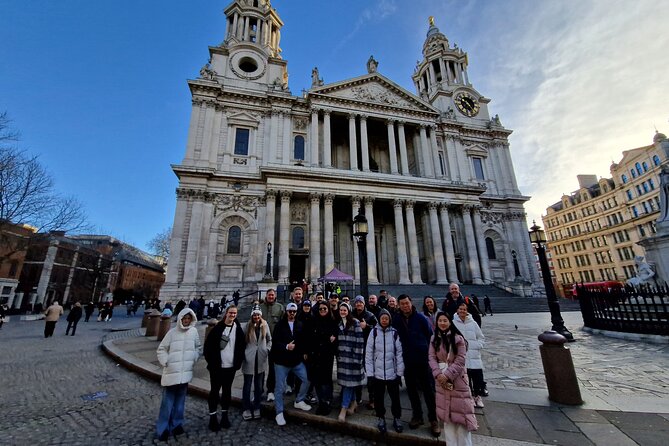
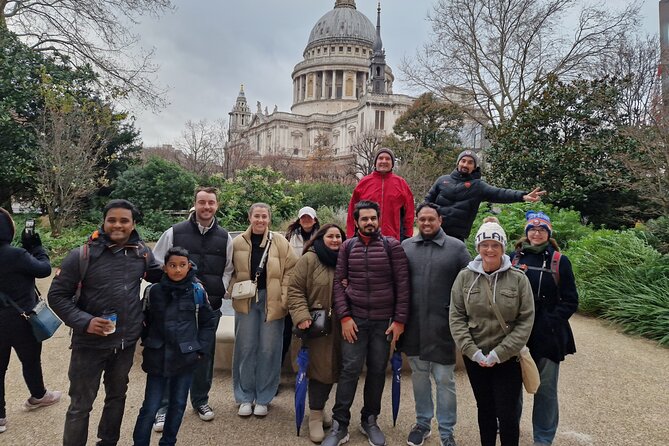
St. Paul’s Cathedral is one of the visual high points of the afternoon. Christopher Wren completed the cathedral in the early 18th century, and its dome remains one of London’s defining views. The building has hosted major events, including Winston Churchill’s funeral and the wedding of Prince Charles and Diana Spencer.
The tour focuses on finding good exterior views, not on entry. You can see the grand structure, take photographs, and hear about features such as the mosaics, arches, and Whispering Gallery, but you will need a separate ticket to explore inside.
At St. Mary Le Bow, your guide explains the story of the Bow Bells. Traditionally, a true Cockney was born within hearing distance of those bells. The church also places you on Cheapside, the site of a medieval market that gave its name to several streets in the area.
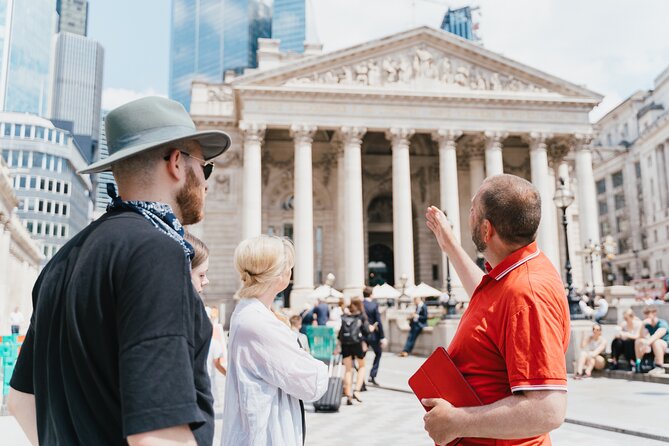
The Royal Exchange and Mansion House then show you the City’s commercial and civic sides. The Royal Exchange began as a center for commerce under Elizabeth I, while the present neoclassical building opened in 1844. It now contains shops, restaurants, and offices.
Mansion House is the official residence of the Lord Mayor of London. Built between 1739 and 1752, it is used for official functions, ceremonies, and receptions. Together, these buildings explain why the City remains more than a collection of offices. It has its own mayor, traditions, boundaries, and ceremonies.
Bank of England, London Bridge, and Tower Bridge
At the Bank of England, you hear how the institution helps manage Britain’s monetary system and financial stability. The guide also points out that the vaults below hold 310 tonnes of gold. You will not enter the vaults, but the fact adds a memorable finish to the City portion of the walk.
The Monument to the Great Fire of London tells the story of the 1666 disaster and the rebuilding of the City under Christopher Wren. The Monument has 211 steps and can be visited separately for a distinctive city view. The tour does not include the climb, and ten minutes is not enough to fit it in, but you can return later if you have the energy.
London Bridge follows. A crossing has occupied this site since AD 42, while the medieval bridge became famous through the nursery rhyme about falling down. The current bridge dates from the 1960s, and your guide explains where you can find the previous version, which was moved out of London.
You also see The Shard, Western Europe’s tallest building at 310 meters, and HMS Belfast across the river. The former Royal Navy cruiser served during World War II, including the D-Day landings and Arctic convoys, and is now a floating museum.
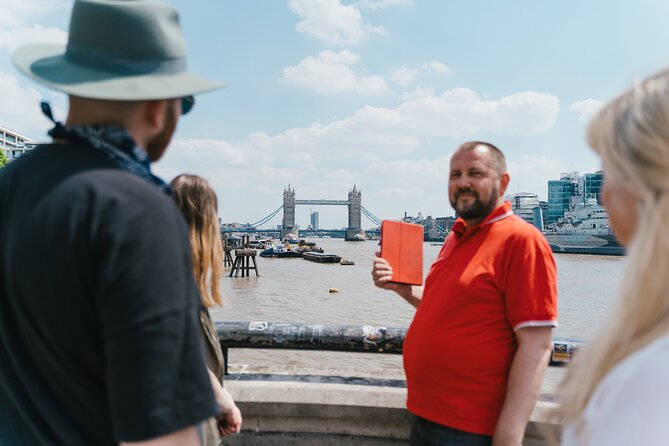
Tower Bridge provides one last grand river view. Completed in 1894, its towers and bascules make it one of London’s most recognizable structures. The bridge still opens for river traffic, and summer afternoon timing may give you a chance to see it lift. The tour itself does not include the high-level walkways.
The Tower of London finale
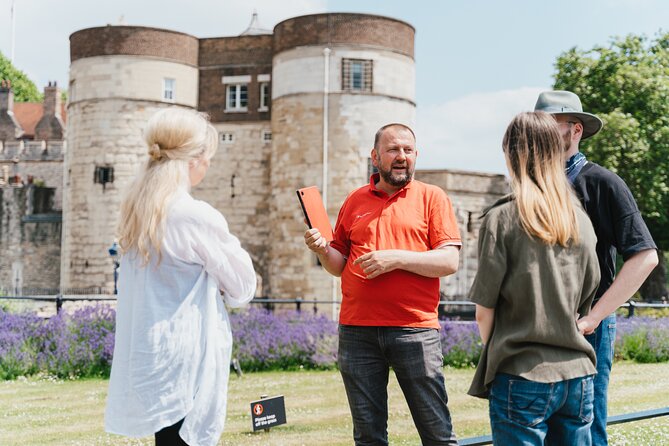
The Tower of London is the final stop, and it is a strong choice. Founded by William the Conqueror in the 11th century, the fortress has served as a royal palace, prison, treasury, and military site. The complex includes the White Tower, medieval defenses, and the Jewel House, home of the Crown Jewels.
Your tour ends at the official ticket office rather than taking you inside. That makes the Tower a natural place to continue your day if you want to buy admission and explore the exhibitions, battlements, and Tower Green. It also means you should budget extra if the Crown Jewels are a priority.
Price, pace, and practical value
The $514.18 group price is easiest to justify with six to 15 people. Split among 10 people, it becomes a reasonable way to get a private guide for a full day of central London sightseeing. For a couple, the cost is much harder to defend unless you place a high value on private attention and efficient routing.
The tour lasts about six hours and 15 minutes, with an hour for lunch. Most sightseeing stops last about 10 minutes, so you will cover ground briskly. Wear comfortable shoes, bring water, and be ready for city walking rather than a relaxed bus tour.
The start point is the Constance Fund fountain near Buckingham Palace at 10 a.m. The finish is the Tower of London ticket office at Tower Hill. You are near public transportation, and service animals are allowed. A moderate level of physical fitness is required.
The tour has a five-star rating from eight published ratings, and Maggie’s ability to combine stories with practical suggestions receives special praise. One especially useful touch was her lunch recommendation and direction to an authentic tea shop for a cuppa at the end.
Who should book this London walking tour?
You should book it if you want a strong first look at London, care about royal and political history, and prefer a private guide to a rigid group schedule. Families and groups of friends can get particularly good value from the flat group price.
I would be cautious if you have limited mobility, dislike long walks, or want to spend serious time inside Westminster Abbey, the Churchill War Rooms, St. Paul’s Cathedral, or the Tower of London. This tour introduces those places, but it does not replace them.
The route is also weather-sensitive. You can cancel up to 24 hours before the start for a full refund, while bad weather or an insufficient number of bookings may lead to a new date or full refund. For the best chance of seeing the Changing of the Guard, choose a Monday, Wednesday, or Friday, then confirm the ceremony is still scheduled.
FAQ
How long does the London in One Day tour last?
The tour lasts approximately six hours and 15 minutes, including a one-hour lunch break.
Where does the tour begin and end?
It begins at the Constance Fund fountain near Buckingham Palace at 10 a.m. It ends at the official ticket office for the Tower of London at 2 Tower Hill.
Is lunch included in the price?
No. The tour includes a one-hour lunch break around Villiers Street, but you choose and pay for your own food or drink.
Does the tour enter the major attractions?
No. The listed admission tickets are not included, and the stops focus mainly on exterior views and guide commentary. You can arrange separate admission to places such as the Tower of London, Westminster Abbey, or the Churchill War Rooms.
When can I see the Changing of the Guard?
The tour plans for the Changing of the Guard on Mondays, Wednesdays, and Fridays. The ceremony may change or be disrupted because of weather, London events, or official royal activity.
Can I cancel for a full refund?
Yes. You can cancel at least 24 hours before the experience start time for a full refund. Changes or cancellations made less than 24 hours before the start time are not accepted for a refund.
Just added in London
- Private Tour: Royal High Tea At Kensington Palace Gardens★ 5.0 · 39 reviews
- Private Tour: Personal Travel Photographer Tour in London★ 4.5 · 27 reviews
- London East End Private Walking Food Tour – Secret Food Tours★ 5.0 · 26 reviews
- Private Tour: Night Photography Tour in London★ 5.0 · 48 reviews
- London Like a Local, Private & Personalized (2-3 hrs)★ 4.5 · 11 reviews
- British Museum & National Gallery of London – Exclusive Guided Combo Tour★ 5.0 · 48 reviews
- Private Tour: Tower of London and St Paul’s Cathedral★ 5.0 · 1 review
- London Soho District – Exclusive Guided Walking Tour★ 5.0 · 2 reviews
1-Day Tours, compared.

Windsor Castle, Stonehenge, and Oxford Day Trip from London
Read our review →
Oxford, Stratford-upon-Avon, Cotswolds & Warwick Castle Day Trip
Read our review →
Leeds Castle, Cliffs of Dover and Canterbury Day Trip from London with Guided Cathedral Tour
Read our review →
Guided Luxury Paris Day Trip with Optional Lunch at the Eiffel Tower
Read our review →
Windsor, Stonehenge and Bath Day Trip from London Spanish
Read our review →Windsor Castle, Stonehenge, and Oxford Day Trip from London
Read our review →
Stonehenge and Bath Day Trip from London with Optional Roman Baths Visit
Read our review →Browse the lists this tour appears in