
Reviewed · HISTORICAL TOURS
History and Hauntings Self Guided Walking Tour in York with App
York’s past is waiting around every corner. This affordable app-based walk links Roman ruins, medieval gates, York Minster, the Shambles, and some of the city’s best ghost stories into a route of about 90 minutes. I like the freedom to walk at your own pace and the fact that you can use the tour over a full year, but you should know that the directions can be less clear than the historical narration.
I also like the low price of $7.88 per person, especially since the tour covers 18 locations and works offline after download. The main drawback is that this is not a guided walk with a person beside you, and a section of the city wall may be closed or difficult to reach at certain times.
In This Review
- Key points to know before you go
- What the York walk actually offers
- Starting at St. Mary’s Abbey and the Yorkshire Museum
- The Multangular Tower and York’s Roman foundations
- Bootham Bar, Robin Hood Tower, and Monk Bar
- A haunted mansion and Constantine’s statue
- York Minster and the Roman road beneath Stonegate
- Mad Alice, the Shambles, and the Golden Fleece
- Merchant Adventurers’ Hall, Vikings, and York Castle Museum
- Ending at Clifford’s Tower
- App performance, directions, and practical limits
- Is $7.88 good value?
- Who should choose this York tour?
- Should you book the History and Hauntings walk?
- FAQ
- How long does the History and Hauntings walking tour take?
- Where does the tour start?
- Where does the tour end?
- Is a human guide included?
- Can I use the tour without an internet connection?
- Are entrance fees included?
- Can I cancel for a full refund?
Key points to know before you go
- Roman and medieval York in one compact route: The walk connects the Multangular Tower, Constantine’s statue, York Minster, medieval bars, Stonegate, and the Shambles.
- Ghost stories are woven into the history: You hear about Mad Alice, the Golden Fleece pub, Roman soldiers, and strange sightings at an old York mansion.
- Use the app at your own speed: You receive one year of access on iOS or Android, with audio, written information, photos, and an interactive map.
- Download the tour before walking: Offline access is available once the tour is downloaded, which matters if your phone signal is weak or you want to save mobile data.
- Start early with care: Some gates near the first stops may be locked before 10am, even though the stated operating hours begin at 8am.
- It is an outside-only experience: Admission to York Minster, the Yorkshire Museum, Clifford’s Tower, and other attractions is not included.
What the York walk actually offers
This is best understood as a flexible city walk with a historical and supernatural theme. The app provides an AI-narrated audio guide, written information, photographs to help you identify each stop, and an interactive map. You can listen as you walk, read instead, or pause whenever a church, shop, museum, or street catches your eye.
The advertised walking time is about 1 hour 30 minutes. That includes time at the stops and the walking between them, but your actual visit can take much longer. You may want to pause for York Minster, explore the Shambles, or stop for a drink at one of the old pubs along the way.
The tour begins at 29 Marygate and ends at Clifford’s Tower. It is designed for up to 20 people, but there is no group meeting and no human guide. You simply follow the route on your phone.
That arrangement is a good fit if you dislike fixed departure times. You can also return to the app on another day, and the one-year access period gives you plenty of room to split the route into shorter walks. The tradeoff is that you must manage your own navigation, battery, timing, and interpretation of the sights.
More History Tours in York
- Shadows of York: Ghost Walk and Horrible History.
★ 5.0 · 1,403 reviews - Private Historical Walking Tour of York
★ 5.0 · 1,324 reviews - York Witches and History Walking Tour
★ 5.0 · 410 reviews
Starting at St. Mary’s Abbey and the Yorkshire Museum
The first named stop is St. Mary’s Abbey, where the tour sets up York’s long story. The remains are free to view from outside, and the setting gives you an immediate sense of how the city changed from Roman settlement to Viking center, medieval religious power, and Tudor-era town.
The abbey ruins are especially useful as an opening stop because they show history in fragments. You are not looking at one complete building from one period. You are seeing the remains of an institution that was shaped by religious power, wealth, political change, and the Dissolution of the Monasteries.
The route also points you toward the Yorkshire Museum. The tour tells you what historical objects and treasures are displayed there, but the museum entrance is not included. If you want a fuller look at York’s archaeological past, you will need to pause the walk and pay separately.
The first section may require a little patience with navigation. Access around the opening stops can change, and one practical warning is worth taking seriously: some gates near the first part of the route may be locked before 10am. The published hours say 8am to 7pm, but actual access to particular paths can differ.
The Multangular Tower and York’s Roman foundations
The Multangular Tower is one of the most interesting early stops because its shape is so unusual. This twelve-sided Roman tower was later adapted for medieval defenses, giving you a clear example of York’s habit of building new protection onto older foundations.
The audio explains how the tower fits into the city’s military past. You can look at the stonework and imagine the Roman fortifications beneath the later medieval city, even though the stop itself is brief.
This is a good place to remember that the route is not a museum tour. You will get context and interpretation from the app, but you are mainly viewing the sights from outside. The value comes from knowing what you are looking at, not from entering a preserved interior.
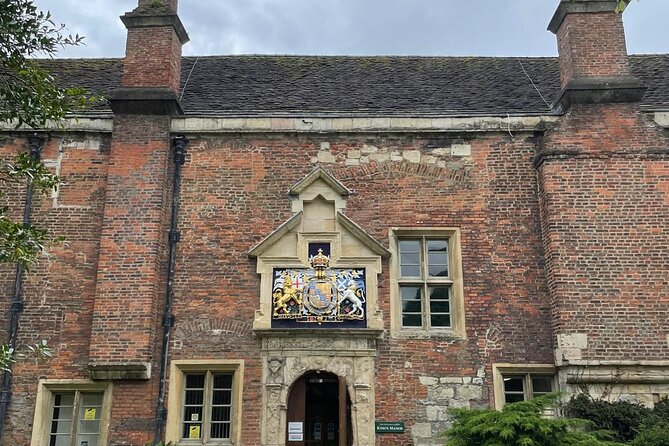
The next section discusses the transformation of an abbey into the King’s Manor during Henry VIII’s Dissolution of the Monasteries. The comparison with Brexit is an unusual modern reference. It gives the app a way to connect a major historical break with a political decision that changed how England related to a wider institution.
You may appreciate the comparison, or find it a little more pointed than the rest of the tour. Either way, it adds a contemporary angle to a story that can otherwise feel remote.
Bootham Bar, Robin Hood Tower, and Monk Bar
York’s medieval gateways are called bars, and Bootham Bar introduces their practical purpose. These were not simply ornamental entrances. They controlled movement into the city and could function as toll points and defensive barriers.
The app helps you notice the difference between walking through a modern city and passing through an old fortified town. Shops, traffic, and crowds can make the bars seem like ordinary city structures until you understand their role.
At Robin Hood Tower, the emphasis shifts to the city walls. The story here is not only medieval. It also covers the Georgian taste for picturesque ruins, later efforts to preserve the walls, and legal disputes surrounding their future.
That is a useful reminder that old buildings do not survive by accident. York’s walls became attractive public walkways partly because local people argued over their value and pushed for their protection.
A practical concern is that the route includes part of the wall walk, and access can change. A section may be closed, forcing you to adjust the route. The app’s map and photos can help, but you should be ready to use Google Maps as a backup if the walking path is blocked.
Monk Bar adds another layer. It was a fortified gateway, but it also served as a home and a place for public proclamations. This makes the stop more personal than a simple military explanation. The bar was part of everyday city life, not just a structure used during conflict.
More Self-Guided Tours in York
- Golden Tours York Hop-on Hop-off Open Top Bus Tour with Audio Guide
★ 4.5 · 468 reviews - Romans, Vikings and Medieval York: An Audio Tour
★ 4.5 · 118 reviews - Private York Self-Guided Tour
★ 4.0 · 24 reviews
A haunted mansion and Constantine’s statue
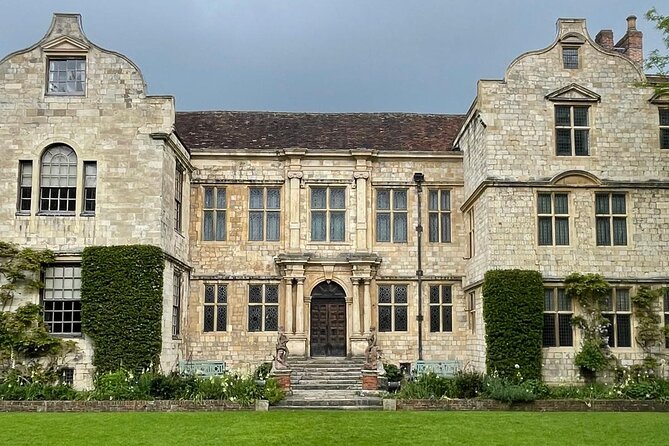
The route then turns toward York’s more atmospheric stories. At an old mansion, you hear about the wealthy lifestyle of York’s elite and reports of Roman soldiers appearing as ghosts.
This stop works because it joins social history with haunting folklore. You are not only hearing about spirits. You are also being reminded that grand houses reflected the power and wealth of a small section of society.
The tour does not include entrance fees, so you view such attractions from outside. That is important if you expect an indoor ghost tour. This is a city walk with stories attached to visible buildings and streets.
The statue of Constantine the Great marks one of York’s most important Roman episodes. Constantine was proclaimed emperor in York in AD 306, and the sculpture commemorates that event. The tour also connects him with the legalization of Christianity.
The statue is modern, but the event it represents reaches back to the Roman period. It is a good stop for understanding how York’s importance extended far beyond its walls. You are standing in a city that once played a role in the politics of the Roman Empire.
York Minster and the Roman road beneath Stonegate

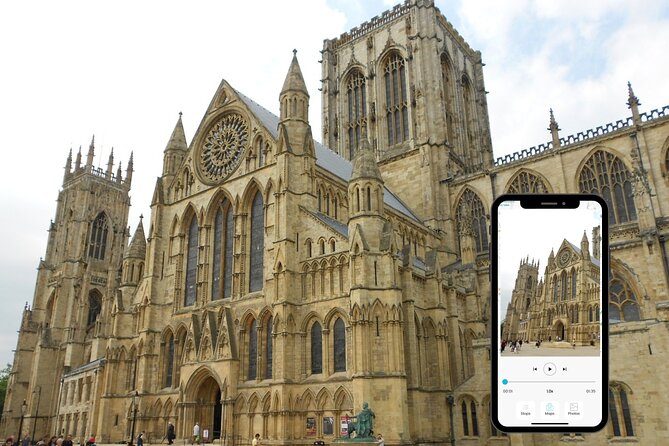
York Minster is the visual high point of the route. The tour describes its Gothic and medieval architecture and gives you time to study the exterior. You can pause the app if you want to enter, but admission is separate.
That pause option matters. York Minster deserves more than five minutes if you want to see the interior, and the self-guided format lets you make that decision without holding up a group. If you are short on time, the exterior still gives you a striking landmark and a useful reference point for the rest of central York.
Stonegate follows, with its shops and busy pedestrian flow. Beneath the modern street is an ancient Roman road, and the app explains how the area developed through Viking and Norman periods as well as during the construction of the Minster.
The stop is strongest when you look beyond the shopfronts. Stonegate is not just a place to buy something. It occupies an old route through the city and has long been connected with York’s religious and civic life.
Directions may require more attention here. The city center has many narrow lanes and intersecting streets, and one weakness of the experience is that the app does not always provide enough extra information while you walk between stops. The photos are helpful, but you should check the map at each turn rather than listen continuously with your phone in your pocket.
Mad Alice, the Shambles, and the Golden Fleece
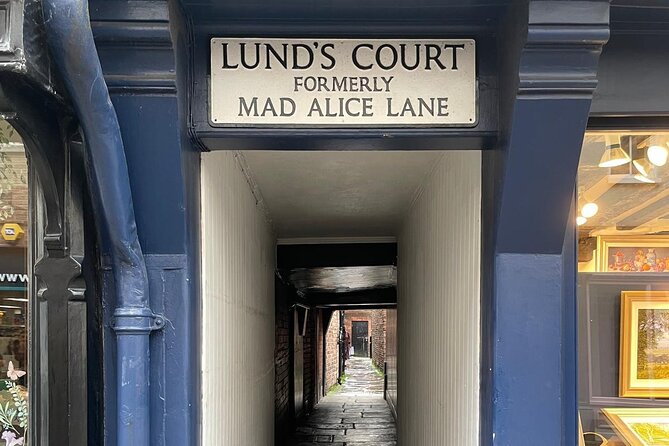
The stop simply labeled York introduces the story of Mad Alice. A snickleway, or narrow passage, once known as Mad Alice Lane is linked with the ghostly figure. The story gives you the kind of unsettling detail that makes York’s side streets feel different after dark, even though this is not advertised as a night tour.
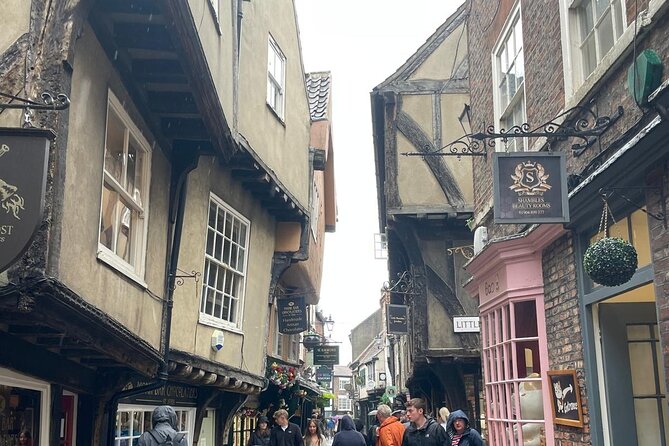
The Shambles is the route’s most memorable street for many people. Its narrow lanes and timber-framed buildings are among York’s clearest surviving medieval scenes. The app explains the street’s former role as the city’s main butcher area and points out the shrine of St. Margaret Clitherow.
Today, the Shambles is also lined with distinctive shops, so it can feel more commercial than historic. That is not a reason to skip it. The contrast helps you see how an old working street has been adapted for modern use.
Take your time here. Five minutes is enough for the formal stop, but not enough for photographs, browsing, and reading the building fronts. If you are visiting during a busy period, narrow lanes can also make it harder to follow the narration while moving. Pause at the side and let people pass.
The Golden Fleece is the final major haunting stop before the walk turns toward York’s other historic institutions. It is described as York’s most haunted pub, with more than 15 spirits said to roam there, including Lady Alice Peckett and One Eyed Jack.
The story is entertaining, but keep your expectations realistic. You are hearing local ghost lore and seeing the pub from the route. This is not a paranormal investigation, and the price does not include drinks or entry.
Merchant Adventurers’ Hall, Vikings, and York Castle Museum
The extra points along the route widen the subject beyond ghosts. You hear about the 14th-century Merchant Adventurers’ Hall, which brings York’s commercial history into view.
The Viking section is another useful addition. York is often associated with medieval streets and Roman walls, but the Viking period is central to the city’s identity. The app gives you a way to connect the streets around you with that earlier chapter.
The route also explains what you can find at York Castle Museum. Again, the museum is not included, so treat this as an introduction rather than a substitute for visiting. If you want to explore the museum’s displays, plan extra time and a separate admission.
These stops show the strength of a self-guided route. You get a broad outline of York’s past without being locked into one subject. Roman military power, Viking settlement, medieval religion, wealthy merchants, Tudor upheaval, and ghost stories all appear within one walk.
The weakness is that the experience can feel like a series of short audio chapters. The named stops are generally about five minutes each, and the walking connections do not always receive much explanation. I would use the app as a framework, then allow yourself time to look around and make your own connections.
Ending at Clifford’s Tower
The walk ends at Clifford’s Tower, a major landmark on York’s historic castle site. The final section gives you more background on the tower and the wider castle area.
The end point is convenient because it leaves you near a substantial York sight rather than dropping you in an unremarkable street. You can stop there, continue exploring the city, or decide if you want to pay separately to enter the tower.
The route’s ending also gives the walk a clear shape. You begin among abbey ruins and Roman defenses, pass through medieval gates and streets, and finish with one of York’s best-known castle structures.
Remember that the tour only covers outside viewing. Entrance to Clifford’s Tower is not included, just as admission to the Minster, museums, and other sights is not included.
App performance, directions, and practical limits
The strongest part of the app is its flexibility. You can access it on iOS or Android for one year, listen as many times as you like, and pick up where you stopped. You can also visit the stops in a different order if that suits your day.
The photographs are clear and help you identify the correct tower, gate, statue, or street. Offline access is particularly useful, but only after you download the tour. Do that before setting out.
The map is less dependable than the narration. It may sometimes help to switch to Google Maps, especially around the wall walk and York’s tight central lanes. I would keep your phone charged and avoid relying on audio alone for directions.
The narration is AI-generated, with both audio and written versions available. The descriptions are not overly long, which helps you keep moving, but the style will not feel as personal as a local guide answering questions in real time.
You receive booking confirmation at the time of purchase, followed by access instructions from Tourific. Search your inbox for an email from Tourific if the app details do not appear immediately.
The tour is offered in English. Service animals are allowed, public transportation is nearby, and most people can participate. Free cancellation is available if you cancel at least 24 hours before the start time. Changes or cancellations inside that window are not refunded.
Is $7.88 good value?
At $7.88, this is inexpensive for a 90-minute route with access lasting a full year. I consider it good value if you want a structured introduction to York and do not need a live guide.
The value improves if you split the walk over two days or return to selected stops. A paid walking tour usually gives you a human guide and more detailed local commentary, but this app gives you control over timing and avoids the pressure of keeping up with a group.
The cost does not cover any attraction admission. If you enter York Minster, the Yorkshire Museum, York Castle Museum, or Clifford’s Tower, those expenses come separately. Think of the app as a low-cost orientation tool, not a complete sightseeing pass.
Who should choose this York tour?
I would choose this walk if you like history in small portions, want the freedom to stop often, or are visiting York without a fixed schedule. It also suits couples, independent adults, and families who prefer not to follow a guide through every street.
The ghost stories make it more appealing than a standard historical orientation, but the haunted material is mixed with Roman, Viking, religious, military, and commercial history. You do not need to be especially interested in ghosts to enjoy the route.
I would be more cautious if you want precise turn-by-turn navigation, a lively local guide, or entry into the buildings. The route can also be awkward if a wall section is closed or if you begin before nearby gates open.
Should you book the History and Hauntings walk?
Book it if you want a cheap, flexible introduction to York with plenty of freedom. The best features are the clear stop photos, offline audio and written content, one-year access, and the mix of serious history with stories about Mad Alice, Roman soldiers, and the Golden Fleece.
Skip it if you expect a polished guided experience with flawless directions. Download the tour before you leave, consider starting after 10am, check the wall route, and keep Google Maps available. With those precautions, the app offers a useful way to connect York’s ancient walls, medieval streets, famous Minster, and haunted corners without spending much.
FAQ
How long does the History and Hauntings walking tour take?
The approximate duration is 1 hour 30 minutes, including time at the stops and the walking between them. You can take longer if you pause at York Minster, the Shambles, museums, or other sights.
Where does the tour start?
The tour starts at 29 Marygate, York YO30 7WH, UK.
Where does the tour end?
The final stop is Clifford’s Tower on Tower Street, York YO1 9SA.
Is a human guide included?
No. This is a self-guided experience delivered through an iOS or Android app. It includes AI-narrated audio, written information, photographs, and an interactive map.
Can I use the tour without an internet connection?
Yes. You can use it offline after downloading the tour to your device.
Are entrance fees included?
No. The tour is intended to be experienced from outside, and admission to sights such as York Minster, the Yorkshire Museum, York Castle Museum, and Clifford’s Tower is not included.
Can I cancel for a full refund?
Yes, if you cancel at least 24 hours before the experience start time. Cancellations or changes made less than 24 hours in advance are not refunded.
More Walking Tours in York
- Wizard Walk of York – WINNER Best Tour & Best of York Award
★ 5.0 · 918 reviews - J & M York City Walking Tours
★ 4.5 · 480 reviews - Shared Walking Tour in York
★ 5.0 · 480 reviews
Just added in York
- Romans, Vikings and Medieval York: An Audio Tour★ 4.5 · 118 reviews
- Private York Self-Guided Tour★ 4.0 · 24 reviews
- York Historical Gems Tour & A Taste of York Chocolate★ 5.0 · 101 reviews
- Evening ‘Happy Hour’ Boat Cruise For All Ages In York★ 4.0 · 243 reviews
- Fun, Flexible Treasure Hunt Around York with Cryptic Clues & Hidden Gems★ 5.0 · 248 reviews
- Yorkshire Dales Tour from York★ 5.0 · 297 reviews
- Steam Trains, Whitby, and the North York Moors Full-Day Tour from York★ 5.0 · 320 reviews
- York Witches and History Walking Tour★ 5.0 · 410 reviews
Historical Tours, compared.


Shadows of York: Ghost Walk and Horrible History.
Read our review →

A Walk Through Time: History of Liverpool Walking Tour
Read our review →
Royal Historic Pubs Walking Guided Tour in London
Read our review →
Private Group: Historical Pub Walking Tour of London
Read our review →
Best Of Liverpool Heritage, History & Culture Guided Walking Tour
Read our review →Browse the lists this tour appears in