
Reviewed · BATH TOURS
Private Guided Tour of Jane Austen’s Bath
Bath reads like one of Austen’s novels. Follow the footsteps of Jane Austen. This private 2.5-hour tour links her family homes, favorite social places, and the streets that appear in Northanger Abbey and Persuasion. I like the efficient route through Bath’s major Austen sites, and I like having a guide explain Regency manners instead of leaving you to piece together the story from plaques.
The private format is a real plus for a group of up to six, especially if you want to ask questions or set a comfortable pace. Theresa, one of the guides associated with the tour, is praised for being well informed, enthusiastic, and entertaining. The main drawback is that the advertised price covers the group rather than each person, so it offers better value with four to six people. Also, several stops are viewed from outside unless you pay separately for admission.
In This Review
- Key points at a glance
- Why Jane Austen’s Bath works best with a guide
- Bath Abbey and Sally Lunn’s old house
- The Cross Bath, Pump Rooms, and fashionable Bath
- Queen Square and the view from No. 13
- The Circus and No. 1 Royal Crescent
- Assembly Rooms and the rules of Regency society
- Milsom Street, St Swithin’s Church, and Austen’s family
- Pulteney Bridge and Great Pulteney Street
- Price, group size, and what you actually receive
- Who should book this Bath experience?
- Should you book the Private Guided Tour of Jane Austen’s Bath?
- FAQ
- How long is the Private Guided Tour of Jane Austen’s Bath?
- Where does the tour begin?
- Where does the tour end?
- How many people can join the private tour?
- Are admission tickets included?
- Can I cancel for a full refund?
Key points at a glance
- Austen’s Bath in one focused route: See Bath Abbey, Queen Square, The Circus, the Royal Crescent, the Assembly Rooms, Milsom Street, and more.
- Private group of up to six: You avoid a large shared group and can direct questions toward Jane Austen, Bath, architecture, or Regency customs.
- Two and a half hours on foot: The route begins at Bath Abbey and ends near Sydney Place, making it useful for getting oriented in the city.
- Strong literary connections: Learn how Milsom Street appears in Northanger Abbey and Persuasion, and why the Pump Rooms matter in Northanger Abbey.
- A tasty Austen detail: Sally Lunn’s large, light, yeasty bun was a Bath favorite, and Austen wrote about it in her letters.
- Weather matters: The experience requires good weather, with a new date or full refund offered if poor conditions force cancellation.
Why Jane Austen’s Bath works best with a guide
Austen lived in Bath for several years, and the city shaped more than a few scenes in her fiction. Yet the connections are scattered. One place relates to her family, another to fashionable society, another to the architecture she saw daily. Without local context, you may simply pass a handsome square or street without understanding why it matters.
I like the way this tour brings those pieces together. You are not only shown grand buildings. You are told how people used them, who gathered there, and what social rules controlled daily life. That matters because Austen’s novels depend on social detail. A dance, a visit, a walk down a shopping street, or a seat in a public room could change a person’s prospects.
The private setup helps here. With only your own party, you can ask why a particular building appears in a novel, how an assembly worked, or what Austen’s family was doing in Bath. A larger group can be fine for a quick overview, but this format should feel more like a conversation than a lecture.
The tour lasts about 2 hours and 30 minutes. That is long enough for a useful introduction without taking up an entire day. You begin outside the West Doors of Bath Abbey and finish at Sydney Place, near the eastern end of the route. Since you do not return to the starting point, think of it as both a tour and a convenient way to cross the city.
A few more to weigh up in Bath
- Walking Tour of Bath with Blue Badge Tourist Guide
★ 5.0 · 1,877 reviews - Stonehenge, Avebury & the Cotswolds from Bath (Small group)
★ 5.0 · 798 reviews - Roman Baths and Bath City Walking Tour
★ 4.5 · 762 reviews
Bath Abbey and Sally Lunn’s old house
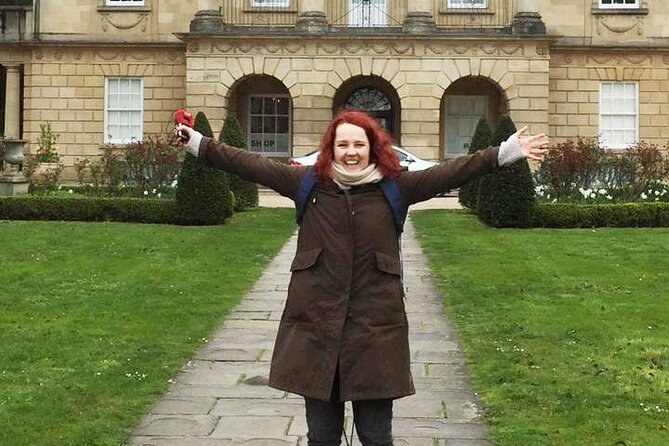
The meeting point is outside the West Doors of Bath Abbey. The Abbey is one of Bath’s central landmarks, so it is an easy place to locate, though the square around it can be active with people and traffic. Allow enough time to identify the correct doors before the tour begins.
The Abbey stop itself lasts about 10 minutes, and admission is not included. The emphasis here is likely on orientation and the role of the Abbey within central Bath rather than a full interior visit. If you want to see inside, treat that as a separate plan and budget for its admission.
From there, the route reaches Sally Lunn’s Museum, set in one of Bath’s oldest houses. The food connection gives the tour a pleasant change of pace. The large, light, yeasty Sally Lunn is often confused with the Bath bun, but they are not the same thing.
The story links the bun to Solange Luyon, a young Huguenot refugee who supposedly brought it to Somerset. Austen liked Sally Lunns enough to mention them in her letters, which gives you a small but appealing glimpse of ordinary pleasure in her life.
The stop lasts about 10 minutes, and museum or food purchases are not included. You should not expect a full tea break during the tour. Instead, note the location and return later if you want to explore the museum or try the bun at a slower pace.
The Cross Bath, Pump Rooms, and fashionable Bath
The next section turns toward Bath’s bathing culture. The Cross Bath is an old bathing pool supplied by natural mineral water. It was rebuilt by Thomas Baldwin in 1789 in a style associated with Robert Adam, giving you a clear link between Bath’s spa tradition and its Georgian makeover.
The nearby Pump Rooms were a social meeting place as much as a health facility. In Austen’s day, people came to see and be seen. That is the point worth carrying into her novels: Bath’s public rooms allowed people to observe one another, form opinions, exchange gossip, and make social connections.
Austen used this setting in Northanger Abbey, where the Pump Room becomes part of the machinery of Bath society. A line about every creature in Bath appearing there at different points during the fashionable hour captures the place’s social purpose. You are looking at a building, but the guide helps you picture the flow of people around it.
This section takes about 20 minutes. Admission is not included, so the visit is best understood as an exterior introduction unless you arrange entry separately. That may disappoint you if you hoped for a series of indoor visits, but it keeps the tour moving and allows the guide to cover more of the city.
Queen Square and the view from No. 13
Queen Square offers one of the clearest links to Austen’s own time in Bath. The square is made up of Grade 1 Georgian houses built in the Palladian style by John Wood the Elder. Its formal design gives you an immediate sense of the ordered world that Bath’s fashionable residents wanted to project.
Austen stayed with her family at No. 13 in 1799. From her bedroom window, she could watch elegantly dressed people walking past the pale stone buildings. That detail makes the square feel personal. It is not just an architectural stop. It connects Austen to the daily spectacle of Bath life.
The guide also discusses the stories behind the houses and the people who lived behind their doors. The obelisk in the center of the gardens was erected by Beau Nash in honor of Frederick, Prince of Wales. Even if you are not an architecture enthusiast, the square helps explain the setting for Bath’s social world.
You spend about 10 minutes here, with no admission charge. Since it is an open public square, this is an easy stop for most people. It is also a good place to pause and ask questions before the route moves into Bath’s grandest Georgian spaces.
A completely different sort of day out:
- Fully Guided Bath Ghost Tours
★ 5.0 · 539 reviews - Best of Bath Walking Tours – Georgian Tour
★ 5.0 · 449 reviews - Bad of Bath fun Walking Tour of Bath
★ 5.0 · 402 reviews - The Cotswolds Tour From Bath (Small group)
★ 5.0 · 349 reviews
The Circus and No. 1 Royal Crescent
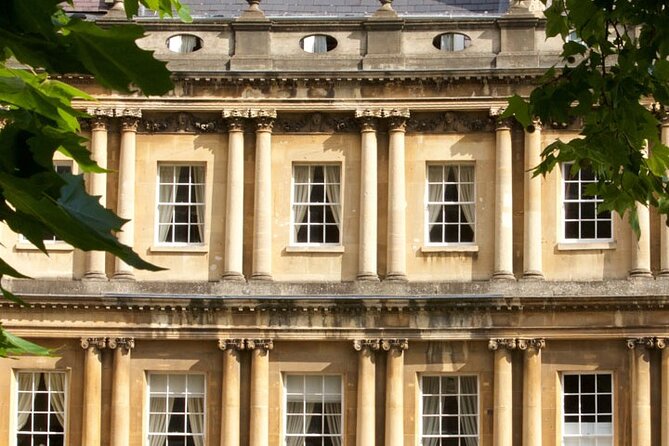
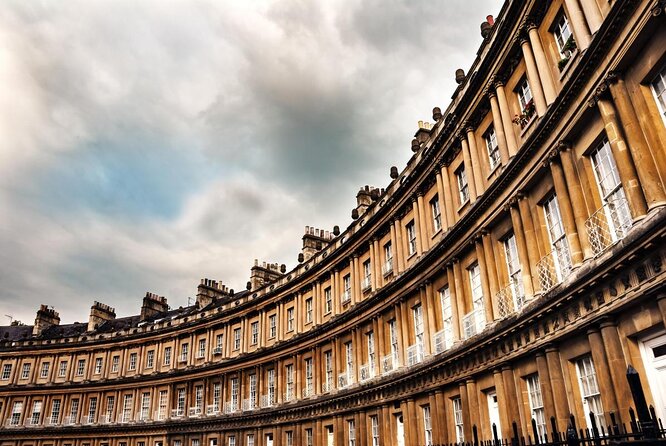
The Circus and Royal Crescent are the visual centerpieces of the tour. The Circus was part of John Wood the Elder’s plan to give Bath a classical Palladian form. Its curved arrangement and repeated architectural details make it one of the city’s most memorable places.
The guide focuses on the people who lived at this address and what life was like behind the elegant facades. That human detail is useful. Grand Georgian buildings can become a blur after a while, but stories about residents and social behavior give the stonework a purpose.
The Circus stop lasts about 15 minutes and is free to view. You will want a camera here, but do not let the photographs replace the explanation. The point is not only that the buildings look beautiful. It is that the design reflects the ambition and order of Georgian Bath.
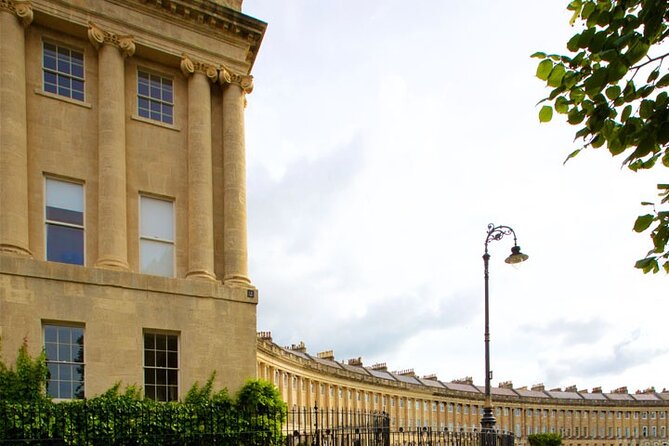
The route then reaches No. 1 Royal Crescent. The crescent contains 30 terraced houses laid out above the city, facing Royal Victoria Park. John Wood the Younger designed the row, which was built between 1767 and 1775.
The exterior remains close to its original appearance, making it easier to imagine Austen’s Bath. The guide explains what the street was like in her time and shares stories connected with the address. Admission is not included, so you may only see the outside during the tour.
If you want to visit the interior of No. 1 Royal Crescent, plan that separately. The tour’s value comes from connecting the building to the period, not from providing a full house museum visit. This distinction is important when you compare the price with tours that include entry tickets.
Assembly Rooms and the rules of Regency society
The Assembly Rooms were where fashionable people gathered for balls, concerts, and other social events. Austen enjoyed dancing, and this was one of the places where a person could be seen, judged, and introduced to others.
The guide explains how the rooms worked and why they mattered to Austen and the characters in her novels. You will also hear about one of Austen’s uncles and the 17th-century investment plan that helped fund the Upper Rooms. That small family connection adds a personal thread to the building.
The stop lasts about 10 minutes. Admission is not included, so check the arrangement before assuming you will go inside. Even from outside, the guide can explain the social function of the rooms, but an interior visit would naturally add more atmosphere.
This is one of the most useful parts of the tour if you enjoy the social mechanics in Austen’s books. You learn why dancing was not merely entertainment. It was a way to meet people, display manners, manage reputation, and perhaps begin a courtship.
Milsom Street, St Swithin’s Church, and Austen’s family
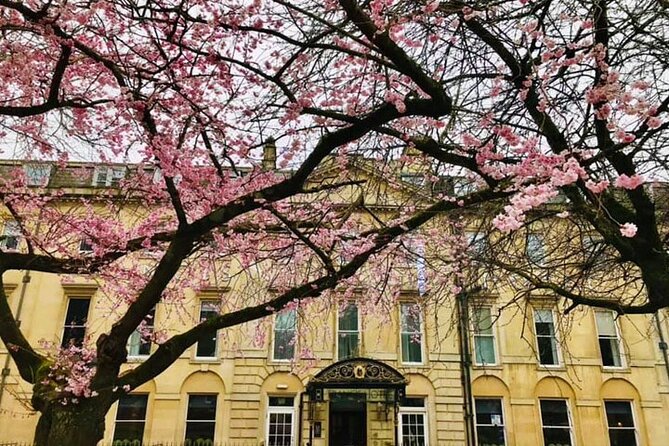
Milsom Street brings the literary connections into the present-day city. It was a fashionable Georgian thoroughfare and appears in both Northanger Abbey and Persuasion. It remains a shopping street, so you can see how an old social corridor continues to function as a busy commercial part of Bath.
On the way, you pass St Swithin’s Church. Austen’s parents were married there, and her father is buried there. This is a quieter family connection, and I like the contrast with the public spectacle of the Assembly Rooms and Pump Rooms.
The stop takes about 10 minutes and is free. The route does not turn Milsom Street into a full shopping visit, so save purchases for after the tour. Its main value is literary and historical: you are seeing a street that Austen knew and used in her fictional world.
Pulteney Bridge and Great Pulteney Street
Pulteney Bridge is one of Bath’s most recognizable sights. Designed by Richard Adam, it crosses the River Avon with shops built across the span on both sides. It is one of only four bridges in the world with shops covering its full length on both sides, according to the tour information.
The bridge makes a good late stop because it shifts the mood from Austen’s enclosed social rooms to Bath’s riverfront setting. You can look at the shopfronts, the bridge structure, and the water while the guide explains why this crossing became such an important part of the city.
The visit lasts about 10 minutes and is free. The bridge can be a popular photo stop, so listen carefully while you have the guide’s attention. You can always return later for a slower look.
The final section follows Great Pulteney Street, a broad Georgian avenue created by Thomas Baldwin to connect Bath with the River Avon, Bathwick, and Sydney Gardens. Wide streets and large townhouses give this part of the route a different feel from the compact center.
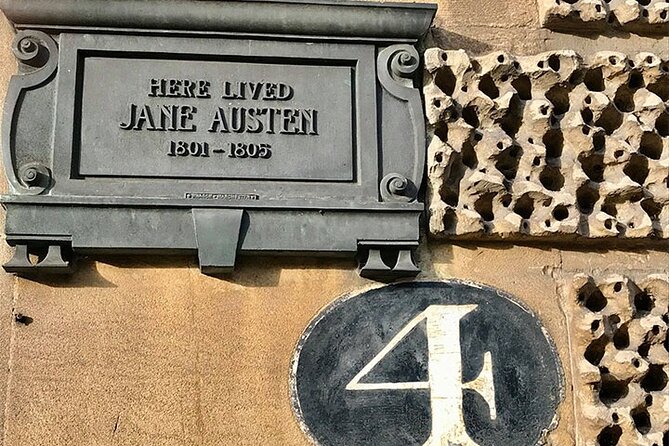
You stroll toward Sydney Place, where Austen and her family lived at No. 4. The tour ends at Sydney Place, Sydney Pl, Bathwick, rather than returning to Bath Abbey. That is practical if you plan to continue eastward, but less convenient if you left belongings near the Abbey or need to meet someone there.
Price, group size, and what you actually receive
The price is $205.29 per group of up to six people. At the maximum group size, that works out to about $34 per person. For two people, the cost is about $103 each, so the value changes sharply depending on the size of your party.
I think the price is reasonable for a private guide who handles the research and organizes a route across many Austen-related locations. You are paying for interpretation, not admission tickets. The tour covers a lot of ground and saves you from planning the connections yourself.
For the best value, bring a group of four to six. A couple who wants a fully private experience may still find it worthwhile, especially if Jane Austen is a major reason for visiting Bath. But if you mainly want to see the city’s exterior landmarks, a general walking tour may cost less.
The tour uses a mobile ticket, and confirmation is provided when you book. It is near public transportation, service animals are allowed, and most people can participate. Since the route is outdoors and requires good weather, wear sensible shoes and check the forecast. That advice is practical rather than glamorous, but Bath’s stone streets are not improved by wet weather.
Free cancellation is available up to 24 hours before the start time. Changes or cancellations inside that window are not accepted for a refund. If poor weather causes the operator to cancel, you receive either another date or a full refund.
Who should book this Bath experience?
I would choose this tour if you already know Austen’s novels or want a focused introduction to her connection with Bath. It is also a good pick for families or friends who prefer a private guide to a large shared group.
You will get the most from it if you enjoy architecture, social history, literary settings, and small personal details. The Sally Lunn connection, Austen’s stay at Queen Square, her parents’ church, and the family address at Sydney Place give the tour more variety than a simple parade of famous buildings.
You may want something else if you expect extended indoor visits. Admission is not included at Bath Abbey, Sally Lunn’s Museum, the Cross Bath, the Pump Rooms, or the Assembly Rooms. The tour passes or discusses these places, but you should budget extra time and money if you want to go inside.
The strongest praise for this experience centers on the guide’s personality. Theresa is described as entertaining, enthusiastic, and fully informed, which is exactly what this subject needs. Austen’s Bath can become dry if presented as a list of dates and addresses. A lively guide makes the manners, gossip, architecture, and family stories easier to remember.
Should you book the Private Guided Tour of Jane Austen’s Bath?
Book it if you want a private, Austen-centered introduction to Bath and your group has at least four people to share the $205.29 cost. The route is well chosen, the literary links are specific, and the guide adds social context that you would miss by simply walking between the landmarks.
I would be cautious if you want included museum entries, a relaxed tea stop, or a tour that returns to the Abbey. For everyone else, this is a focused way to understand why Bath mattered to Austen and why the city still feels so closely tied to her books.
FAQ
How long is the Private Guided Tour of Jane Austen’s Bath?
The tour lasts approximately 2 hours and 30 minutes.
Where does the tour begin?
It begins outside the West Doors of Bath Abbey in Bath, England.
Where does the tour end?
The tour ends at Sydney Place in Bathwick, near No. 4 Sydney Place, where Jane Austen and her family lived.
How many people can join the private tour?
The price covers one private group of up to six people. Only your group participates.
Are admission tickets included?
No. Admission is not included for Bath Abbey, Sally Lunn’s Museum, the Cross Bath, the Pump Rooms, or the Assembly Rooms. Queen Square, The Circus, Milsom Street, Pulteney Bridge, Great Pulteney Street, and the exterior of No. 1 Royal Crescent are listed as free stops.
Can I cancel for a full refund?
Yes. You can cancel at least 24 hours before the start time for a full refund. If poor weather causes the experience to be canceled, you are offered another date or a full refund.
Just added in Bath
- Highlights from Bath’s Canal Walk: A Self-Guided Audio Tour★ 5.0 · 1 review
- The Splendour of Georgian and Victorian Era Bath: A Self-Guided Audio Tour★ 4.0 · 3 reviews
- Wells, Cheddar Cheese and Cheddar Gorge – Private Day Trip from Bath★ 5.0 · 10 reviews
- ‘Stonehenge & Secret England’ from Bath for 2-8 curious adventurers★ 5.0 · 54 reviews
- Stonehenge and Bath City Tour – Private tour from Bath★ 5.0 · 33 reviews
- Stonehenge & the Cotswolds Including Admission from Bath★ 5.0 · 145 reviews
- Stonehenge Private Tour – Half-Day Tour from Bath★ 5.0 · 145 reviews
- Interactive Treasure Hunt Experience of Bath’s Secrets★ 5.0 · 1 review
Bath Tours, compared.
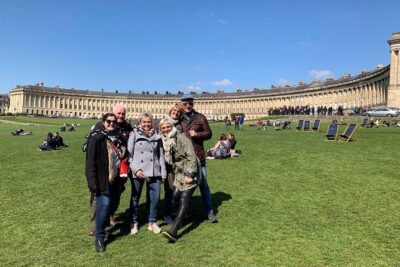
Walking Tour of Bath with Blue Badge Tourist Guide
Read our review →
Stonehenge, Avebury & the Cotswolds from Bath (Small group)
Read our review →
Bath Tootbus Hop-on Hop-off Sightseeing Bus Tour
Read our review →Browse the lists this tour appears in