
Reviewed · WALKING TOURS
Best of Bath Walking Tours – Georgian Tour
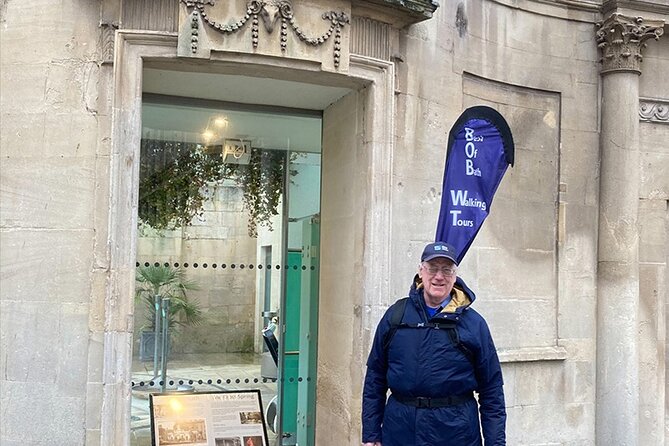
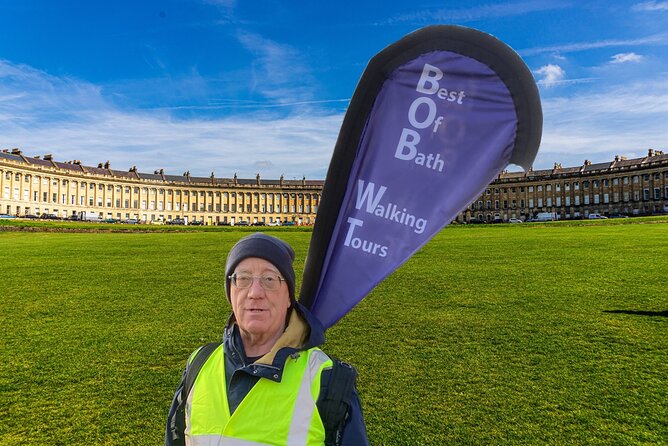
Bath rewards slow walking. Best of Bath Walking Tours makes the city’s grand Georgian streets easier to understand, with guide Bob leading a small group through the buildings, people, and stories behind them. I especially like the gentle pace and the way the tour links famous sights such as the Circus and Royal Crescent. I also like that Bob welcomes questions instead of delivering a stiff speech. The main consideration is that several interiors, including the Roman Baths and Assembly Rooms, are viewed from outside unless you pay separate admission.
The walk lasts about two to three hours and begins at 1:00 p.m. in front of Bath Abbey. With a maximum of 15 people and a price of $27.73 per person, it offers a personal introduction to Bath without the cost of a private guide. Good shoes matter, since you will be on foot for most of the afternoon.
In This Review
- Key points at a glance
- Why Georgian Bath makes such a good walking tour
- Starting beside Bath Abbey at 1:00 p.m.
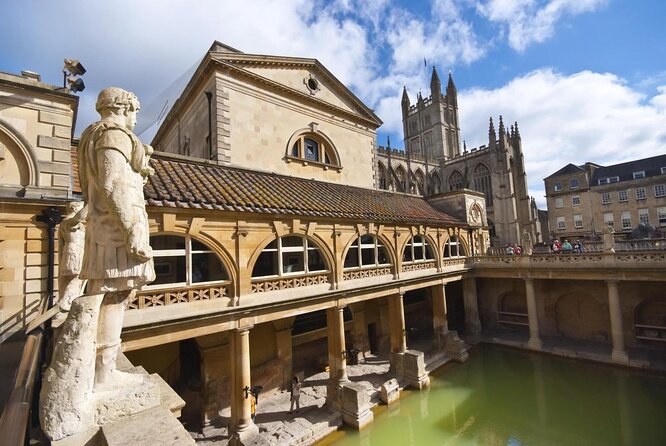
- The Roman Baths and the city’s hot springs
- Royal Mineral Water Hospital and Bath’s healing culture
- Queen Square, where the Georgian plan begins
- Assembly Rooms and the social life of 18th-century Bath
- The Circus, a circular lesson in Georgian design
- Royal Crescent and the view from No. 1
- Pulteney Bridge and the River Avon
- Bath Guildhall Market, an everyday finish
- Bob’s approach: stories, questions, and a comfortable pace
- Price, timing, and practical value
- Who will get the most from this Bath walk?
- Should you book Best of Bath Walking Tours?
- FAQ
- Where does the Georgian Bath walking tour start?
- What time does the tour begin?
- Where does the tour finish?
- How long does the tour last?
- How much does the tour cost?
- Is the tour offered in English?
- How large is the group?
- Are attraction admission tickets included?
- What fitness level is required?
- Can I cancel for a full refund?
Key points at a glance
- Bath Abbey starting point: Meet Bob in Abbey Churchyard, directly in front of Bath Abbey, then return to the same place at the end.
- A full Georgian circuit: See Queen Square, the Circus, Royal Crescent, Pulteney Bridge, Guildhall Market, and other central sights.
- Bob’s warm teaching style: Expect history, architecture, dry humor, and plenty of room for questions.
- Small group format: The tour accepts no more than 15 people, which makes conversation easier than on a large city walk.
- Mostly an exterior tour: The Roman Baths, Assembly Rooms, Royal Mineral Water Hospital, and No. 1 Royal Crescent require separate admission if you want to go inside.
- Good value for a first visit: At $27.73, the walk helps you make sense of Bath before exploring more deeply on your own.
Why Georgian Bath makes such a good walking tour
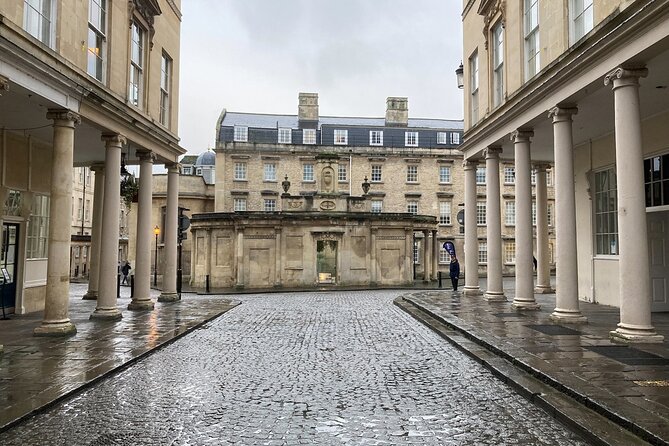
Bath is compact, but its architecture can feel like a grand collection of disconnected set pieces. A guide gives you the thread that ties them together: the city’s transformation into an 18th-century resort for fashionable society.
The Georgian period brought careful planning, broad squares, curved terraces, assembly rooms, and formal views. Architects John Wood the Elder and John Wood the Younger shaped much of the city you see today. Their work was not simply decorative. Buildings were arranged to create a sense of order, status, and spectacle.
I like tours that explain how a place works rather than just naming buildings. This walk appears to do that well. Bob talks about the people who commissioned, designed, and lived in Bath, so the stone facades have a social story behind them.
The tour also places Georgian Bath beside older layers of the city. Roman baths, medieval walls, religious buildings, and the River Avon all appear along the route. That wider view matters because Bath was not created in one age. It has been rebuilt and reshaped again and again.
More Walking Tours in Bath
- Walking Tour of Bath with Blue Badge Tourist Guide
★ 5.0 · 1,877 reviews - Roman Baths and Bath City Walking Tour
★ 4.5 · 762 reviews - Bad of Bath fun Walking Tour of Bath
★ 5.0 · 402 reviews
Starting beside Bath Abbey at 1:00 p.m.
The meeting point is Abbey Churchyard, in front of Bath Abbey. This is a practical place to begin because it sits in the center of Bath and is easy to identify.
Bath Abbey itself has a long story. It began in the seventh century, was reorganized in the 10th century, and was rebuilt in the 12th and 16th centuries. The church also occupies the site of a former Benedictine monastery, so the opening discussion gives you a quick sense of Bath’s religious past before the tour turns toward Georgian society.
You spend about 10 minutes here at the start. That is enough time to gather the group and establish the setting without using up the afternoon on one building.
The walk ends back in Abbey Churchyard. Bob allows time at the finish for questions and discussion, which is useful if you want advice on what to see next.
The Roman Baths and the city’s hot springs
The Roman Baths are one of Bath’s defining sights, even if this walking tour only pauses for about five minutes. The original temple was built around 60 to 70 AD, during the early decades of Roman Britain.
The stop is best understood as an orientation rather than a full museum visit. You will not receive the complete interior experience as part of the walking tour, and admission is not included. If you want to see the spring, temple remains, bathing areas, and museum displays in detail, you need to buy a separate ticket.
Still, seeing the Roman Baths in the context of the surrounding streets is useful. The hot springs explain why people came here long before the Georgian period. The site also helps you see how Bath’s reputation for healing grew across centuries.
I would not book this tour as a substitute for visiting the Roman Baths. Instead, use the walk to understand their place in the city, then decide if the interior visit fits your schedule and budget.
Royal Mineral Water Hospital and Bath’s healing culture
The Royal Mineral Water Hospital receives a short stop of about five minutes. Construction began in 1737, at a time when belief in Bath’s mineral waters combined religious faith with growing interest in scientific explanations.
That detail adds balance to the usual image of Bath as a place for elegant balls and polite society. The city was also a center for people seeking relief from illness. The hospital reflects the practical side of the spa economy.
Because the stop is brief and admission is not included, you should expect an exterior explanation rather than a hospital tour. Its value comes from the connection Bob makes between the springs, medical treatment, and Bath’s rise as a fashionable destination.
A completely different sort of day out:
- Stonehenge, Avebury & the Cotswolds from Bath (Small group)
★ 5.0 · 798 reviews - Fully Guided Bath Ghost Tours
★ 5.0 · 539 reviews - The Cotswolds Tour From Bath (Small group)
★ 5.0 · 349 reviews - Bath Tootbus Hop-on Hop-off Sightseeing Bus Tour
★ 4.5 · 247 reviews
Queen Square, where the Georgian plan begins
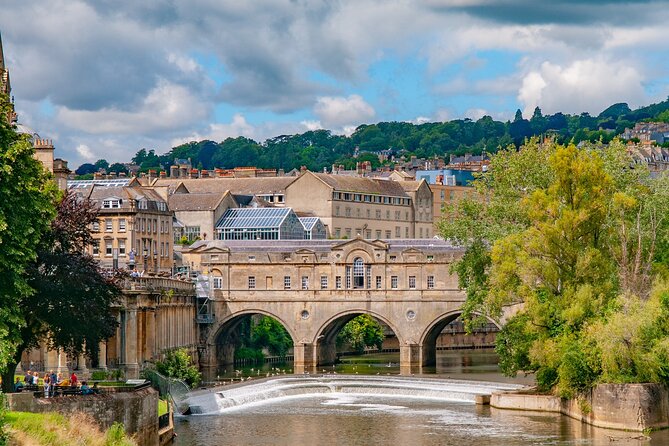
Queen Square is one of the clearest places to see Bath’s Georgian design. Every building in the square is Grade I listed, and the square forms the first part of a larger architectural sequence that continues toward the Circus and Royal Crescent.
You spend about five minutes here, but the stop has a larger role than its timing suggests. Queen Square helps you understand how Bath’s developers used repeated facades and carefully arranged spaces to make a new district feel unified.
Look around before moving on. The point is not only to admire individual houses. Notice the way the buildings work together as a single composition. A guide is especially helpful here because the design can be easy to take for granted when you are busy photographing the square.
Assembly Rooms and the social life of 18th-century Bath
The Assembly Rooms represent the social engine of Georgian Bath. The upper rooms opened in 1771 with a grand ball and became a venue for dancing, concerts, gambling, and formal gatherings.
The stop lasts around five minutes, and interior admission is not included. That is an important distinction. You can learn why the building mattered from outside, but a separate visit is needed to see the rooms themselves.
The building’s connection with Jane Austen adds interest, but the broader story is even more useful. Bath’s Georgian architecture was designed for a society that wanted places to meet, display wealth, arrange marriages, and be seen. The Assembly Rooms were not just pretty halls. They were part of the machinery of fashionable life.
Bob’s style, based on the available feedback, seems particularly suited to this kind of subject. He mixes facts with humor and keeps the material from feeling like a lecture. The tour’s strong appeal is not only what you see, but how the city’s social rules become easier to picture.
The Circus, a circular lesson in Georgian design
The Circus is one of Bath’s great architectural surprises. John Wood the Elder designed this ring of townhouses, built between 1754 and 1768. Three entrances open into the circle, and each segment is arranged so that a classical facade faces you as you enter.
The group spends about 10 minutes here, with no admission charge. That extra time makes sense because the Circus needs a little study. Walk your eyes around the curve and notice the repeated columns, decoration, and proportions.
This is where a guide can save you from a quick photograph and a quick departure. Bob explains why the buildings were arranged as they were and who shaped Bath’s Georgian expansion. His humor also helps, since architectural detail is easier to remember when it is tied to a good story.
The Circus is a strong stop for anyone interested in design. It also gives you a clear example of how Georgian architects used geometry to create a sense of order.
Royal Crescent and the view from No. 1
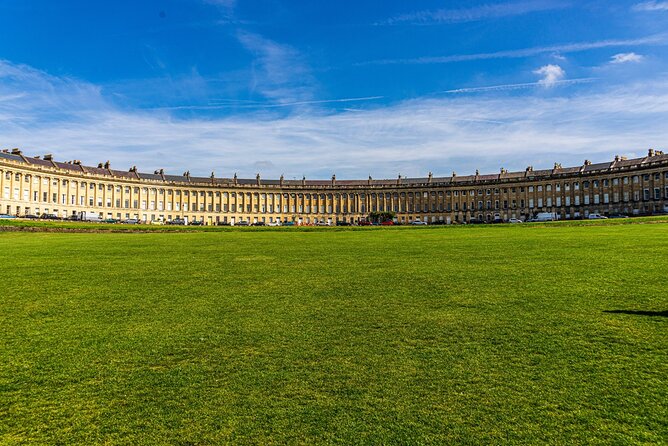
The Royal Crescent is Bath’s most recognizable Georgian landmark, a sweeping row of 30 terraced houses designed by John Wood the Younger and built between 1767 and 1774.
You spend about 10 minutes here. No. 1 Royal Crescent requires separate admission, so the standard walking tour does not include the interior. The outside, however, is the main visual event: a long curved facade that makes ordinary townhouses feel like a ceremonial building.
The stop becomes more meaningful after Queen Square and the Circus. You can see the progression from square, to circle, to crescent. These places were not scattered accidents. They formed part of an ambitious plan to give Bath a grand, fashionable identity.
The walk also includes Gravel Walk, a quieter route associated with the Royal Crescent area. One useful feature of this tour is that it goes beyond the obvious postcard views. A past participant even described being shown an old medieval path below the modern streets, running toward the river beside the ancient city walls. Details like that can change the way you look at Bath’s pavements and corners.
Pulteney Bridge and the River Avon
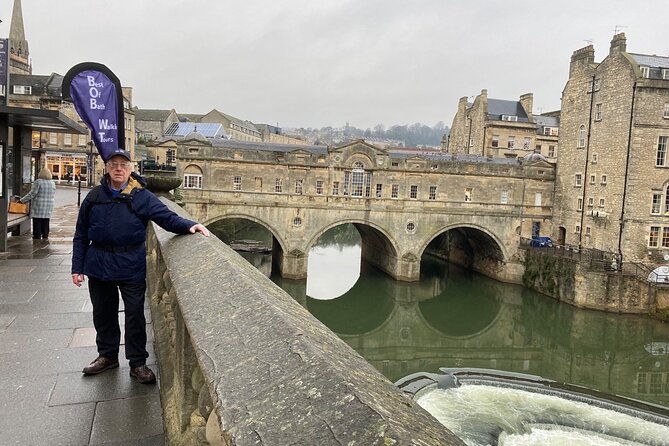
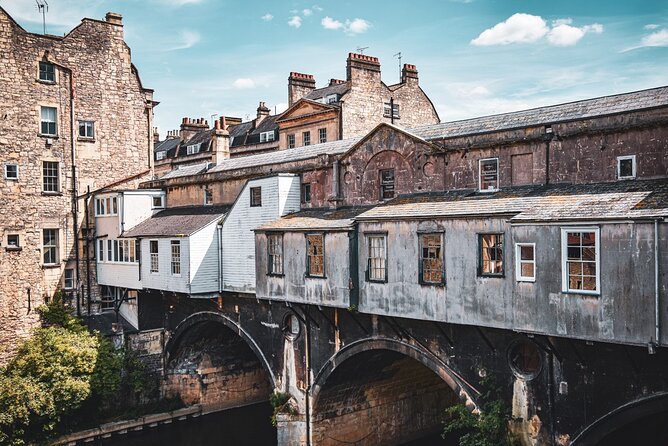
Pulteney Bridge provides a change of mood after the formal Georgian terraces. Completed by 1774, it crosses the River Avon and connects Bath with land intended for development by the Pulteney family.
Architect Robert Adam designed the bridge in a Palladian style. Its most unusual feature is the line of shops built across the full span on both sides. You are not simply crossing a bridge. You are walking through a working commercial street suspended above the river.
The stop lasts about five minutes and is free. That is enough for a short explanation and a look at the bridge, though you may want to spend extra time here later if the shops or river views catch your interest.
Pulteney Bridge also helps complete the tour’s picture of Bath. The city’s grand buildings were linked to commerce, property development, tourism, and daily life. The elegant architecture had an economic purpose behind it.
Bath Guildhall Market, an everyday finish
Bath Guildhall Market offers a more ordinary and local-feeling stop. The indoor market has existed since 1284 and occupies a handsome building near the city center.
You spend about five minutes here, wandering among the stalls. It is not a major historical lecture stop, but that is part of its charm. After the formal grandeur of the Royal Crescent and Circus, the market shows Bath as a place where people still shop, browse, and conduct everyday business.
This is also a useful place to note for later. The tour does not include a meal or shopping time, so you will need to return on your own if you want to explore the stalls at leisure.
Bob’s approach: stories, questions, and a comfortable pace
The most praised part of this experience is Bob himself. He is described as friendly, funny, patient, and deeply familiar with Bath’s past. The strongest feedback points to his ability to answer questions, explain architecture in plain language, and make two hours pass quickly.
That matters because a city walk can fail in two opposite ways. It can be too shallow, giving you dates without meaning, or too dense, burying you under names and facts. Bob appears to aim for the middle ground. One particularly useful quality is his willingness to admit when he does not know something, rather than pretending to have every answer.
The walk is also flexible in small ways. Bob has answered questions before the tour, shown sights beyond the main route, and adjusted his attention when the city was crowded during the Christmas markets. Feedback also points to a comfortable pace and regular checks that everyone is keeping up.
The maximum group size is 15. That is small enough for questions to be heard and for the guide to keep an eye on the group, though it is not a private tour. If you want complete control over stops and timing, a private guide would suit you better.
Price, timing, and practical value
At $27.73 per person, this is a reasonable price for a two to three-hour guided walk in central Bath. You are paying for interpretation, route planning, and the ability to spot details you might miss alone.
The value is strongest if this is your first visit or if you have limited time before a train. One person booked with only a few free hours in Bath and found the gentle two-hour walk a better use of time than wandering without context. That is exactly the kind of situation where a city tour earns its keep.
The cost does not cover admission to the Roman Baths, Assembly Rooms, Royal Mineral Water Hospital, or No. 1 Royal Crescent. Plan for those as separate choices. You can take the walking tour without entering them, but anyone wanting a full Bath sightseeing day should add the admission costs to the total budget.
The tour starts at 1:00 p.m. and ends at the original meeting point. It is offered in English only. You need a moderate level of fitness, and good weather is required. Service animals are allowed, and the meeting point is near public transportation.
Free cancellation is available up to 24 hours before the start time. If bad weather or insufficient bookings causes cancellation, you are offered another date or a full refund.
Who will get the most from this Bath walk?
I would choose this tour if you want the city to make sense quickly. It suits first-time visitors, architecture fans, Jane Austen readers, history-minded people, and anyone who prefers stories to silent sightseeing.
It also works well for solo visitors and couples because the small group makes it easier to ask questions and chat along the way. Families with older children may enjoy the short stops and human stories, though the moderate walking requirement should be kept in mind.
You may want something else if your main goal is a long interior visit to the Roman Baths or a detailed study of one building. This is a city overview with an emphasis on Georgian architecture, not a museum tour.
The tour is also a good choice if you like a guide with personality. Bob’s dry humor, patience, and love for Bath are central to the experience. If you prefer a formal lecture with little conversation, his relaxed approach may feel less structured than you expect.
Should you book Best of Bath Walking Tours?
I would book it for a first afternoon in Bath, especially if you have two or three hours and want a clear framework for the city. The combination of Queen Square, the Circus, Royal Crescent, Pulteney Bridge, and older sites gives you both the grand Georgian story and the earlier layers beneath it.
The strongest reason to choose this walk is Bob’s personal approach. He explains why the buildings look the way they do, brings in the people behind them, and leaves room for questions. At $27.73, that is solid value for a small-group introduction.
Just remember that the main attractions are viewed as part of the city walk, not entered as part of the price. Book this for context, stories, and a well-paced orientation, then decide which interiors deserve your extra time.
FAQ
Where does the Georgian Bath walking tour start?
It starts in Abbey Churchyard, Bath BA1, in front of Bath Abbey.
What time does the tour begin?
The stated start time is 1:00 p.m.
Where does the tour finish?
It finishes back at Abbey Churchyard, the same place where it begins.
How long does the tour last?
The tour lasts approximately two to three hours. The planned walking route is described as about two hours, with additional time available for questions and discussion.
How much does the tour cost?
The listed price is $27.73 per person.
Is the tour offered in English?
Yes. The tour is offered in English.
How large is the group?
The maximum group size is 15 people.
Are attraction admission tickets included?
Admission is not included for the Roman Baths, Royal Mineral Water Hospital, Assembly Rooms, and No. 1 Royal Crescent. The outdoor walking stops and Bath city locations do not require an admission ticket for the tour.
What fitness level is required?
A moderate level of physical fitness is recommended because the experience is a walking tour lasting two to three hours.
Can I cancel for a full refund?
Yes. You can cancel at least 24 hours before the start time for a full refund. Cancellations or changes made less than 24 hours before the start time are not refunded or accepted.
Just added in Bath
- Highlights from Bath’s Canal Walk: A Self-Guided Audio Tour★ 5.0 · 1 review
- The Splendour of Georgian and Victorian Era Bath: A Self-Guided Audio Tour★ 4.0 · 3 reviews
- Wells, Cheddar Cheese and Cheddar Gorge – Private Day Trip from Bath★ 5.0 · 10 reviews
- ‘Stonehenge & Secret England’ from Bath for 2-8 curious adventurers★ 5.0 · 54 reviews
- Stonehenge and Bath City Tour – Private tour from Bath★ 5.0 · 33 reviews
- Stonehenge & the Cotswolds Including Admission from Bath★ 5.0 · 145 reviews
- Interactive Treasure Hunt Experience of Bath’s Secrets★ 5.0 · 1 review
- Secrets of Stonehenge Private Half-Day Tour from Bath★ 5.0 · 6 reviews
Walking Tours, compared.
Oxford University Walking Tour With University Alumni Guide
Read our review →
Tour for Muggles The Ultimate Harry Potter Walking Tour in London
Read our review →
Cambridge University Walking Tour by Alumni™ Kings College Option
Read our review →
Blackbeard to Banksy – The Ultimate Walking Tour of Bristol
Read our review →
Air Raid Shelter + St. Nicholas Market Walking Tour
Read our review →
Walking Tour of Bath with Blue Badge Tourist Guide
Read our review →
Changing of the Guard Guided Walking Tour in London
Read our review →Browse the lists this tour appears in