
Reviewed · WALKING TOURS
Powerhouse London – Private Walking Tour
Power still shapes London’s streets. This four-hour private walk follows it from Roman Londinium and royal rule to courts, newspapers, clubs, and global finance. I like the private format, which gives your group room to ask questions and set the pace, and I like the route’s broad sweep from Westminster to the City of London. The main drawback is the price: at $536.74 per person, it makes the most sense for a small group that values personal guiding over a budget sightseeing walk.
The tour also earns warm praise for Sonja, who is described as funny, interesting, and able to tailor the experience to the group. You should expect a serious amount of walking, several outdoor stops, and transport costs of up to £14 for Zone 1 to 2. Bring comfortable shoes and a curious mind.
In This Review
- Key points before you book
- What the Powerhouse route is really about
- Parliament Square begins the story of power
- Lambeth Bridge brings power into view
- Lambeth Palace and the Church of England
- Whitehall reveals an empire’s working parts
- Banqueting House and the fate of a king
- The Mall is a royal ceremonial road
- Pall Mall changes the meaning of power
- Buckingham Palace asks who built the symbol
- Temple Church opens a medieval chapter
- The Royal Courts of Justice and the power of law
- Newspapers show the power of the pen
- Guildhall Art Gallery recalls Roman Londinium
- The Royal Exchange explains London money
- Leadenhall Market is a sociable finish
- Price, group size, and physical demands
- Who should book this London walk?
- FAQ
- How long is the Powerhouse London tour?
- Is this a private tour?
- Where does the tour begin?
- Where does the tour end?
- Is food and drink included?
- Are TfL transport costs included?
- What is the cancellation policy?
- Should you book Powerhouse London?
Key points before you book
- Two thousand years in four hours: The route links Roman London, medieval power, royal government, law, empire, and modern finance.
- A genuinely private experience: Only your group takes part, so you can ask questions without competing with a crowd.
- Westminster to the City: You begin near Big Ben and finish at Leadenhall Market beside Monument Station.
- Great photo stops: Parliament Square, Lambeth Bridge, The Mall, Buckingham Palace, and the City provide plenty of chances to pause.
- A guide makes the difference: Sonja receives especially strong praise for her humor, knowledge, and ability to shape the tour around her group.
- A costly but focused choice: The price is high, but a private guide can be good value for families or friends who want one shared, tailored outing.
What the Powerhouse route is really about
Many London walks focus on kings, churches, or famous buildings. This one follows a bigger idea: who held power, how they used it, and how that power changed hands.
You move from Parliament and the monarchy to espionage, the Church of England, law courts, newspapers, merchant guilds, and financial trading. That gives the walk a useful thread. The buildings are not just backdrops for photographs. They show how London was governed, defended, judged, reported, and financed.
The route also crosses several distinct parts of central London. Westminster feels ceremonial and political. The Mall is royal and formal. Pall Mall points toward old social privilege. The legal district feels more institutional, while the City turns the story toward commerce and money.
Because the tour is private, you can ask for more detail in the subjects that grab you. If you want royal stories, you can linger on Buckingham Palace and The Mall. If law and political conflict interest you more, the Royal Courts of Justice and Banqueting House deserve your attention.
More Walking Tours in London
- Tour for Muggles The Ultimate Harry Potter Walking Tour in London
★ 5.0 · 4,684 reviews - London Jack The Ripper Guided Walking Tour
★ 5.0 · 3,131 reviews - Changing of the Guard Guided Walking Tour in London
★ 5.0 · 1,793 reviews
Parliament Square begins the story of power
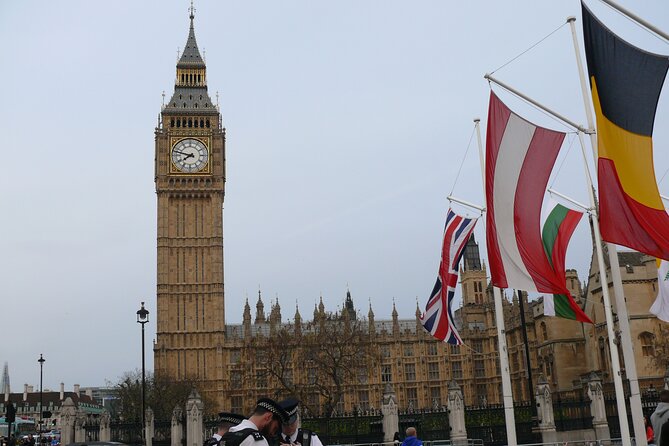
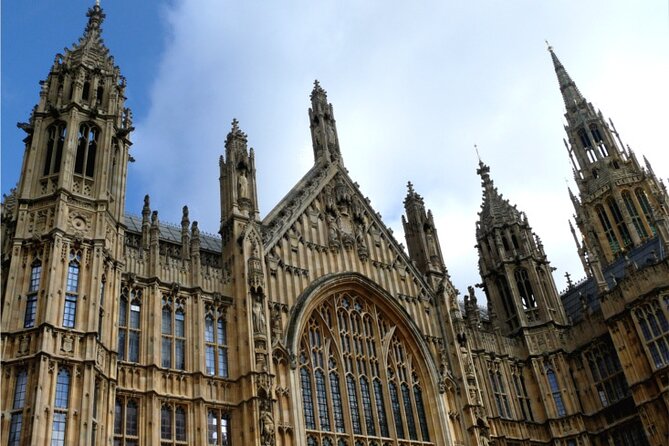
The meeting point is Big Ben, officially at Parliament Square, where the walk opens with the structure of British government. You learn why Parliament has two Houses and why the buildings sit beside Westminster Abbey, one of England’s most important religious sites.
The square also contains less obvious buildings connected with government and national authority. This is a useful start because it gives you the setting for the rest of the tour. Britain’s political power has not been tucked away in one isolated palace. It has developed in a tight cluster of churches, courts, government offices, and parliamentary buildings.
You spend about 20 minutes here. Admission is free, and the area offers strong photo opportunities. The tradeoff is that Parliament Square can be crowded and noisy, so your guide’s explanation matters more than the quiet atmosphere.
Lambeth Bridge brings power into view
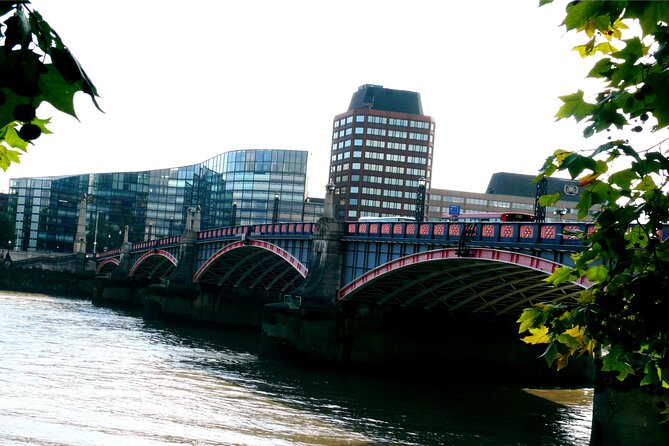
At Lambeth Bridge, the focus shifts across the Thames and toward the machinery of the modern state. You get one of the route’s prettiest river views while learning why the headquarters of MI5 can be seen in such a public setting.
The tour presents espionage as part of London’s everyday cityscape. Rather than treating intelligence work as a distant mystery, it connects national security to ordinary streets and recognizable buildings. The discussion also considers the real power behind MI5, giving this short stop more substance than a simple photo pause.
You spend around 15 minutes here. The stop is free, but you should allow for the route’s transport arrangements. The tour does not include TfL fares, and the stated cost for an Oyster card or day ticket covering Zones 1 and 2 is no more than £14.
Lambeth Palace and the Church of England
Another 15-minute stop takes you to Lambeth Palace, the home of the Archbishop of Canterbury. The emphasis here is not only on the building itself, but on the reach of the Church of England and the relationship between religious authority and the Crown.
The tour asks you to consider why the most powerful figure in the English Church built such a substantial residence, and why even the king of England has knelt before him. It is a compact lesson in ceremony, hierarchy, and the way religion once shaped political life.
This stop is especially useful if you want more than royal sightseeing. London’s story is not simply monarchs giving orders. Religious leaders, Parliament, courts, merchants, and public opinion all had a role.
A completely different sort of day out:
- Stonehenge, Windsor Castle, and Bath from London
★ 4.5 · 18,662 reviews - London Big Bus Hop-On Hop-Off Tour with Optional River Cruise
★ 3.5 · 10,803 reviews - London Small Group Tour of Historical Pubs
★ 5.0 · 10,422 reviews - Stonehenge, Windsor Castle and Bath with Pub Lunch in Lacock
★ 4.5 · 7,402 reviews
Whitehall reveals an empire’s working parts
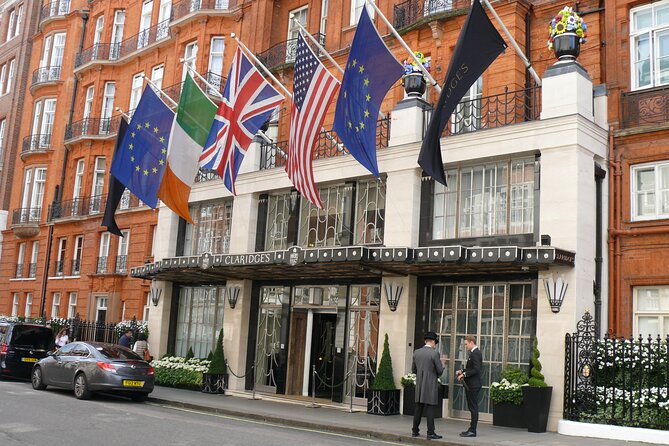
Whitehall is one of the strongest sections of the route. Here, you learn about the palace that disappeared and the buildings that remain. Those surviving structures still represent administration, military force, and the long traditions of government.
The 20-minute stop helps explain why Whitehall feels so different from the royal spaces nearby. It is less about pageantry and more about the practical work of ruling a kingdom and, later, an empire. The buildings show how power can survive even after the original palace is gone.
You should expect plenty of looking up and around rather than entering major attractions. The tour is primarily an outdoor walk, and the listed stops do not include admission tickets.
Banqueting House and the fate of a king
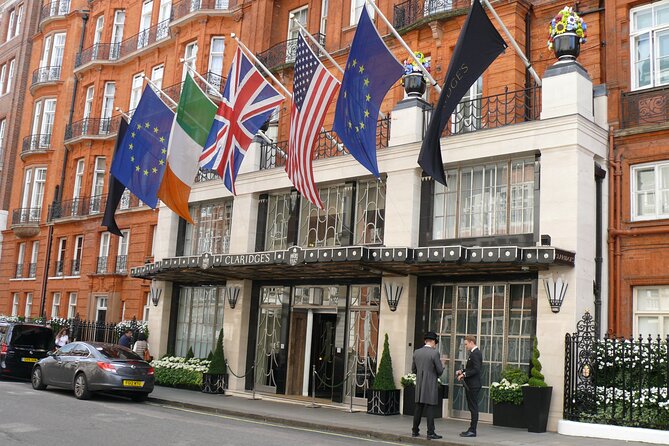
Banqueting House receives only five minutes, but its subject is dramatic. You hear how a king was convicted of treason and executed, and why the act was considered legal.
That story gives the tour a sharp constitutional edge. Royal power was not always absolute, and the relationship between monarch and Parliament could turn deadly. A short stop can still be memorable when it deals with a major break in political history.
The building also fits neatly into the wider Whitehall section. You are not simply seeing an old ceremonial hall. You are looking at a place connected with the limits of royal authority and the idea that a ruler could be held accountable.
The Mall is a royal ceremonial road
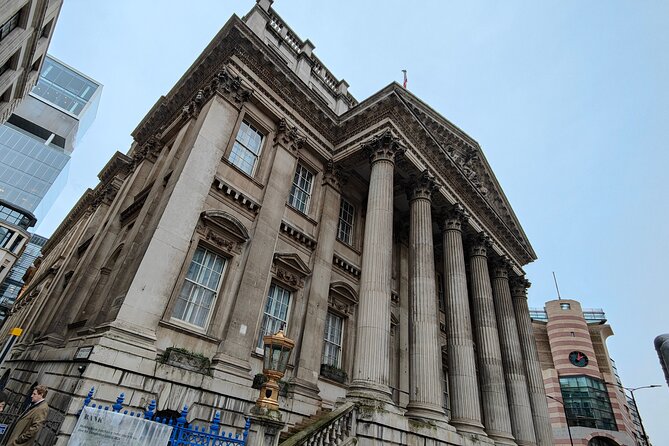
The walk down The Mall lasts about 20 minutes. This is the grand route of royal celebration and mourning, lined with buildings tied to national ceremony and royal life.
Your guide explains why every building along this street carries weight. The value here is in learning to read the road as a stage for public events. Triumphs, funerals, processions, and national symbolism all pass through the same formal setting.
The Mall also makes a fine photo stop. You get a clear sense of how London uses streets, not just buildings, to express authority. If the day is busy, your private guide can help your group pause without the stop becoming a long delay.
Pall Mall changes the meaning of power
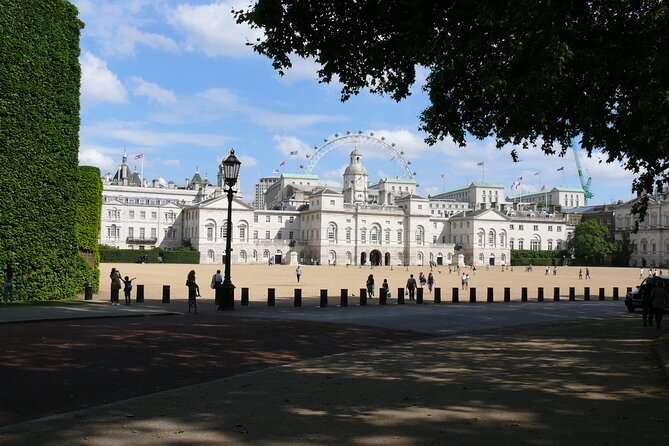
Pall Mall introduces a different kind of authority: the private power of elite gentlemen’s clubs. The tour points out that this area contains many clubs with a long tradition of male membership, then considers how even these institutions can change over time.
This is one of the route’s more revealing stops because it shifts attention from official offices to social networks. Influence has often grown through who could meet, dine, and make decisions together. Pall Mall lets you see that power is not always written on a government sign.
The stop takes about 15 minutes. You will mainly view the area from outside, so the guide’s storytelling is central. If you are interested in class, custom, and changing social rules, this section should give you plenty to discuss.
Buckingham Palace asks who built the symbol
Buckingham Palace is the obvious royal highlight, but the tour approaches it with a useful question: who built it, and why?
Today, it is the official residence of the King. The stop gives you a chance to consider how a private or limited residence became one of the world’s best-known symbols of monarchy. You spend about 15 minutes here, with no admission fee included because the experience is an exterior walking visit.
You get a major photo opportunity, but do not expect a palace interior visit as part of the four-hour route. The strength is context. By this point, you have seen Parliament, the Church of England, government offices, elite clubs, and royal roads. Buckingham Palace becomes one part of a larger system rather than the whole story.
Temple Church opens a medieval chapter
The 30-minute stop at Temple Church is the longest single visit on the route. It turns back to the Templars and the medieval world of crusades, kings, religion, and international power.
The church’s story includes a king who went outre mer, meaning overseas, linking the site to the wider world beyond England. The Templars are a natural fit for a tour about power because they operated across religious, military, and financial spheres.
This is also a change of mood. After the open ceremonial spaces of Westminster and The Mall, Temple Church brings you into a more enclosed and secretive chapter of London’s past. Admission is listed as free, though the information does not promise a guaranteed interior visit or a particular opening arrangement, so you should treat the stop as a guided visit to the church area rather than assume full access.
The Royal Courts of Justice and the power of law
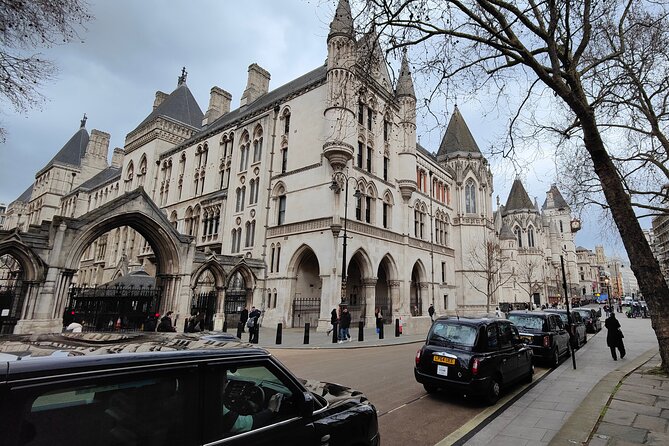
At the Royal Courts of Justice, the tour moves into the legal heart of London. You walk through a square where law and order is an ever-present idea, then hear the unusual story of a business concern that went to war with the Empress of India.
That subject connects commerce, law, and imperial authority. It also keeps the tour from becoming a simple parade of royal buildings. London’s power has often rested on contracts, courts, companies, and rules as much as on crowns and armies.
This is the one listed stop where an admission ticket is not included. The tour does not provide a separate admission price, so ask your guide or the operator what access involves before booking if entering the building matters to you.
Newspapers show the power of the pen
The route includes a stop connected with London’s old newspaper street. Here, you learn why the pen could be more powerful than the sword and how major newspapers came to gather in one area.
This section adds public opinion to the tour’s power story. Governments can issue laws, courts can judge disputes, and businesses can move money, but newspapers can shape what the public believes and debates.
The stop is not assigned a clear number or time in the supplied schedule, so the exact length may vary. That is worth noting if you want a tightly timed walk. It also means the route may feel more like a flowing conversation than a rigid sequence of attractions.
Guildhall Art Gallery recalls Roman Londinium
At Guildhall Art Gallery, the tour reaches the earliest power discussed on the route: the Roman invasion and the creation of Londinium. You hear how one woman changed the future of the city in a single day, a reference to the revolt led by Boudica.
The gallery stop lasts around 20 minutes and admission is free. It gives the tour an important foundation. Before London became the seat of Parliament, the monarchy, the courts, and the financial district, it was a Roman city shaped by conquest, trade, and rebellion.
This is another place where the guide’s explanation matters more than simply passing by. The stop ties ancient London to the modern City and helps you understand why this location became so important in the first place.
The Royal Exchange explains London money
The Royal Exchange shifts the focus to trade and finance. You learn why there is no lasting political power without money and why the City of London remains a worldwide center for trading and finance.
The route then moves through streets associated with London’s guilds and merchant leaders. These merchants helped build the commercial power of the city and the wider empire. The discussion gives you a way to understand the City beyond office towers and business suits.
You spend about 15 minutes here, with free admission listed. The walk does not promise access to trading floors or private offices. Its value is in seeing how commerce became a central force in London’s development.
Leadenhall Market is a sociable finish
The tour ends at Leadenhall Market after about 15 minutes there. This ornate market is now a popular place for office workers to eat and drink after work, giving the final stop a more relaxed tone than the formal beginning at Parliament Square.
Ending here works well. You have followed power from rulers and churches through courts and newspapers to the financial district, then finish in a place where modern City workers gather. It gives you a practical chance to continue the afternoon with a drink or meal, though food and drink are not included.
Leadenhall Market is close to Monument Station, making the end point convenient for continuing your London day. The start and finish are not close together, so plan to use public transport afterward rather than expecting to walk back to Westminster.
Price, group size, and physical demands
The listed price is $536.74 per person. That is a major expense for a four-hour walk, especially because food, drinks, and TfL transport are extra. The price is easier to justify if you are booking for a small private group and want a guide to adjust the discussion to your interests.
A private experience also changes the pace. You can ask about a detail that catches your attention, stop for photos, and avoid being tied to the questions of a large mixed group. For a family, history-minded couple, or group of friends, that personal attention may be worth more than a cheaper standard walking tour.
You should have moderate physical fitness. The route covers a long stretch of central London and includes repeated outdoor stops. Wear comfortable shoes, bring weather protection, and allow time for the walking itself, not only the scheduled minutes at each stop.
Confirmation arrives when you book, and mobile tickets are available. Service animals are allowed, and the route is near public transportation. Free cancellation is available if you cancel at least 24 hours before the local start time. Inside that window, the amount paid is not refunded, and changes are not accepted.
Who should book this London walk?
I would choose this tour if you want London explained through institutions and power, not only famous sights. It suits history fans, first-time visitors who want a strong central-London orientation, and repeat visitors who have seen the major buildings but want the stories connecting them.
It is also a good fit for anyone who prefers a private guide and enjoys asking questions. Sonja’s praised style, funny, engaging, and adaptable, is a real asset if she is assigned to your group.
I would hesitate if you want interior visits, a low-cost experience, or a relaxed stroll with lots of time for lunch. The schedule covers thirteen areas in roughly four hours, so the day has purpose and pace. You are paying for interpretation and privacy, not a long stop inside every landmark.
FAQ
How long is the Powerhouse London tour?
The tour lasts approximately four hours.
Is this a private tour?
Yes. Only your group participates in the activity.
Where does the tour begin?
The tour begins at Big Ben, London SW1A 0AA, UK.
Where does the tour end?
The tour ends at Leadenhall Market on Gracechurch Street, London EC3V 1LT, near Monument Station.
Is food and drink included?
No. Food and drink are not included in the tour price.
Are TfL transport costs included?
No. TfL transport fees are extra. An Oyster card or day ticket for Zones 1 and 2 costs no more than £14 according to the tour information.
What is the cancellation policy?
You receive a full refund if you cancel at least 24 hours before the experience start time. Cancellations or changes made less than 24 hours before the start time are not accepted and are not refunded.
Should you book Powerhouse London?
Book it if you want a private, story-led walk that connects Parliament, monarchy, religion, law, newspapers, and finance. The route is unusually broad, and the start-to-finish journey gives you a clear sense of how London’s centers of power developed beside one another.
Skip it if $536.74 per person feels too high for a four-hour outdoor tour, or if you mainly want to enter major attractions. For the right small group, though, the combination of a private guide, strong photo stops, and a route ending in Leadenhall Market can make this a memorable way to read London from the street.
Just added in London
- Private Shoreditch Street Photography Workshop★ 4.5 · 4 reviews
- London to Southampton Cruise Port Including Stonehenge★ 5.0 · 13 reviews
- Private 2.5 Hour Taxi Tour of London – London’s Greatest Bits!★ 5.0 · 4 reviews
- Private Round Trip Transfer from London to Canterbury Cathedral and Leeds Castle★ 5.0 · 1 review
- Private Round Trip Transfer between London Airports and Hotel★ 3.5 · 56 reviews
- East London to Southampton Cruise Terminals Private Port Transfer★ 5.0 · 2 reviews
- Private Round Transportation: London to London with Stopover at Stonehenge★ 5.0 · 2 reviews
- Bicester Village Private Vehicle Round Trip Service from London★ 4.5 · 3 reviews
Walking Tours, compared.
Oxford University Walking Tour With University Alumni Guide
Read our review →
Tour for Muggles The Ultimate Harry Potter Walking Tour in London
Read our review →
Cambridge University Walking Tour by Alumni™ Kings College Option
Read our review →
Blackbeard to Banksy – The Ultimate Walking Tour of Bristol
Read our review →
Air Raid Shelter + St. Nicholas Market Walking Tour
Read our review →
Walking Tour of Bath with Blue Badge Tourist Guide
Read our review →
Changing of the Guard Guided Walking Tour in London
Read our review →Browse the lists this tour appears in