
Reviewed · WALKING TOURS
London: Churchill & World War 2 Walking Tour
Churchill’s London is best understood on foot. This 2 to 3-hour walk links the underground War Rooms, Downing Street, Parliament, and several important memorials, giving you a clear picture of how Britain’s wartime government worked. I especially like the way the tour connects Churchill’s public leadership with smaller personal details, including his marriage at St Margaret’s Church and his fondness for a favorite pub. I also like that the route covers more than Churchill alone, bringing in the women who supported the war effort and the airmen who defended Britain.
The main point to watch is simple: the Churchill War Rooms are not entered. You finish outside the museum, and admission is not included in the $19.01 tour price. That keeps the walk inexpensive, but you should plan and pay separately if you want to visit the famous underground complex afterward.
The tour starts at 1:30 pm outside Embankment Station and ends in front of the Churchill War Rooms. The maximum group size is 25 people, so this is not a private walk, but it should be more manageable than a large city tour. The highest praise focuses on the strong Churchill content and the useful explanation of British government during the war.
In This Review
- Key points before you book
- Why this walk works for understanding wartime London
- Starting at Embankment Station and heading toward Westminster
- The Churchill War Rooms: an important ending, not an included visit
- Downing Street and the machinery of British government
- Churchill’s statue and the Houses of Parliament
- The Battle of Britain Memorial and the air defense of Britain
- The Women of World War II Memorial
- The Cenotaph and the public ritual of remembrance
- The Ministry of Defence and HM Treasury
- St Margaret’s Church and Churchill’s personal life
- What the $19.01 price really includes
- Timing, walking needs, and cancellation rules
- Should you book the Churchill and World War 2 Walking Tour?
- FAQ
- How long is the Churchill and World War 2 Walking Tour?
- Where does the tour begin?
- What time does the tour start?
- Where does the tour end?
- Are Churchill War Rooms admission tickets included?
- Is the tour available in English?
- Is the tour suitable for people with mobility difficulties or strollers?
Key points before you book
- The War Rooms are an exterior stop only: Buy a separate admission ticket if you want to see Churchill’s underground headquarters.
- The route links government and remembrance: You visit Downing Street, Parliament, the Cenotaph, the Battle of Britain Memorial, and the Women of World War II Memorial.
- Churchill’s private life gets attention: St Margaret’s Church is where Churchill married Clementine Hozier in 1908.
- The price is low for a guided Westminster walk: At $19.01, you are paying mainly for the guide and historical context, not museum admission.
- Plan for steady walking: The tour is not suitable for people with walking or mobility difficulties, or for prams, buggies, and strollers.
- The ending is well chosen: You finish at the Churchill War Rooms, making it easy to continue with the museum on your own.
Why this walk works for understanding wartime London
London’s World War II story can feel scattered. One building recalls speeches, another recalls air raids, and a memorial may honor people whose work is easy to overlook. This tour gives those places an order and a human connection.
I like the focus on government as much as the focus on Churchill. One especially useful part of the experience is the link between Churchill’s leadership and the wider machinery of the British state. Downing Street, the Treasury, the Ministry of Defence, and Parliament were not just impressive addresses. They were working parts of a country trying to direct a war while its cities came under attack.
The route also gives you a broader view of service and sacrifice. The Battle of Britain Memorial honors RAF pilots, while the Women of World War II Memorial recalls women who worked in civil defense, military services, and wartime industries. The Cenotaph then brings the story back to national mourning.
At $19.01, I see this as a reasonably priced introduction to Westminster’s wartime story. You are not buying a museum visit or a long guided tour inside major buildings. You are paying for a guide to explain what you are looking at, which is often the difference between walking past a government building and understanding why it matters.
More Walking Tours in London
- Tour for Muggles The Ultimate Harry Potter Walking Tour in London
★ 5.0 · 4,684 reviews - London Jack The Ripper Guided Walking Tour
★ 5.0 · 3,131 reviews - Changing of the Guard Guided Walking Tour in London
★ 5.0 · 1,793 reviews
Starting at Embankment Station and heading toward Westminster
The meeting point is Embankment Station on Embankment Place, London WC2N 6NS. The start time is 1:30 pm, so you should arrive with enough time to find the meeting area and avoid beginning the walk in a rush.
Beginning near the Thames gives the tour a practical London setting rather than dropping you directly into a museum. From here, the walk moves toward the government center around Westminster. The exact time spent walking between stops is part of the 2 to 3-hour total, so you should expect a sightseeing walk rather than a series of long indoor visits.
A mobile ticket is provided, and the tour is offered in English. The group can include up to 25 people. That size allows for a shared experience while keeping the walk smaller than many hop-on, hop-off or mass-market city outings.
The Churchill War Rooms: an important ending, not an included visit
The Churchill War Rooms are the most obvious subject of the tour, but the distinction between seeing them and entering them matters. The route includes the exterior only, with about 10 minutes allocated to this stop. The underground complex was the nerve center of British operations during World War II. Churchill and his staff worked there while London faced bombing.
I think the tour’s ending is both convenient and slightly frustrating. It is convenient because you can finish the walk and then visit the museum immediately, provided you have arranged a separate ticket. It is frustrating if you arrive assuming the famous underground rooms are part of the $19.01 price.
Treat the walking tour and museum as two connected experiences. The guide can explain the importance of the site from outside, then you can decide if the interior museum deserves extra time and money. If Churchill is your main reason for coming, I would budget for both rather than viewing this walk as a substitute for the War Rooms.
Downing Street and the machinery of British government
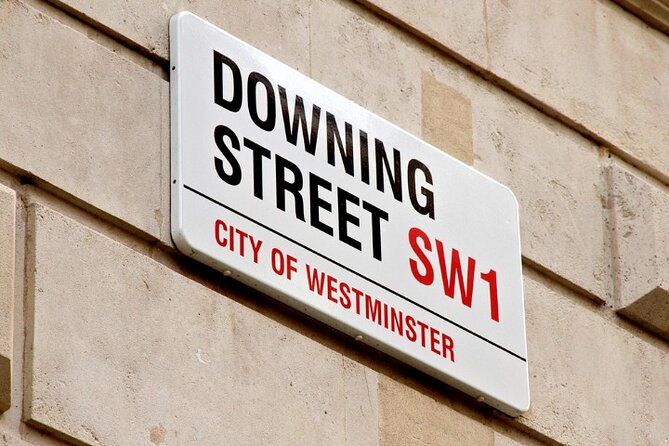
The tour pauses at 10 Downing Street for about 10 minutes. Downing Street is closely linked with British political leadership, and No. 10 has been the Prime Minister’s home and office since the 18th century. No. 11 is associated with the Chancellor of the Exchequer.
This stop helps explain why the tour is not only about military events. Churchill’s wartime decisions were political decisions too. They involved national finances, government departments, military planning, and public communication. A guide can connect the familiar black door of No. 10 with the less visible work carried out across the surrounding government district.
You should not expect to enter Downing Street. The attraction here is the setting and the explanation. Ten minutes is enough for the guide to establish its role without turning the stop into a long photo break.
A completely different sort of day out:
- Stonehenge, Windsor Castle, and Bath from London
★ 4.5 · 18,662 reviews - London Big Bus Hop-On Hop-Off Tour with Optional River Cruise
★ 3.5 · 10,803 reviews - London Small Group Tour of Historical Pubs
★ 5.0 · 10,422 reviews - Stonehenge, Windsor Castle and Bath with Pub Lunch in Lacock
★ 4.5 · 7,402 reviews
Churchill’s statue and the Houses of Parliament
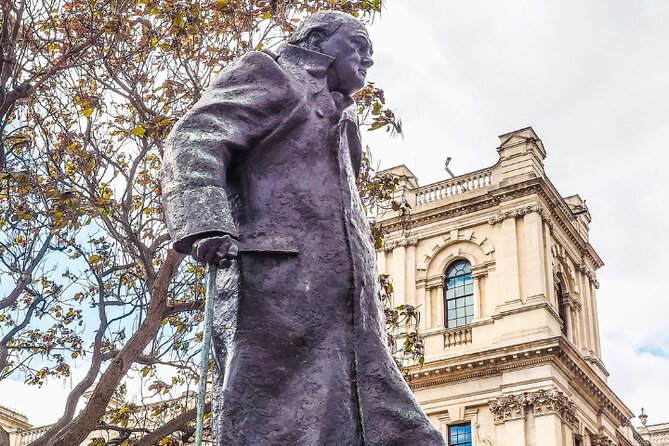
The Winston Churchill statue in Parliament Square is one of the clearest visual reminders of his wartime image. The bronze figure shows him in a military overcoat, leaning on his cane, with a determined expression. Its location near the Houses of Parliament ties Churchill’s leadership to Britain’s democratic institutions.
I find this a useful place to think about the difference between a national symbol and a private person. The statue presents Churchill as the leader associated with resistance and resolve. Elsewhere on the tour, St Margaret’s Church shows a more personal side of his life.
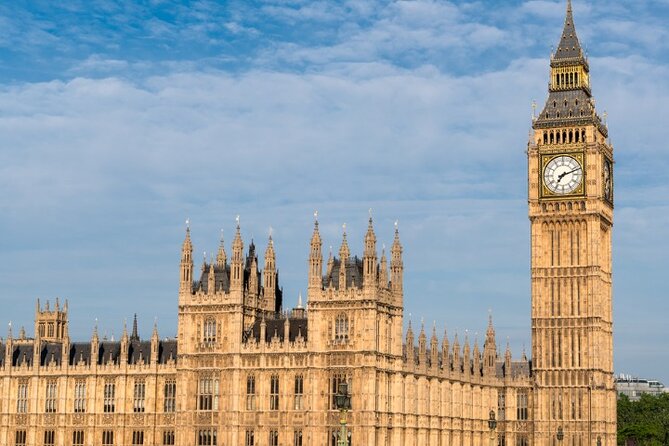
The Houses of Parliament receive about 10 minutes of attention. During World War II, the buildings were targeted by air raids, and the Commons chamber suffered major damage in 1941. Parliament continued to meet, and Churchill delivered important wartime speeches there.
That detail gives the building real meaning. You are not simply looking at an ornate London landmark. You are looking at a working democratic institution that continued its business during a national emergency. The tour does not include entry to the Houses of Parliament, so the value comes from the guide’s explanation and the view from Parliament Square.
The Battle of Britain Memorial and the air defense of Britain
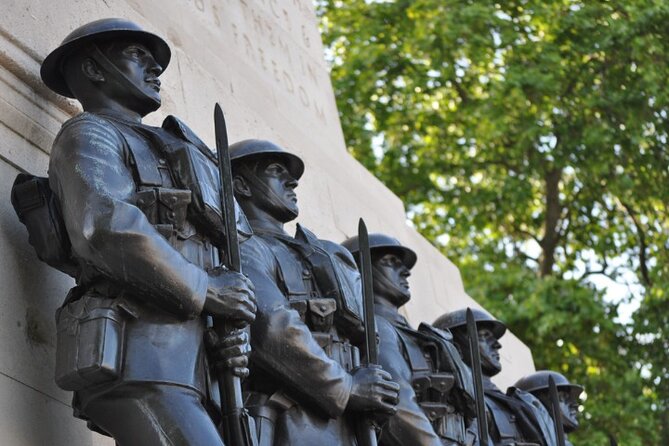
The Battle of Britain Memorial recalls the RAF pilots who defended Britain during the air campaign of World War II. The bronze monument includes a detailed frieze with scenes from the battle, along with the names of airmen who served.
This stop adds a military dimension to a route otherwise centered on government and politics. Churchill’s speeches and decisions mattered, but they were connected to the people who carried out the defense of the country. The memorial gives you a place to pause and consider the cost behind the famous story of resistance.
The supplied timing does not list a separate duration for this stop, so the guide may keep it brief as part of the route. If you want long periods for reading every name and detail, you may need to return independently. Even a short explanation can make the monument more meaningful than a quick passing glance.
The Women of World War II Memorial
The Women of World War II Memorial is one of the most valuable stops because it widens the story beyond famous male leaders and uniformed pilots. The bronze statue shows a woman in overalls, representing women who worked in civil defense, military services, and wartime industries.
The memorial recalls essential work that often receives less attention. Women helped keep services and industries operating while the country fought the war. Their contribution was not a side note, and this stop gives it a clear place in the tour.
The visit lasts about five minutes and admission is free. That is enough time to look closely, listen to the explanation, and take in the monument before continuing toward the Cenotaph and the Ministry of Defence.
The Cenotaph and the public ritual of remembrance
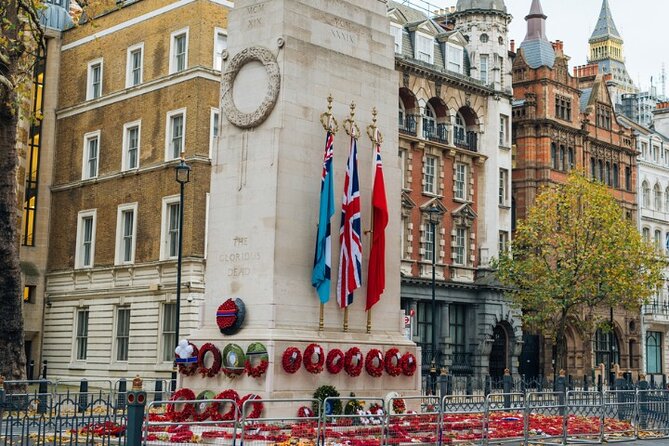
The Cenotaph is a solemn memorial to British and Commonwealth soldiers killed in the two World Wars and later conflicts. It is also the focus of the annual Remembrance Day ceremony on November 11.
This is a quieter stop than the Parliament Square sights. The Cenotaph is not mainly about one leader or one event. It represents national mourning and the repeated act of remembering those who died in military service.
The tour allows about five minutes here. I would use that time respectfully rather than treating the memorial as another quick photograph. Its plain form and central location make it an important part of the walk’s emotional progression.
The Ministry of Defence and HM Treasury
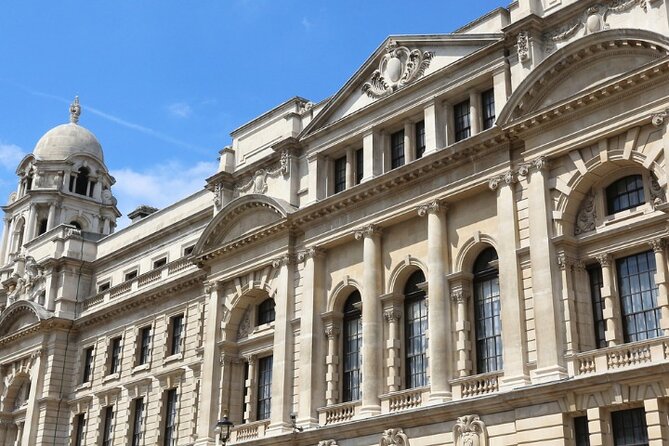
The Ministry of Defence occupies the historic Main Building and is responsible for national defense and military affairs. The tour spends about five minutes here, using the building to explain how Britain organizes military policy and national security.
HM Treasury receives about 10 minutes. During World War II, the Treasury helped manage the war economy and the resources needed for both military and civilian life. Its basement served as an emergency location for officials during air raids.
These stops may be less instantly familiar than Churchill’s statue, but they are important for understanding how a country sustains a long war. Armies need equipment, money, planning, and administration. The Treasury and Ministry of Defence show the less glamorous side of wartime leadership, which is often where a good guide adds the most value.
Neither stop is an indoor visit included with the tour. You will see the buildings from the outside and hear about their wartime roles.
St Margaret’s Church and Churchill’s personal life
St Margaret’s Church on Parliament Square dates back to the 12th century and is known as the Church of the House of Commons. It also has a direct personal connection to Churchill: he married Clementine Hozier there in 1908.
The tour allows about 10 minutes at the church. This is a welcome change of pace after the government buildings and memorials. Churchill can seem like a carved figure from a national story, but the church connects him to family life, ceremony, and the parliamentary world he occupied long before World War II.
Admission is not included, and the tour does not promise an interior visit. You should regard the stop as an opportunity to hear the connection and view the historic church from the route.
What the $19.01 price really includes
The $19.01 price is attractive for central London. It includes a guided walking tour in English, a professional guide, and the route through the major Churchill and World War II sites. It does not include entry to the Churchill War Rooms, and the listed stops at Parliament, St Margaret’s Church, the Ministry of Defence, and HM Treasury are not presented as included indoor admissions.
That makes the tour good value if you want orientation and historical explanation. It is less good value if you expect several indoor attractions or a full museum experience. I would think of it as a guided Westminster walk with a Churchill theme.
The strongest appeal is the combination of stops. A short walk that includes Downing Street, Parliament Square, the Cenotaph, the Women of World War II Memorial, and the War Rooms exterior would be difficult to interpret fully without a guide. The tour gives you a framework, then lets you decide which sites deserve more time afterward.
Timing, walking needs, and cancellation rules
The experience lasts approximately 2 to 3 hours and begins at 1:30 pm. It ends at King Charles Street, in front of the Churchill War Rooms, so you finish in a useful location for continuing your sightseeing.
You should be comfortable walking for the duration. The tour is specifically not suitable for people with walking or mobility difficulties, and it is not suitable for prams, buggies, or strollers. Service animals are allowed, and the route is near public transportation.
Most people can participate, but the walking requirement should guide your decision. If you need frequent rest stops or have difficulty keeping pace, this may not be the right format.
Free cancellation is available if you cancel at least 24 hours before the local start time. Cancellations made less than 24 hours before the start are not refunded, and changes inside that window are not accepted. The tour also requires a minimum number of participants. If that minimum is not met, you are offered another date or experience, or a full refund.
Should you book the Churchill and World War 2 Walking Tour?
I would book this tour if you want a low-cost, focused introduction to Churchill’s London and are happy to explore the major sites from outside. The strongest feature is the balance between Churchill’s leadership, British government, military service, and the contribution of women during the war.
I would not book it expecting the Churchill War Rooms museum itself. Buy a separate admission ticket if the underground headquarters are central to your plans, and allow extra time after the walk to visit them.
The tour suits history-minded visitors, first-time London sightseers, and anyone who wants more context for Westminster’s familiar landmarks. It is less suitable for anyone with limited mobility or for families using a stroller. For $19.01, it is a sensible way to put several important places into one coherent story, provided you understand that the famous bunker is viewed from the outside.
FAQ
How long is the Churchill and World War 2 Walking Tour?
The tour lasts approximately 2 to 3 hours.
Where does the tour begin?
It begins at Embankment Station, Embankment Place, London WC2N 6NS, UK.
What time does the tour start?
The scheduled start time is 1:30 pm.
Where does the tour end?
The tour ends in front of the Churchill War Rooms on King Charles Street, London SW1A 2AQ.
Are Churchill War Rooms admission tickets included?
No. The walking tour visits the exterior of the Churchill War Rooms only, and entrance tickets must be purchased separately.
Is the tour available in English?
Yes. The tour is offered in English and includes a professional tour guide.
Is the tour suitable for people with mobility difficulties or strollers?
No. The tour is not suitable for people with walking or mobility difficulties, prams, buggies, or strollers.
Just added in London
- Private Transfers between London & Windsor★ 5.0 · 9 reviews
- Private Transfer: Heathrow Airport to London Kings Cross or St Pancras Stations★ 5.0 · 3 reviews
- London to Southampton Transfers★ 5.0 · 7 reviews
- Private 3-hour Tour of The Iconic Tower of London & Tower Bridge★ 4.5 · 6 reviews
- London to Southampton Cruise Port | Private Transfer★ 5.0 · 6 reviews
- Private Tour to Westminster Abbey with optional Houses of Parliament in London★ 4.0 · 15 reviews
- Private Tours to Stonehenge & Oxford★ 4.0 · 4 reviews
- Private Tour to Stonehenge and Windsor Castle★ 5.0 · 11 reviews
Walking Tours, compared.

Oxford University Walking Tour With University Alumni Guide
Read our review →
Tour for Muggles The Ultimate Harry Potter Walking Tour in London
Read our review →
Cambridge University Walking Tour by Alumni™ Kings College Option
Read our review →
Blackbeard to Banksy – The Ultimate Walking Tour of Bristol
Read our review →
Air Raid Shelter + St. Nicholas Market Walking Tour
Read our review →
Walking Tour of Bath with Blue Badge Tourist Guide
Read our review →
Changing of the Guard Guided Walking Tour in London
Read our review →Browse the lists this tour appears in