Reviewed · WALKING TOURS
Discover Coventry’s Treasures: Private Walking Tour
Coventry rewards curious walkers. This private city walk links post-war design with older streets, medieval buildings, bicycles, cars, theatres, and public art. I like the way it moves beyond the usual cathedral visit, and I especially like the close look at Lady Herbert’s Garden, the city wall, and Coventry’s industrial past.
I also like the small-group format. You get one guide for your own party, with time to ask questions and keep the walk at a useful pace. The main drawback is the price: at $250.26 per person, it is a serious outlay, especially for one or two people, and 18 stops in less than three hours means several are quick exterior visits.
In This Review
- Key points before you book
- Why Coventry works so well on foot
- From ribbon weaving to the jet engine
- Lady Herbert’s Garden and the saved city wall
- The Ring Road and the motor city
- Palmer Lane, the Old Grammar School, and Coventry’s public face
- Bond’s Hospital and the phrase Sent to Coventry
- Spon Street and the working city
- Market streets, public art, and royal connections
- Greyfriars Spire, Ford’s Hospital, and Hertford Street
- Is $250.26 per person good value?
- Who should book this Coventry walk?
- FAQ
- Where does the private Coventry walking tour begin?
- Where does the tour end?
- How long does the walking tour last?
- Is this a private tour?
- How many stops are included?
- What is the price?
- Are admission tickets included?
- Can most people take part?
- What happens if the weather is poor?
- Should you book it?
Key points before you book
- Lady Godiva begins the story: The walk starts at Broadgate, in the center of Coventry’s post-war City of Tomorrow plan.
- Bicycles and cars share the spotlight: Lady Herbert’s Garden covers the birth of bicycle making, while Millennium Place explains Coventry’s rise as England’s motor city.
- The route reaches lesser-seen corners: Palmer Lane, the old city wall, Greyfriars Spire, and tucked-away historic buildings add variety.
- Expect a brisk historical walk: Most stops last about nine minutes, with a few at ten minutes, so this is not a slow photography tour.
- It is private, not a mixed group: Only your party participates, and group discounts are available.
- The finish is central: The walk ends on Hertford Street, close to shops, restaurants, and entertainment venues.
Why Coventry works so well on foot

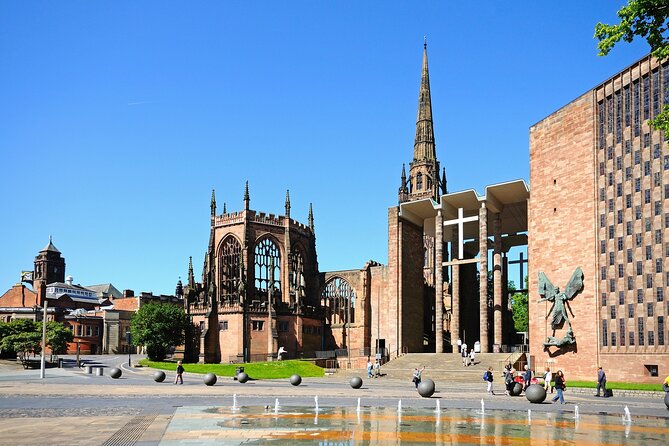
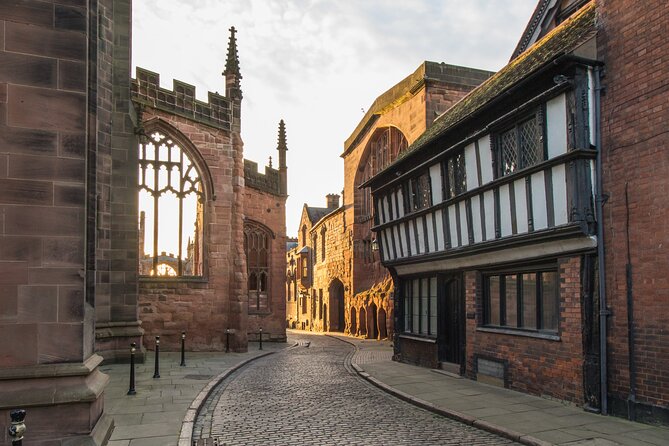
Coventry can seem like a city of contrasts. Broad post-war roads and concrete structures sit near old timber buildings, medieval churches, charitable almshouses, and remnants of earlier industry. This walk uses that contrast as its main subject.
You begin at the Lady Godiva Statue in Broadgate. The statue is more than a familiar city symbol. It introduces Donald Gibson’s plan for a rebuilt Coventry, often described here as the City of Tomorrow. After wartime destruction, the city center was redesigned with a different kind of urban vision. You get that context at the start, before the route turns toward older surviving buildings.
The walk is useful if you want Coventry to make sense as a whole. You are not simply moving from one attractive building to another. The route connects weaving, bicycles, jet engines, cars, theatre, markets, and civic design. Those links help explain why Coventry changed so often and why its identity is tied to making things.
Because the tour is private, you can ask for more explanation at the subjects that interest you most. The published details do not name the guide, so you should not expect a particular person by name. Still, a private setup gives your own group the chance to ask about architecture, industry, or local stories without waiting for a large party to catch up.
More Walking Tours in England:
- Oxford University Walking Tour With University Alumni Guide
★ 5.0 · 6,905 reviews - Tour for Muggles The Ultimate Harry Potter Walking Tour in London
★ 5.0 · 4,684 reviews - London Jack The Ripper Guided Walking Tour
★ 5.0 · 3,131 reviews
From ribbon weaving to the jet engine
The second stop takes you beside New Buildings and the last remaining former ribbon weaving factory in the city center. This is a useful reminder that Coventry’s industrial story began long before mass car production. You hear about the rise and decline of ribbon weaving while also seeing part of the original Coventry Cathedral, known here through the surviving wall of St Mary’s.
That pairing is one of the walk’s strengths. Instead of treating industry and religion as separate subjects, the route places them side by side. You can look at a working-era building and a surviving church wall within the same short stop.
At the Sir Frank Whittle statue, the focus shifts from textiles to aviation. Whittle was born in Earlsdon and became an engineer and RAF officer associated with the invention of the jet engine. The stop is brief, but it gives Coventry another claim to technological importance. The city’s story reaches from hand production to aircraft engineering, not just factory-built cars.
These first three stops also show the pace. Each is about ten minutes, and admission is free. You will have enough time for an explanation and a look around, but not an extended visit inside a building.
Lady Herbert’s Garden and the saved city wall
Lady Herbert’s Garden is one of the most appealing parts of the route. Here, the guide explains how Coventry helped give birth to the bicycle industry and how the modern bicycle developed. That subject gives the walk a practical, human scale. You are hearing about an object that changed travel, work, and manufacturing, rather than only looking at grand civic buildings.
Turn around, and the city wall adds another layer. This is described as the best-preserved section of Coventry’s wall, saved from destruction by industrialist Alfred Herbert. The stop makes an important point about preservation: old structures do not survive by accident. Someone has to value them, protect them, and make room for them in a changing city.
The garden visit lasts about nine minutes. It is not a long pause, but the setting should help break up the harder urban sights. If bicycles interest you, this is one place where you may want to ask extra questions, since the schedule otherwise moves on quickly.
The Ring Road and the motor city
A couple of minutes are given to the A4053, Coventry’s ring road. That may sound like an odd stop on a walking tour, but it fits the city’s post-war design story. The road is presented as an engineering feat and forms part of the modern urban plan around the center.
You may not find this the most scenic pause, but it helps explain why Coventry feels different from many older English cities. The walk asks you to look at roads and traffic design as part of the city’s character, not just as obstacles between attractions.
At Millennium Place, the subject becomes Coventry’s motor industry. Near the Coventry Transport Museum, you learn how the city earned its reputation as the motor city of England, became a major car manufacturing center with an international reach, and then came close to losing that identity altogether.
This is likely the strongest stop for anyone interested in cars, manufacturing, or twentieth-century Britain. The tour does not include admission to the transport museum, so this is an outside explanation rather than a museum visit. If you want displays and vehicles, you would need to arrange that separately.
A few more to weigh up in England
- The Premier Classic London: Private 4-Hour Tour in a Black Cab
★ 5.0 · 2,737 reviews - Stonehenge Inner Circle Private Tour from London with Bath Visit
★ 5.0 · 1,909 reviews - Private Historical Walking Tour of York
★ 5.0 · 1,324 reviews - Private Tour: Black Taxi Tour of London
★ 5.0 · 1,153 reviews
Palmer Lane, the Old Grammar School, and Coventry’s public face
Palmer Lane takes you off the main route and into city-center corners that many people might pass without noticing. The supplied details do not specify every feature here, which is part of the appeal. This is a discovery stop rather than a famous landmark checklist.
The Old Grammar School stop gathers several subjects into one street corner. You can see the building called the Old Grammar School, an artwork celebrating Coventry’s motor industry, and a structure named for the city’s best-known poet. It is an efficient example of how Coventry layers different periods and forms of public memory in a small space.
The route then reaches the Belgrade Theatre. You walk around the exterior while hearing about the theatre’s story, Coventry’s famous plays, Ira Aldridge, and the three women identified as the most influential figures in the city’s arts history.
Ira Aldridge is a particularly striking detail. He was the first Black man to play Othello, two centuries after Shakespeare’s play was created. That gives the theatre stop a wider cultural reach. It is not only about a local stage. It also connects Coventry with questions of race, performance, and the history of Shakespearean theatre.
Again, this is an exterior visit. You should not expect a performance or an inside tour. The value comes from the stories attached to the building and the people linked to Coventry’s arts life.
Bond’s Hospital and the phrase Sent to Coventry
Bond’s Hospital was built in 1505 by Thomas Bond and still serves its original purpose more than 500 years later. That continuing use is what makes the building especially worthwhile. You are not looking at a shell or a reconstruction. You are hearing about a charitable institution that has retained its function across centuries.
The next stop is the Parish Church of St John the Baptist. It was first built as a private place of worship for some of the city’s wealthiest residents. Outside the church, the guide explains its connection with the phrase Sent to Coventry, one of the city’s best-known expressions.
This is a good example of the tour’s method. A building becomes the doorway into language and local identity. You do not need a long church visit to understand that Coventry’s name has traveled far beyond the city itself.
Both stops last about nine minutes. Since the tour does not list admission to interiors, plan on seeing these places from outside unless the guide provides access as part of the visit. The stated tour information only promises the walking experience and free admission at the stops.
Spon Street and the working city

Historic Spon Street brings several trades into the same part of the route. The guide covers dyeing, tanning, watchmaking, and bicycles, while also explaining the street’s long role as one of the country’s major roads.
This is the kind of stop I value on a city walk. You get a sense of how streets functioned before modern tourism. People made goods, sold them, moved through the city, and relied on routes such as Spon Street for business. The bicycle story returns here, tying the earlier visit to Lady Herbert’s Garden into a larger account of local work.
The stop also promises lesser-known stories around the street. Since no specific examples are supplied, I would treat that as a reason to listen closely rather than expect a fixed list of sights. The tour is strongest when the guide can add local context to what you are seeing at street level.
Market streets, public art, and royal connections

Coventry Market Shopping Centre brings you into the city’s current commercial center. It is described as a diverse shopping destination, so this part offers a change from monuments and old walls. You see where people shop and move through the center today.
At Bull Yard and Shelton Square, the focus returns to the City of Tomorrow. You hear about the area’s historical importance and the stories behind its public artworks. This stop continues the tour’s interest in modern Coventry. The city is not presented as an old town that simply survived. It is also a place that made bold choices about rebuilding and public space.
Cheylesmore Manor House adds a much older note. You pass a 700-year-old royal palace hidden in the center of the city and hear stories about its heritage. The wording indicates a pass-by rather than a full interior visit, but even a short look can be useful when you know what you are seeing.
These stops are close to the middle and later parts of the walk, when the changing subjects help keep the route from feeling repetitive. You move from shopping to public art, then to royal history, without paying separate entry fees.
Greyfriars Spire, Ford’s Hospital, and Hertford Street
On New Union Street, the guide tells the story of Greyfriars Spire, described as an enduring Coventry landmark. The itinerary does not provide the full story, so this is another place where the guide’s explanation supplies the meaning. The spire gives you a vertical marker in a city known for both surviving medieval structures and modern rebuilding.
Ford’s Hospital, also called Ford’s Almshouses, was founded in the early sixteenth century by William Ford, a wealthy merchant. It was created to house and support older people in need. Like Bond’s Hospital, it shows how charity shaped the city’s buildings and services.
The final stop is Hertford Street, a central thoroughfare with shops, restaurants, and entertainment venues. It is a practical ending point. You finish in an active part of Coventry rather than at an isolated site, making it easy to continue your afternoon.
The complete walk lasts about 2 hours and 45 minutes. With 18 stops, you are covering a lot of ground in a limited period. I would wear comfortable shoes and expect a steady pace, even though the route is described as suitable for most people.
Is $250.26 per person good value?
The price needs careful thought. At $250.26 per person, this is not a low-cost introduction to Coventry. Every listed stop has free admission, so you are paying mainly for the guide, the private format, the route design, and the convenience of having the city explained in one continuous walk.
For a larger party using the available group discount, the value may improve. A private tour can also make sense when your group wants a focused introduction and does not want to join strangers. For a solo visitor or a pair, the cost is harder to justify unless personalized guiding is a high priority.
One positive sign is the breadth of the route. You get industrial history, local expressions, post-war planning, public art, theatre, markets, religious buildings, and charitable institutions. A shorter, cheaper walk might cover only the most familiar sights. This one aims to show how the parts connect.
The compromise is depth. Eighteen stops in 165 minutes leaves an average of roughly nine minutes per stop, before allowing for walking between them. You will collect many useful starting points, but you will not spend long inside any one place. I would view it as a city orientation with strong historical detail, then choose one or two museums or buildings to explore separately.
The experience is booked around 12 days ahead on average, so advance planning is sensible. You receive confirmation at booking, can use a mobile ticket, and the start is near public transportation. Free cancellation is available until 24 hours before the start time. If poor weather cancels the walk, you are offered another date or a full refund.
Who should book this Coventry walk?
I would recommend it to a private group that wants a broad introduction to Coventry and values context more than formal admissions. It fits people interested in manufacturing, bicycles, cars, architecture, local sayings, theatre, or the way cities rebuild after destruction.
It is also useful for a first visit because the end point on Hertford Street places you near shops, food, and entertainment. The route can help you decide what deserves a longer return visit.
I would think twice if you want a slow photography walk, a museum tour, or extensive time inside historic buildings. The schedule is packed, and the supplied information does not include admission to the Coventry Transport Museum or other interiors.
FAQ
Where does the private Coventry walking tour begin?
It begins beside the Lady Godiva Statue in Broadgate, Coventry, at CV1 1LL.
Where does the tour end?
The tour ends on Hertford Street in Coventry, at the last site visited.
How long does the walking tour last?
The experience lasts approximately 2 hours and 45 minutes.
Is this a private tour?
Yes. Only your own group participates in the activity.
How many stops are included?
The route includes 18 listed stops, from the Lady Godiva Statue to Hertford Street.
What is the price?
The listed price is $250.26 per person. Group discounts are available.
Are admission tickets included?
Each listed stop is marked as having free admission. The experience does not list separate admission to the Coventry Transport Museum or other paid attractions.
Can most people take part?
The tour information says most people can participate. It is also near public transportation.
What happens if the weather is poor?
The experience requires good weather. If it is canceled because of poor weather, you can choose another date or receive a full refund.
Should you book it?
Book this walk if you want Coventry explained through its makers, buildings, roads, artists, and surviving medieval places. The strongest parts are the bicycle story at Lady Herbert’s Garden, the motor-industry account at Millennium Place, and the mix of lesser-known streets with major civic landmarks.
Skip it if the price feels too high for a mostly outdoor orientation or if you want long visits inside museums and churches. For a group that can use the discount, this is a useful and unusually broad way to get your bearings fast, with plenty of ideas for exploring Coventry on your own afterward.
Just added in England
- Private Transfer: Heathrow Airport to London Kings Cross or St Pancras Stations★ 5.0 · 3 reviews
- London to Southampton Transfers★ 5.0 · 7 reviews
- Private Transfers between London & Windsor★ 5.0 · 9 reviews
- Private 3-hour Tour of The Iconic Tower of London & Tower Bridge★ 4.5 · 6 reviews
- London to Southampton Cruise Port | Private Transfer★ 5.0 · 6 reviews
- Private Tour to Westminster Abbey with optional Houses of Parliament in London★ 4.0 · 15 reviews
- Private Tours to Stonehenge & Oxford★ 4.0 · 4 reviews
- Private Tour to Stonehenge and Windsor Castle★ 5.0 · 11 reviews
Walking Tours, compared.
Oxford University Walking Tour With University Alumni Guide
Read our review →
Tour for Muggles The Ultimate Harry Potter Walking Tour in London
Read our review →
Cambridge University Walking Tour by Alumni™ Kings College Option
Read our review →
Blackbeard to Banksy – The Ultimate Walking Tour of Bristol
Read our review →
Air Raid Shelter + St. Nicholas Market Walking Tour
Read our review →
Walking Tour of Bath with Blue Badge Tourist Guide
Read our review →