
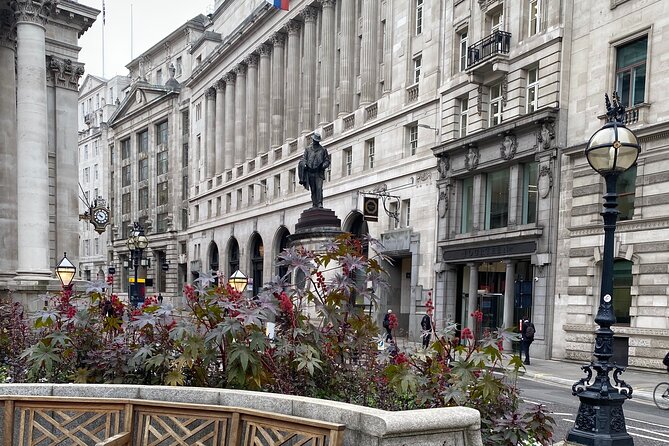
Reviewed · CITY TOURS
Money and Power in the City Sightseeing Tour
Money built London here. This two-hour walk links Roman beginnings, medieval guilds, royal finance, coffeehouse gossip, and today’s stock market. I like the small group of up to eight, which gives the guide room to answer questions. I also like the way the route connects grand buildings with narrow lanes and lesser-known stories. The main consideration is that it is a walking tour outdoors, and it requires good weather.
Guide Terry receives repeated praise for making difficult subjects clear, lively, and useful, even for people arriving with little background in London’s financial past. At $41.14 per person, the tour is not the cheapest way to see the City, but the focused route and personal attention make it a sensible choice if you want context rather than a quick photo stop.
In This Review
- Key points at a glance
- Why this City of London walk is different
- Starting with Roman and medieval London
- East India Company power and global trade
- The Royal Exchange, Bank of England, and Mansion House
- Exchange Alley and the coffeehouse beginning of the stock market
- Medieval Guildhall and nearby guild buildings
- The modern stock market beneath St Paul’s
- Terry’s approach to money and power
- Is $41.14 a fair price?
- Who should book this walk?
- Should you book Money and Power in the City?
- FAQ
- How long does the Money and Power in the City tour last?
- How much does the tour cost?
- Where does the tour start?
- What time does the tour begin?
- Where does the tour finish?
- How many people can join the tour?
- Is the tour offered in English?
- Is a mobile ticket available?
- Can service animals join the tour?
- What is the cancellation policy?
Key points at a glance
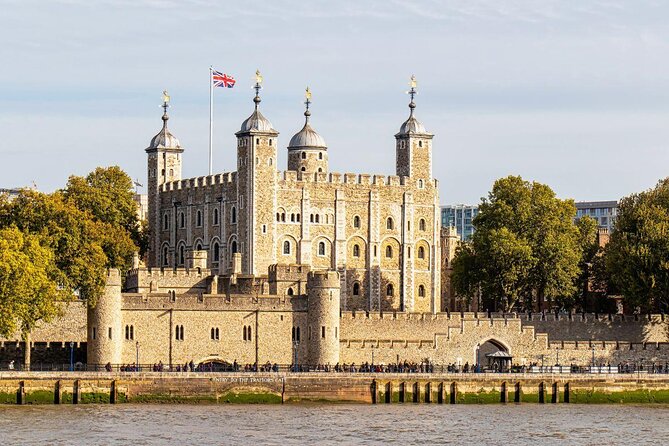
- Roman London to modern finance: The tour traces the City’s development from its earliest beginnings to the present-day stock market.
- A maximum of eight people: The small group size should make it easier to hear, ask questions, and keep the pace personal.
- Terry’s storytelling: His humor, clarity, and ability to explain complex subjects are central to the experience.
- Royal Exchange and Bank of England: You see some of the City’s grandest neoclassical buildings and learn how money gained public power.
- Exchange Alley’s coffeehouse past: A narrow passage reveals where coffee, gossip, and early stock trading met.
- A strong finish at St Paul’s: The route ends near the London Stock Exchange, with St Paul’s Cathedral providing a dramatic counterpoint.
Why this City of London walk is different
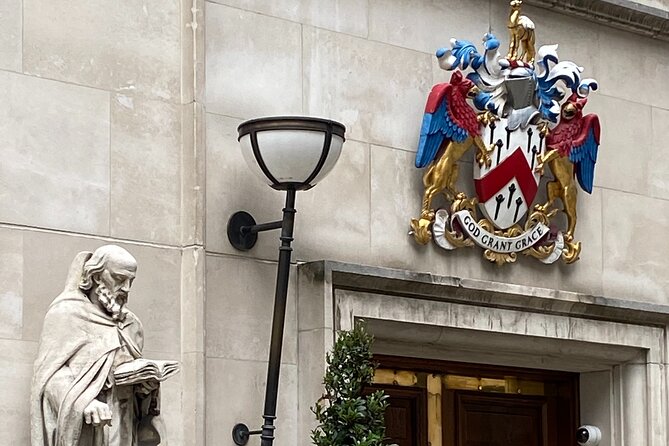
London’s City district can feel confusing at first. Modern offices crowd around medieval lanes, polished banks, ancient churches, and fragments of Roman London. If you simply walk through, you may see fine stonework without grasping why these places matter.
This tour gives the area a clear storyline. You move from early settlement to trade, from trade to political influence, and from coffeehouse dealings to the modern financial system. That broad sweep is useful because the City is not just a collection of old buildings. It is a record of who had money, who had authority, and how those two forces kept changing hands.
I especially like the focus on stories behind the buildings. The route includes gossip, scandal, and insider tales, so the past does not become a dry list of dates. At the same time, the subject has real weight. You are learning how institutions such as the Royal Exchange, the Bank of England, guilds, and the stock market shaped London.
The pace is about two hours, long enough to build a proper picture without taking up your entire afternoon. Since the walk is in English, you should be comfortable following spoken explanations while moving between stops.
A few more to weigh up in London
- Stonehenge, Windsor Castle, and Bath from London
★ 4.5 · 18,662 reviews - London Big Bus Hop-On Hop-Off Tour with Optional River Cruise
★ 3.5 · 10,803 reviews - London Small Group Tour of Historical Pubs
★ 5.0 · 10,422 reviews
Starting with Roman and medieval London
The walk begins at Emperor Trajan, at A100, London EC3N 4DR. The meeting point places you in the City’s eastern area, where the first part of the tour introduces the Roman and medieval foundations of the financial district.
That opening matters. It prevents the City from seeming like a purely modern business zone. Before the banks and insurance firms, this was an important center of settlement, trade, and civic life. The Roman and medieval layers help explain why the City developed such a strong identity and why its streets do not follow the broad, orderly pattern you might expect from a newer district.
You can expect the guide to set the scene rather than rush straight to famous façades. The best value here is the connection between early London and later financial power. Once you understand that the City grew through commerce and civic institutions, the rest of the walk becomes easier to follow.
The opening may be less visually dramatic than the grand buildings later in the route. That is a fair trade. You are getting the background needed to make the rest of the sights meaningful.
East India Company power and global trade
One stop focuses on the most important historic location associated with the East India Company, after seeing other sites linked to it. This part adds a wider imperial and commercial dimension to the walk.
The East India Company was not simply a trading business in the modern sense. Its activities connected London to overseas commerce and helped show how private enterprise could gain enormous political influence. The company’s story fits the tour’s central theme: money and power were often partners, and the people controlling trade could affect government, law, and public life.
This section should appeal to you if you want London history connected to world events rather than confined to local streets. It also gives the guide a chance to explain how the City’s institutions reached far beyond London.
There is a lot to cover in a two-hour walk, so do not expect a full study of the company’s history. Instead, treat this stop as one part of a larger explanation about commerce, empire, and influence. The route works best when you see each stop as a piece of the larger argument.
The Royal Exchange, Bank of England, and Mansion House
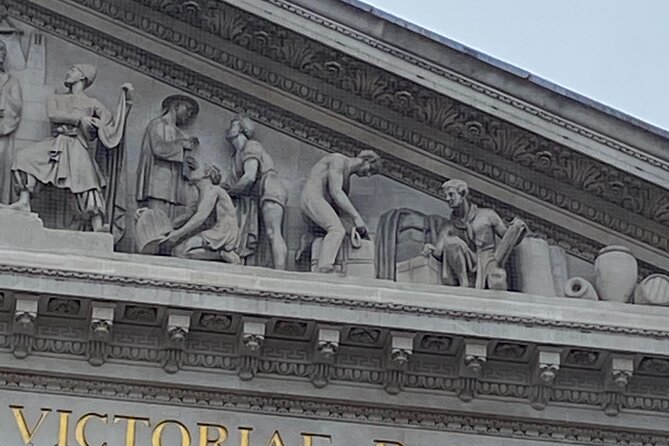
The route then reaches the grand civic and financial buildings around the Royal Exchange, the Bank of England, and Mansion House. This is likely to be one of the most impressive visual sections of the walk.
The Royal Exchange represents the public face of commerce. Its neoclassical design gives a sense of order, ceremony, and confidence. The Bank of England brings the story toward national finance, while Mansion House connects the area to the City’s civic leadership.
I like this group of stops because the architecture carries part of the lesson. These are not modest private offices tucked away on side streets. Their scale and formal style show how financial institutions wanted to present themselves: stable, authoritative, and worthy of trust.
The guide’s role is especially important here. Without context, you might admire the columns and move on. With a clear explanation, you can think about what these buildings represented and how financial power became part of London’s public identity.
The drawback is that exterior viewing is not the same as an interior visit. The provided details describe seeing these landmarks, not entering them. If you want museum rooms, guided interiors, or a tour inside the Bank of England, this walk may not meet that specific aim.
A completely different sort of day out:
- Stonehenge, Windsor Castle and Bath with Pub Lunch in Lacock
★ 4.5 · 7,402 reviews - Tower of London and Crown Jewels Exhibition Ticket
★ 4.5 · 6,677 reviews - Thorpe Park Admission Ticket
★ 4.0 · 5,915 reviews - Stonehenge, Windsor Castle and Bath Full Day Guided Tour
★ 4.5 · 5,346 reviews
Exchange Alley and the coffeehouse beginning of the stock market
Exchange Alley, also called Change Alley, is one of the most memorable settings on the route. This narrow passage connects Cornhill with Lombard Street and once offered a shortcut between the Royal Exchange and the Post Office.
Its importance comes from what happened in the coffeehouses around it. One stop identifies the location of the coffee shop where the stock market was first based. That detail turns an ordinary-looking alley into a key part of London’s financial story.
This is exactly the kind of stop that makes a walking tour worthwhile. A grand building can announce importance, but a narrow lane can explain how business actually happened. Coffeehouses provided places to meet, exchange news, discuss prices, and build commercial relationships. The setting helps you picture finance as a social activity before it became associated with electronic screens and office towers.
The route’s references to gossip and scandal fit particularly well here. Coffeehouse culture was built around information, and information can be valuable, dangerous, or both. The guide can use this setting to show how rumor and news affected commerce.
You should keep your expectations practical. The alley is a place to see and understand, not a large attraction with displays or formal exhibits. Its value comes from the story attached to the space.
Medieval Guildhall and nearby guild buildings
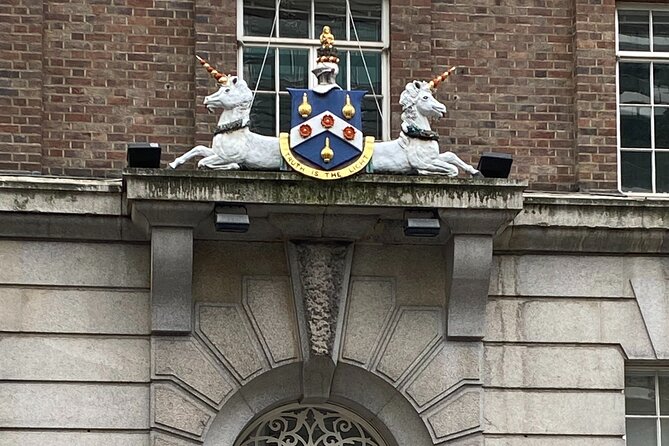
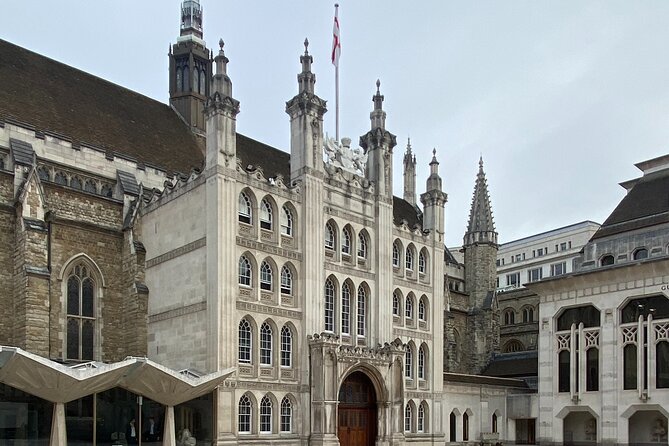
The medieval Guildhall adds another layer to the City’s past. You see the Guildhall and selected nearby guild buildings, with an explanation of how medieval guild halls served their members and the wider town.
These buildings were used to store goods and host celebrations. When guild members did not need them, the halls could also be used by townspeople for entertainment, including Passion plays. That detail is particularly useful because it shows the guilds as part of everyday civic life, not just closed organizations for merchants.
For you, this stop provides a welcome change from the major financial institutions. The Royal Exchange and Bank of England suggest national and international finance. The guild buildings show how trade was organized at a more local level, with professional groups shaping work, commerce, and public culture.
The medieval material also helps explain why London’s City has such a mix of uses. Business, ceremony, religion, entertainment, and local government have shared this small area for centuries. The guide’s job is to make those connections clear, and Terry’s ability to provide context is one of the strongest reasons to choose this tour.
The Guildhall section may appeal most to people who enjoy social history. If your only interest is modern banking, it could feel like a detour. I would see it as an important part of the route because it shows the human machinery behind the City’s commercial life.
The modern stock market beneath St Paul’s
The walk ends at the London Stock Exchange, 10 Paternoster Square, beside the main column in Paternoster Square. This closing location brings the story into the present.
You also see the modern stock market towered over by St Paul’s Cathedral. That pairing is visually strong and historically suggestive. The stock exchange represents current financial power, while St Paul’s connects the scene to London’s religious, architectural, and civic past.
St Paul’s sits on Ludgate Hill, the highest point in the City of London, and serves as the mother church of the Diocese of London. Even if the tour does not include an interior visit, the cathedral gives the final stop a grand sense of place.
I like the ending because it does not treat modern finance as separate from old London. The stock market is surrounded by institutions and buildings shaped by centuries of change. You finish with a better sense of how the City’s past still frames its present.
The end point is convenient if you plan to continue sightseeing around St Paul’s or Paternoster Square. Since the tour does not include entry to St Paul’s Cathedral, you will need a separate ticket and visit if you want to go inside.
Terry’s approach to money and power
The guide can make or break a history walk, and Terry receives especially warm praise for his energy, humor, and clarity. His strongest skill appears to be explaining complex subjects in plain terms.
That matters on this route. Finance, political influence, guild structures, and the East India Company can quickly become abstract. Terry is praised for meeting each member of a family at their level of knowledge, answering questions, and placing individual sights in a larger context.
You should expect a lively history lesson rather than a silent march between landmarks. Stories, scandal, and gossip help keep the subject human. The tour also appears well suited to people who have just arrived in London and want a framework for understanding the city.
The experience has earned a five-star rating from 11 published ratings, with 100 percent recommending it. That is a small sample, so I would not treat it as final proof of quality. Still, the praise is consistent: the guide’s explanations and engaging style are the main strengths.
Is $41.14 a fair price?
At $41.14 per person, this is a mid-priced two-hour walking tour. You are not paying for entry to a major attraction, transport, food, or a full-day excursion. You are paying for a focused route and a guide who can provide meaning that you would be unlikely to get from simply walking past the buildings.
For a small group capped at eight, the price becomes easier to justify. A large group can make city walks hard to hear and limit questions. Here, the personal format should give you a better chance to interact with Terry and ask about topics that interest you.
The value is strongest if you enjoy history, architecture, politics, business, or local stories. It is weaker if you want a broad sightseeing tour covering many famous London landmarks. This is a specialist walk with a clear subject, not a general introduction to every corner of central London.
Booking is often made about 33 days ahead, so planning early is sensible if your schedule is fixed. Confirmation arrives when you book, and you receive a mobile ticket. The tour is offered in English.
Who should book this walk?
I would recommend it to first-time London visitors who want to understand the City beyond its famous skyline. It also suits repeat visitors who have seen the standard sights and now want a more focused look at finance, trade, and civic power.
Families can do well here if children or teenagers enjoy stories about business, politics, and old London. One particularly positive account describes Terry adjusting explanations so the whole family could follow along.
The tour is also a good match for people who like walking through real streets rather than spending two hours in a museum. You see major landmarks, but you also pass through alleys and locations whose importance is easy to miss.
I would hesitate to recommend it if you dislike outdoor walking, need a fully indoor activity, or want extensive time inside historic buildings. The tour requires good weather, and poor conditions can lead to a different date or a full refund.
Free cancellation is available up to 24 hours before the start time. Cancellations or changes made within 24 hours are not refunded or accepted, so keep that deadline in mind.
Should you book Money and Power in the City?
Book this tour if you want London’s financial district explained through people, places, and power struggles. The route is compact, the group is small, and Terry’s clear storytelling gives the subject life.
Skip it if you are looking for a general city highlights tour or guaranteed interior access to the Bank of England, Guildhall, or St Paul’s Cathedral. For the right audience, though, $41.14 buys a useful two-hour foundation in how London grew from Roman and medieval beginnings into a world center of money and influence.
FAQ
How long does the Money and Power in the City tour last?
The tour lasts approximately two hours.
How much does the tour cost?
The listed price is $41.14 per person.
Where does the tour start?
The tour starts at Emperor Trajan, A100, London EC3N 4DR, United Kingdom.
What time does the tour begin?
The stated start time is 2:00 pm.
Where does the tour finish?
It finishes at the London Stock Exchange, 10 Paternoster Square, London EC4M 7LS, beside the main column in Paternoster Square.
How many people can join the tour?
The maximum group size is eight people.
Is the tour offered in English?
Yes. The tour is offered in English.
Is a mobile ticket available?
Yes. A mobile ticket is provided.
Can service animals join the tour?
Yes. Service animals are allowed.
What is the cancellation policy?
You can cancel up to 24 hours before the start time for a full refund. Cancellations and changes made less than 24 hours before the start time are not accepted or refunded. If poor weather causes the tour to be canceled, you will be offered another date or a full refund.
Just added in London
- London to Southampton Transfers★ 5.0 · 7 reviews
- Private Transfers between London & Windsor★ 5.0 · 9 reviews
- Private Transfer: Heathrow Airport to London Kings Cross or St Pancras Stations★ 5.0 · 3 reviews
- Private 3-hour Tour of The Iconic Tower of London & Tower Bridge★ 4.5 · 6 reviews
- London to Southampton Cruise Port | Private Transfer★ 5.0 · 6 reviews
- Private Tour to Westminster Abbey with optional Houses of Parliament in London★ 4.0 · 15 reviews
- Private Tours to Stonehenge & Oxford★ 4.0 · 4 reviews
- Private Tour to Stonehenge and Windsor Castle★ 5.0 · 11 reviews
City Tours, compared.


Liverpool City Sights Hop On Hop Off City Tour – 24hr Ticket
Read our review →
1.5-hour Oxford City and University Walking Tour
Read our review →
City Sightseeing London Hop-On Hop-Off Bus Tour & Bookable Extras
Read our review →
City Sightseeing Oxford Hop-On Hop-Off Bus Tour
Read our review →
Browse the lists this tour appears in