
Reviewed · CITY TOURS
Extended: Oxford University & City Tour With Christ Church
Oxford rewards curious walkers. This tour links its grand colleges, old libraries, famous courtyards, and student traditions in one well-organized outing. I especially like the small-group format, with no more than 19 people, and the Oxford student guide, who can explain both ancient customs and present-day university life. The main caution is timing: Christ Church comes at the end, and one hour can feel short if sections close early.
The route also includes entry to Trinity College, the Bodleian Library, Christ Church, and the Divinity School when open. You hear the guide through headsets, a useful touch on crowded streets or when you stop for photos. If your guide is as warm and lively as Luke, Antonia, Rose, Sam, or Olli have been, the long walk becomes a story-filled introduction rather than a march between buildings.
In This Review
- Key details before you book
- Why a student guide changes the Oxford walk
- Balliol, Trinity, Exeter, and Hertford: four very different colleges
- Magdalen College and the deer park
- Einstein’s chalkboard and Oxford’s changing architecture
- Martyrs’ Memorial, the Sheldonian, and New College
- The Bodleian Library, Divinity School, and Bridge of Sighs
- Radcliffe Camera, All Souls, and the university heart
- Christ Church Meadow and the one-hour finish
- The London pickup option and overall value
- Who will enjoy this tour most?
- Should you book it?
- FAQ
- Where does the tour start?
- How long does the experience last?
- Is transportation from London included?
- Is Christ Church included?
- Is the Bodleian Library included?
- Will I enter the Divinity School?
- How large is the group?
- What happens if I cancel?
Key details before you book
- Christ Church comes last: Allow the full hour and follow the suggested order once inside.
- A current student leads the walk: You get stories about Oxford traditions, college life, and famous former students.
- The route covers a remarkable amount: Expect Balliol, Trinity, Exeter, Hertford, Magdalen, the Bodleian area, Radcliffe Camera, Merton, and more.
- Headsets help: You can hear the guide while walking, taking pictures, or catching up with the group.
- The Divinity School is not guaranteed in summer: From June through August, closures are common, with another college entrance offered instead.
- Choose your meeting point carefully: The pickup option starts in London, while the standard option meets in Oxford.
Why a student guide changes the Oxford walk
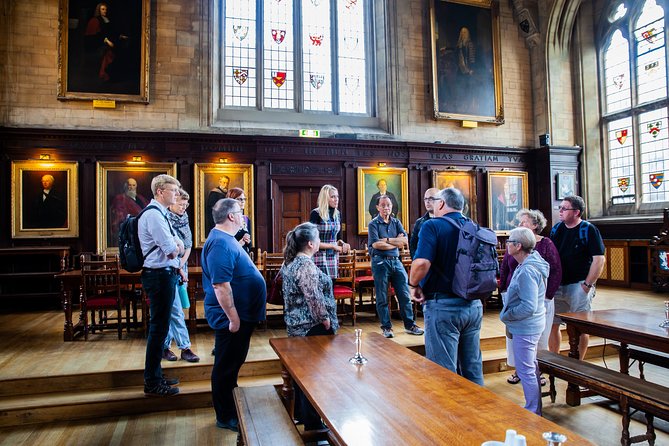
Oxford can feel like a collection of grand stone buildings until someone explains how the university works. A student guide gives the streets a human scale. You learn not only when a college was founded, but also how its traditions, rivalries, food, ceremonies, and academic culture still shape daily life.
The guides praised most warmly include Luke, Antonia, Rose, Sam Day, Olli, Oliver, Ben, and Ruth. Their styles differ, but the strongest pattern is clear: the best guides mix dates with stories, humor, and personal knowledge of student life. Antonia, a student at Queen’s College, was especially good at explaining Oxford from the inside. Rose was praised for keeping the pace comfortable while still covering a lot of ground.
The tour uses audio headsets, which I consider a real advantage. Oxford’s streets can be noisy, and a guide standing several people ahead is easy to lose. With the headset, you can pause for a photograph and still hear the explanation.
This is a walking tour, not a photo stop tour. You will see many buildings from the outside, enter several important spaces, and cover a large part of central Oxford. Wear shoes suited to several hours on foot, and bring a rain jacket. Cold, wet weather has not stopped good guides from keeping the mood light, but it can make the route tiring.
More Oxford college tours:
- Oxford University Walking Tour With University Alumni Guide
★ 5.0 · 6,905 reviews - Oxford University Walking Tour by Alumni™ & Optional New College
★ 5.0 · 323 reviews - Social Distancing Specialised Oxford University Walking Tour With Student Guides
★ 5.0 · 44 reviews
Balliol, Trinity, Exeter, and Hertford: four very different colleges
The route begins with Balliol College, traditionally argued to be Oxford’s oldest college. The stop is brief, but it gives the guide a chance to explain how Oxford’s colleges differ from one another and why their claims to age can become a matter of proud debate.
Trinity College dates from 1555 and is often considered one of Oxford’s prettiest colleges. The tour includes admission, so this is more than a passing look through a gate. Ten minutes is enough for an introduction and some photographs, though not enough for a leisurely exploration.
Exeter College dates to 1314 and has a Tolkien connection. J.R.R. Tolkien attended Exeter as a student, making this a natural stop for readers interested in the author’s Oxford years. The visit is short, so expect a focused story rather than a long literary tour.
Hertford College brings a different angle. Its history reaches back to 1282, and it is presented as one of Oxford’s more progressive colleges. That matters because the university can seem frozen in medieval ceremony. This stop helps correct that image and shows that Oxford has also changed with the times.
Magdalen College and the deer park
Magdalen College receives the longest outdoor stop before Christ Church, about 20 minutes. Founded in 1458, it is the largest college on the route and has impressive grounds, including a deer park.
That open space makes Magdalen feel different from the tighter college courtyards elsewhere in the city. The college is also linked with C.S. Lewis and Oscar Wilde, giving the guide plenty to discuss beyond architecture. If you enjoy old institutions with a little room to breathe, this is likely one of the most rewarding early stops.
The itinerary also refers to a building founded in 1427 with a historic rivalry with its neighbors, but it does not identify the building by name. Your guide supplies the context on the day. This is a good example of how the tour works: not every stop is about entering a building. Some are short explanations that connect Oxford’s colleges through competition, tradition, and local politics.
Einstein’s chalkboard and Oxford’s changing architecture
The History of Science Museum is a five-minute stop, but its Einstein connection is memorable. The museum preserves a chalkboard bearing Albert Einstein’s markings from a series of lectures he gave at Oxford.
You may not have time to visit the museum’s wider collection during the walk. Still, the chalkboard gives the stop a clear purpose and links Oxford’s old academic world with modern scientific thought.
Nearby, the Weston Library offers an architectural contrast. Oxford is famous for Victorian Gothic stonework, while the Weston is a dramatic Brutalist building with a modern interior following renovation. It holds more than five million books, including documents of major importance to human history.
The short stop is mainly an exterior introduction, but the building helps break up the parade of medieval and Gothic façades. It also reminds you that Oxford is not only a museum of old colleges. It continues to build, adapt, and serve as a working university.
A few more to weigh up in Oxford
- 1.5-hour Oxford City and University Walking Tour
★ 4.5 · 1,383 reviews - Oxford Official University & City Tour
★ 5.0 · 1,134 reviews - City Sightseeing Oxford Hop-On Hop-Off Bus Tour
★ 4.5 · 1,042 reviews - Harry Potter Walking Tour of Oxford Including New College
★ 4.5 · 930 reviews
Martyrs’ Memorial, the Sheldonian, and New College
The Martyrs’ Memorial is easy to pass without stopping. The guide explains its connection to the violent conflict between Protestants and Catholics in England, including the deaths of religious figures in Oxford. It is a sobering pause in an otherwise handsome city walk.
The Sheldonian Theatre brings you back to university ceremony. Designed by Sir Christopher Wren and finished in 1669, it hosts major Oxford ceremonies. The stop is brief, but the building helps explain why Oxford’s formal traditions remain so visible in everyday city life.
New College is another name that can mislead you. It dates to 1379, so new is a relative term here. The tour uses the college to explain how one institution became a model for later colleges. The five-minute stop will not satisfy anyone seeking a full interior visit, but it gives you useful historical structure for the rest of the route.
The Bodleian Library, Divinity School, and Bridge of Sighs
The Bodleian Library is one of the tour’s major draws. Founded in 1602, it is responsible for more than 12 million books, with documents reaching back to the era of the pharaohs. The tour includes admission when access is available.
This is also where you need realistic expectations. Oxford is a working institution, and library access can change at short notice. One person had specifically chosen the tour for the Bodleian and was disappointed when entry was unavailable. If the library is closed, the operator says it will explain the change and provide the best available substitute, but no replacement can fully match a site you chose for its name.
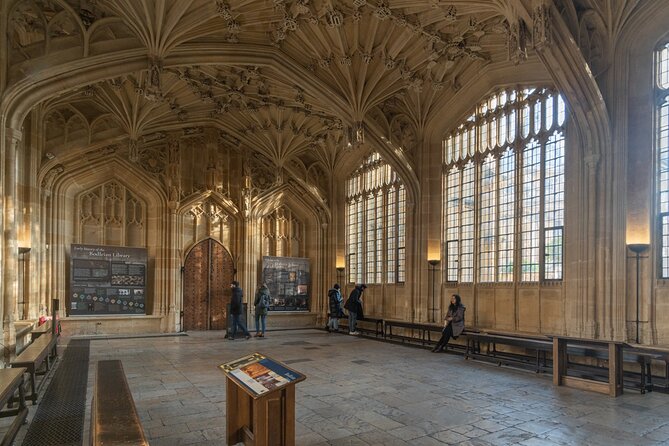
The Divinity School is an exceptional medieval lecture room and one of Europe’s finest examples of medieval architecture. Its carved stonework and ceremonial role make it a highlight for visitors interested in architecture, university history, or film locations. It was used in Harry Potter and other films.
Summer access is the weak point. From June through August, the Divinity School may close often because of ceremonies and high demand. If it cannot be entered, another college entrance is offered instead. That honest warning is important. Do not book this tour assuming the film-famous room is certain.
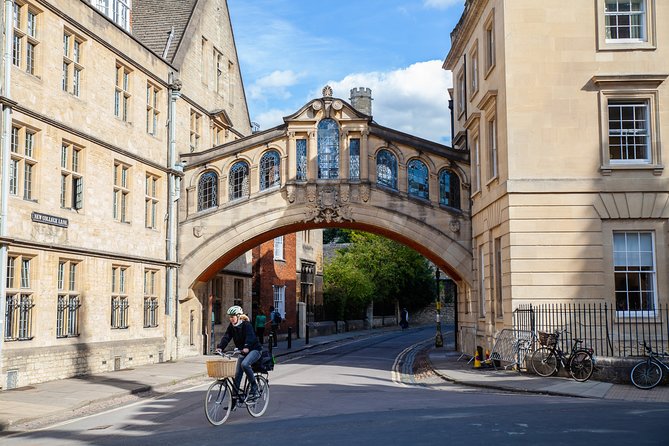
The Bridge of Sighs is perhaps Oxford’s most photographed site. The name and elegant design make it an easy favorite, though the stop is mainly for viewing and photographs. Your guide can place it within the working college system rather than treating it as an isolated postcard.
Radcliffe Camera, All Souls, and the university heart
Radcliffe Camera is the Oxford image most often seen on postcards. It is certainly worth the attention, but its function is commonly misunderstood. It is a library, not a camera in the modern photographic sense, and the tour explains how this circular building fits into the university’s library system.
All Souls College provides a glimpse of Oxford’s most exclusive academic world. It is associated with Laurence of Arabia and maintains some of the university’s strongest traditions. The stop is external and short, so think of it as an introduction to the college’s role rather than a full visit.
The University Church of St. Mary the Virgin marks the religious roots of Oxford. It was once central to university life and also has some of the city’s most detailed grotesques. This stop adds visual detail and institutional context after the larger library buildings.
Merton College dates to 1264 and has a reputation for serious academic study. It is also known for unusually good student food, a cheerful detail that makes the college feel inhabited rather than purely historic. As with many stops, the visit is short, but the guide’s stories give the building personality.
Christ Church Meadow and the one-hour finish

Christ Church Meadow offers a change of pace. This open area in central Oxford has a strong connection with Alice’s Adventures in Wonderland, making it especially appealing if you are interested in literary Oxford.
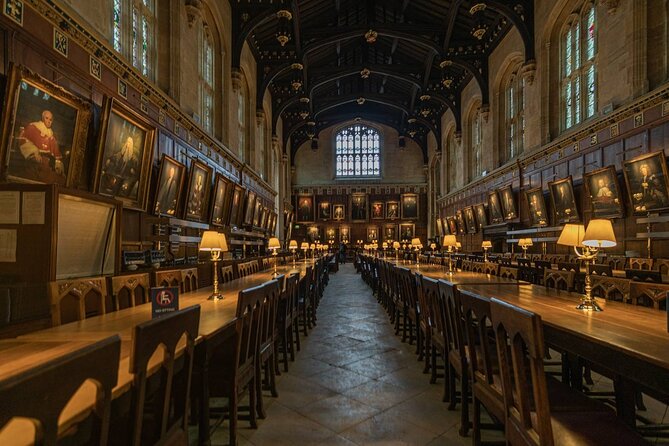
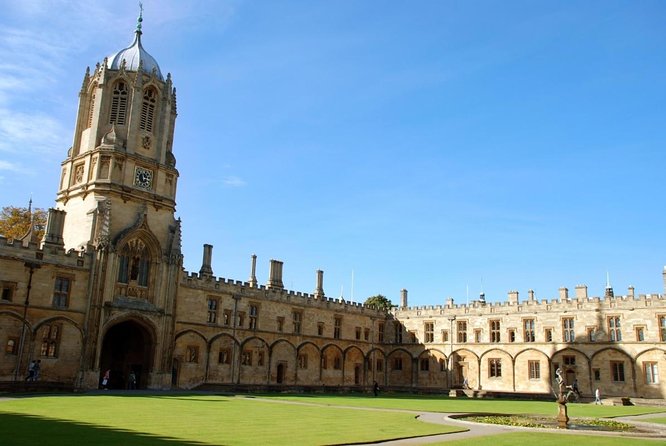
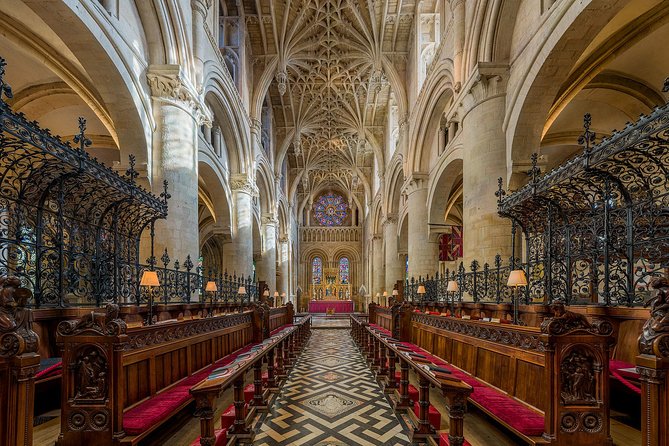
Christ Church itself is the tour’s grand finish. Nearly 500 years old, it is one of Oxford’s best-known colleges, with links to both Harry Potter and Alice’s Adventures in Wonderland. Your guide first gives an external explanation of the college and grounds. Then you enter independently with a multimedia audio guide produced by the Christ Church team.
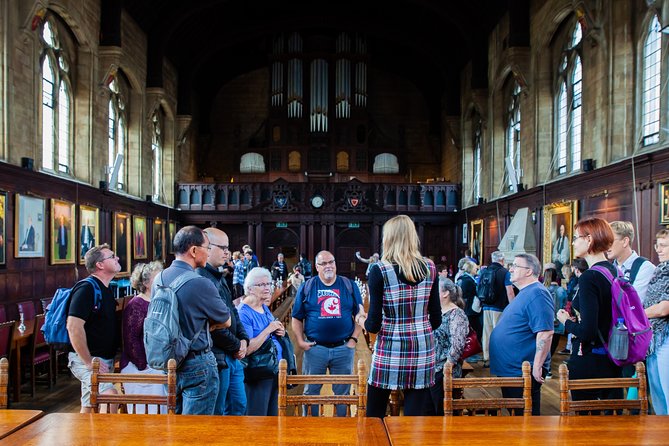
That arrangement has advantages and limits. You get the guide’s wider Oxford context, then explore the college at your own pace. You are not rushed along by a walking guide inside, and the official audio material can add detail to the rooms and grounds.
The practical problem is the clock. The tour allows about one hour, and that is usually enough for a focused visit. It may not be enough if you want to stop for every photograph, linger in the hall, or encounter a partial closure. One person arrived around 4:05 and found sections beginning to close at 4:30, leaving little time to explore.
The best strategy is simple: enter Christ Church and follow the recommended order. Save your relaxed photo time for the spaces that remain open. If Christ Church is your main reason for booking, check the departure and arrival timing before paying, especially on an afternoon tour.
The London pickup option and overall value
At $110.90 per person, this is not a cheap Oxford walk. Its value depends heavily on which version you choose.
The standard option meets in Oxford at 15 Broad Street. That is the better value if you are already in the city or can arrange your own transport. The more expensive pickup option begins at Gloucester Road Underground station in South Kensington, London. That option is useful if you want transport from London handled as part of the day, and one guide named Fred was praised for making the van journey enjoyable.
You must be at the London meeting point for the 8am departure. If you miss it, even for a reason beyond your control, there is no refund. That makes the early start a serious part of the booking, not a minor detail.
The price covers a small group, an Oxford student guide, several college entries, Bodleian access when available, Christ Church entry, and the Divinity School when open. Buying each admission separately and arranging the route yourself may cost less, but you would lose the guide’s explanations and the simple sequence through central Oxford.
For people with only a short stay, the convenience can justify the price. If you are staying several days and enjoy planning, two shorter walks or independent visits may give you more time inside each college.
Who will enjoy this tour most?
I would choose this for a first visit to Oxford, especially if you want the university explained rather than simply photographed. It suits families too. Ruth was praised for keeping the stories enjoyable for children aged 10 and 13, while other guides mixed humor with serious history.
It is also a good match for readers, architecture fans, Harry Potter followers, and anyone curious about student life. The mix of colleges, libraries, religious sites, literary links, and present-day university customs gives you a broad first look.
I would hesitate if you dislike long walks, need a slow photographic pace, or want guaranteed access to the Bodleian and Divinity School. I would also avoid treating the tour as a dedicated Harry Potter experience. Christ Church and the Divinity School have film connections, but the main subject is Oxford itself.
Should you book it?
Book it if you want a lively introduction to Oxford with many major sights connected by a student’s perspective. The guides are the heart of the experience, and names such as Antonia, Rose, Luke, Sam, and Olli show how much warmth and humor can add to the history.
Skip it if your priority is lingering inside buildings or taking a carefully planned set of photographs. In that case, arrange separate college visits and give Christ Church a longer window.
For most first-time visitors, I think the tour offers solid value, especially when you select London pickup for convenience or need help organizing several admissions. Just bring good shoes, a rain jacket, and realistic expectations about working university buildings.
FAQ
Where does the tour start?
With the pickup option, it starts at Gloucester Road Underground station, Gloucester Road, South Kensington, London SW7 4SF. Without pickup, it starts at 15 Broad Street in Oxford.
How long does the experience last?
The walking portion is approximately three hours, with about one hour allocated to exploring Christ Church independently at the end.
Is transportation from London included?
Transportation is offered only when you select the more expensive pickup option. That option starts at Gloucester Road Underground station with an 8am departure.
Is Christ Church included?
Yes. Your guide explains Christ Church from the outside, then you enter with a multimedia audio guide created by the Christ Church team.
Is the Bodleian Library included?
Admission to the Bodleian Library is included when access is available. Oxford is a working institution, so the library can close without notice.
Will I enter the Divinity School?
Admission is included when the building is open. From June through August, access can be limited because of closures and high demand. If it is unavailable, another university college entrance is substituted.
How large is the group?
The tour has a maximum of 19 participants.
What happens if I cancel?
You receive a full refund if you cancel at least 24 hours before the experience begins. Changes or cancellations made less than 24 hours in advance are not accepted for a refund.
Just added in Oxford
- Discovering Cheltenham: A Self-Guided Audio Tour★ 4.5 · 23 reviews
- Harry Potter PRIVATE Tour + Self Guided Christ church Daily 12.45★ 5.0 · 32 reviews
- Oxford Tour App, Hidden Gems Game and Big Britain Quiz (1 Day Pass) UK★ 4.0 · 4 reviews
- Harry Potter PUBLIC Tour + Self Guided Christ church Daily 12.45★ 5.0 · 82 reviews
- Social Distancing Specialised Oxford University Walking Tour With Student Guides★ 5.0 · 44 reviews
- River Cruise with Three Course Riverside Restaurant Dining★ 5.0 · 201 reviews
- Fun, Flexible Treasure Hunt Around Oxford with Cryptic Clues & Hidden Gems★ 5.0 · 202 reviews
- 90 Minute Classic Walking Tour of Oxford★ 5.0 · 237 reviews
City Tours, compared.



Liverpool City Sights Hop On Hop Off City Tour – 24hr Ticket
Read our review →
1.5-hour Oxford City and University Walking Tour
Read our review →
City Sightseeing London Hop-On Hop-Off Bus Tour & Bookable Extras
Read our review →

City Sightseeing Oxford Hop-On Hop-Off Bus Tour
Read our review →
Browse the lists this tour appears in